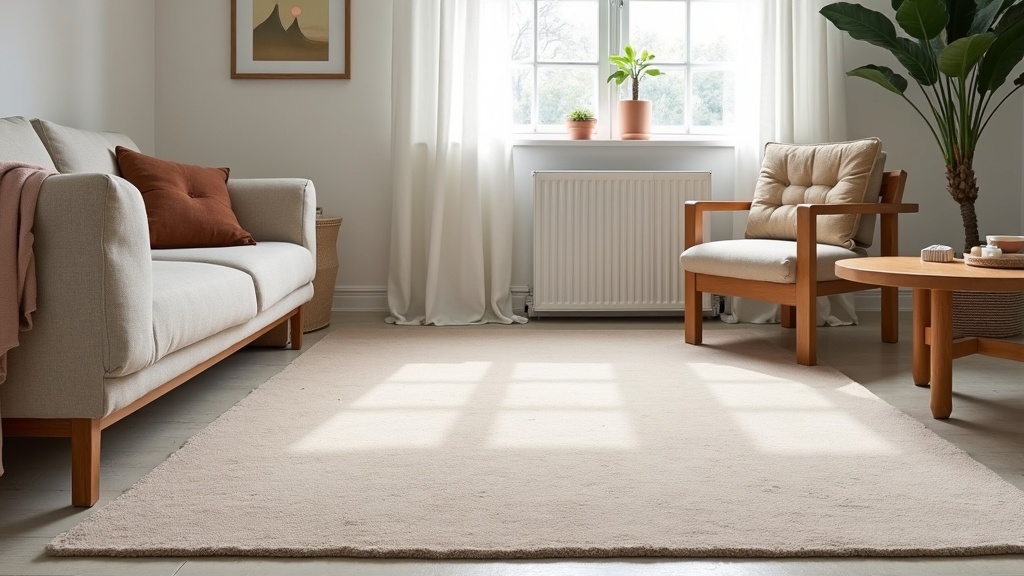
For most living rooms, the rug should be large enough that at least the front legs of every major seating piece rest on it — ideally all four legs of the sofa and chairs sit on the rug, with 12 to 18 inches of bare floor showing around the edges. In practical terms, that usually means an 8×10 or 9×12 rug for an average-sized room, though the right answer depends on your furniture layout, room shape, and how the space is used.
Rug size is one of those decisions people get wrong constantly, not because they don’t have taste, but because they’re eyeballing it against an empty floor instead of against the furniture that will eventually sit on top of it. The fix is simple: measure the seating arrangement first, then work backward to the rug.
Start with the furniture, not the room
A living room rug’s job is to visually anchor a seating group — sofa, chairs, coffee table — so the arrangement reads as one composition instead of scattered furniture floating on bare floor. That means the rug’s dimensions should be dictated by the footprint of your seating cluster, plus a margin, not by the total square footage of the room. A 20×20 foot living room with a small conversation area near the fireplace might still only need an 8×10 rug; a modest 12×14 room fully occupied by an L-shaped sectional might need a 10×14.
Measure the outer edges of your seating arrangement first — the widest points of the sofa and any chairs, including how far chairs are pulled back from the coffee table. That measurement is your floor, and the rug needs to be at least as large, usually larger by a foot or two on each side.
The three common layouts
There isn’t one “correct” way to size a rug against furniture — there are three widely used approaches, each with a different visual effect and a different price implication, since larger rugs cost more regardless of material.
- All legs on the rug. Every piece of seating furniture sits entirely on the rug, with the rug extending 12 to 18 inches beyond the furniture on all sides. This is the most grounded, formal look and generally requires the largest rug, but it reads as intentional and finished in almost any room.
- Front legs on, back legs off. The front legs of the sofa and chairs rest on the rug while the back legs sit on bare floor. This is the most common compromise in mid-sized rooms because it still visually unifies the seating group without requiring an oversized (and more expensive) rug.
- Floating rug, no furniture touching it. The rug sits entirely within the open area in front of the seating, touching no furniture legs. This can work in very large rooms with multiple furniture groupings, but in a smaller room it tends to look like an afterthought — a rug-shaped island rather than a considered layout.
As a general rule, if you’re unsure which to choose, front-legs-on is the safer default for a typical family living room, and all-legs-on is the safer default for a formal or open-plan space where the rug needs to do more visual work.
Standard sizes and what they actually fit
Rugs are sold in a small set of standard sizes, and it helps to know roughly what each one accommodates before you start measuring your own room.
| Rug size | Typical use |
|---|---|
| 5×8 | Small apartment living rooms, a loveseat and single chair, or layered under a larger furniture footprint in an entryway-adjacent space |
| 8×10 | The most common living room size — fits a standard sofa, two chairs, and a coffee table with front legs on |
| 9×12 | Larger living rooms or sectionals; usually allows all four legs of the main seating on the rug |
| 10×14 and up | Open-plan living areas, large sectionals, or rooms that combine living and dining zones under one rug |
These are starting points, not rules — a narrow, long living room may need a runner-adjacent shape like 8×11 rather than a squarer 9×12, and open floor plans sometimes call for two coordinated rugs rather than one oversized piece.
Working out the margin
The border of bare floor between the rug and the wall matters more than people expect. Too little and the rug looks like it’s trying to be wall-to-wall carpet; too much and it looks undersized and lost. A margin of 12 to 24 inches on each side is the range most designers work within, with smaller rooms sitting toward the tighter end and larger, higher-ceilinged rooms able to handle a wider margin without the rug feeling small.
If your room has a fixed architectural feature — a fireplace, a bay window, a media console — measure from that feature as well as from the seating group, since an off-center rug relative to the room’s visual anchor can look wrong even when it’s correctly sized for the furniture.
Shape, not just size
Rectangular rugs suit rectangular seating arrangements, which covers most living rooms. Round rugs work well under a single circular coffee table or in a room with strong rectilinear lines elsewhere that could use a softening shape, but a round rug rarely does the job of anchoring a full sofa-plus-two-chairs arrangement — the corners of the seating group end up hanging off the edge in a way that looks unresolved. Square rooms with square furniture groupings are one of the few situations where a square rug genuinely outperforms a rectangle.
Material and construction affect the sizing conversation too
Once you know the size you need, construction and fibre determine both price and how the rug will perform underfoot over the years — a hand-knotted wool rug in a 9×12 behaves very differently over a decade than a machine-made synthetic in the same footprint, in terms of durability, cleaning options, and cost. A machine-made wool-blend rug in a common living room size might sit somewhere in the low hundreds, while a hand-knotted wool piece in the same dimensions is typically priced well beyond that, and a hand-knotted silk or silk-blend piece higher still — construction and origin drive this enormously, so treat any figure as illustrative rather than a quote. The rug buying guides hub covers material trade-offs like wool versus synthetic pile, hand-knotted versus machine-made, and how construction interacts with size and budget in more depth.
Layering rugs in oversized rooms
In large or open-plan living spaces, some homeowners layer a smaller decorative rug over a larger neutral one, or split the floor into two zones with separate rugs — one for a seating group, one for a reading chair or media area. This is a legitimate design choice, but it does mean thinking about two rugs’ worth of care and cleaning requirements rather than one, since different rugs in the same room may be different fibres with different vulnerabilities.
Buying vintage, antique, or hand-knotted for size reasons
Because standard rug sizes are a relatively modern manufacturing convention, older hand-knotted and antique rugs often come in less predictable dimensions — an antique piece might measure 8’4″ by 11’2″ rather than a clean 8×10. If you’re drawn to an older or hand-knotted rug for a specific footprint, it’s worth having any piece you’re seriously considering examined for knot density, foundation material, dye characteristics, and wear pattern before you commit, since these are the factors that distinguish a genuinely hand-knotted antique from a machine-made reproduction — and only an in-person appraisal by a qualified appraiser can reliably confirm origin, age, or value. The rug craft hub goes into how weavers and appraisers read these details.
Whatever size and construction you land on, remember that larger rugs and finer, hand-knotted construction both mean more surface area and more value at risk if the rug is cleaned incorrectly, so it’s worth reading up on proper care — the rug care hub covers cleaning by fibre type, stain response, and long-term storage — before the rug ever meets its first spill.
Frequently asked questions about living room rug size
What size rug do I need for an 8×10 living room?
An 8×10 room is on the smaller side for a full living room rug, so a 5×8 or 6×9 usually works better, letting front legs of the sofa and chairs sit on the rug while leaving a reasonable bare-floor margin around the walls.
Should a rug go under the couch or just in front of it?
Either can work: having the sofa’s front legs on the rug is the most common approach in mid-sized rooms, while having all four legs on the rug is more formal and grounded but requires a larger, often pricier rug to leave a proper margin around the furniture.
Is a 9×12 rug too big for a living room?
Not usually — a 9×12 is a standard choice for living rooms with a full sofa, two chairs, and a coffee table, and it’s often the size that lets all the furniture legs rest on the rug rather than just the front legs.
How much space should be between the rug and the wall?
Most living rooms look best with 12 to 24 inches of bare floor between the rug’s edge and the walls; smaller rooms suit the tighter end of that range, while larger rooms with higher ceilings can carry a wider margin comfortably.
Can I use two rugs in one large living room?
Yes — layering or zoning with two rugs is common in open-plan or oversized living rooms, typically one for the main seating group and another for a secondary area like a reading nook, though it does mean managing two sets of fibre-specific cleaning needs.
Rug Academy publishes general information about rugs and is not a dealer, appraiser, or cleaning service. Cleaning and repair methods depend entirely on fibre, dye and construction — test any treatment on a hidden corner first, and consult a professional rug cleaner or conservator before treating a hand-knotted, antique, silk, or valuable rug, as damage from cleaning is usually permanent. Any prices mentioned are illustrative examples only, and nothing here is an appraisal, an authentication, or a guarantee of a rug’s origin or value.