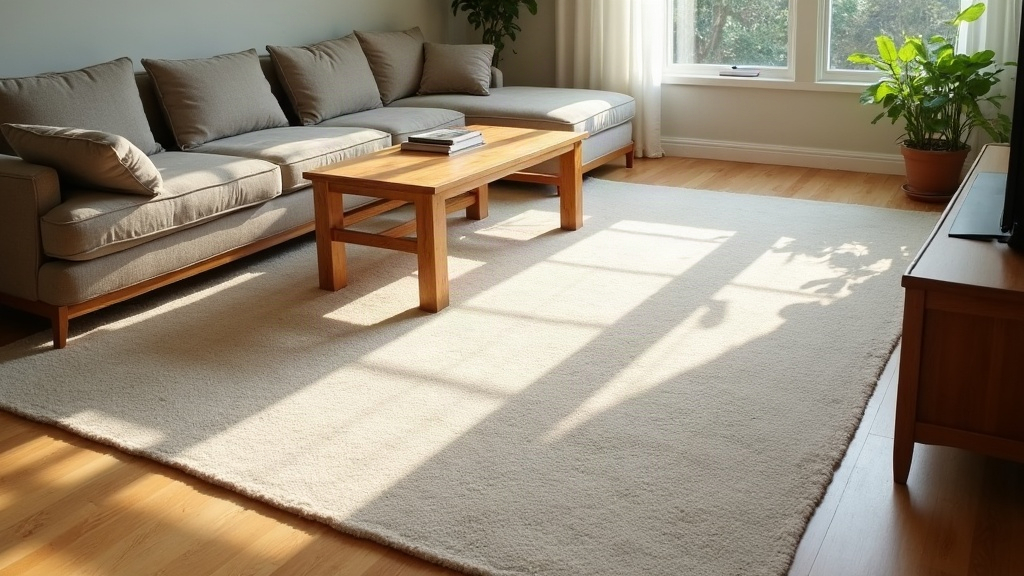
A rug can make a room look bigger or smaller, but color and size alone don’t decide it. The real control is how much bare floor you leave showing around the rug’s edge, and how close that floor’s tone sits to the rug’s tone. Get both right and a room reads larger. Get either wrong, and no amount of careful color picking will fix it.
That’s the part most buying guides skip. They’ll tell you to choose light colors and go big. True as far as it goes, but incomplete, and it leaves readers guessing at the one measurement that actually matters: the exposed border.
It’s Not the Rug. It’s the Border.
Walk into a room with a rug and your eye does two things almost instantly. It measures the rug against the floor around it, and it checks the contrast between them. That comparison, not the rug’s square footage, is what tells your brain how big the room is.
A small gap of visible floor acts like a frame. It lets the eye travel past the rug’s edge and read the floor as continuous space. Traditional carpet weaving understood this centuries before “open floor plan” was a phrase anyone used — the field-and-border structure common to Persian and Caucasian pile carpets exists partly to give the eye a resting edge before it reaches the room itself, a convention well documented in museum carpet collections such as the Metropolitan Museum’s overview of carpets from the Islamic world. A living room rug does the same job on a smaller, more literal scale: it frames the floor instead of covering it.
Push the rug too small and that frame disappears. The border reads as leftover space, not a design choice, and the room feels pinched. Push the rug edge-to-edge and the frame disappears the other way — there’s no floor left to read as continuous, so the rug itself becomes the visual boundary of the room. Either mistake shrinks the room. Only the middle band works.
The 8-to-18-Inch Rule
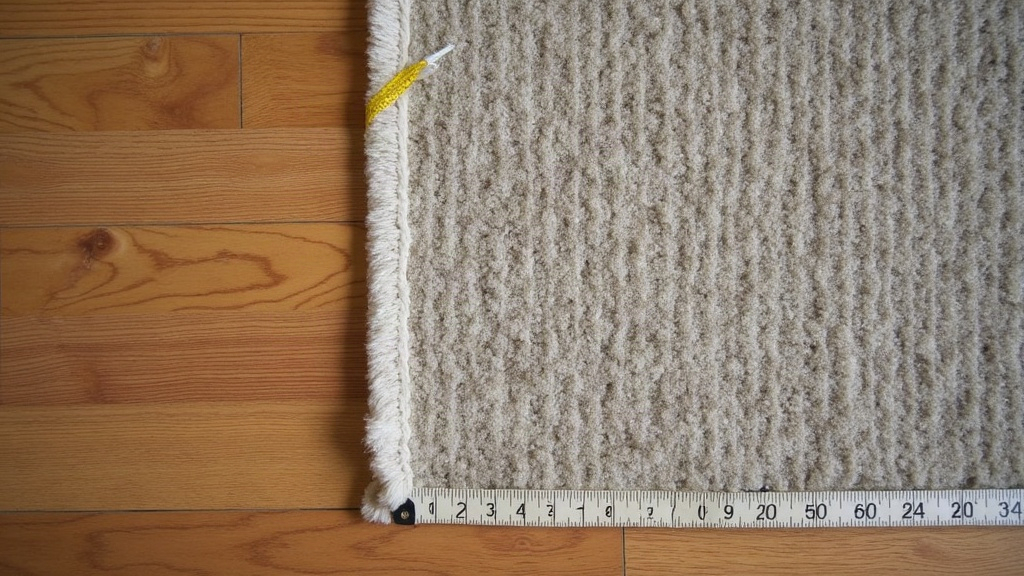
Here is the specific range worth testing before you buy: a rug reads as enlarging a room only when the exposed floor border measures roughly 8 to 18 inches on each side, and the contrast between rug and floor stays within about two to three shades of each other.
Below 8 inches, the border reads as cramped — your eye registers it as “not quite enough rug” rather than as an intentional frame. Above 18 inches, the rug starts to read as an island floating in the middle of the floor, and a floating island shrinks the perceived room no matter how pale or how large the rug itself is. This holds true even with a rug that’s objectively enormous; a 9×12 rug in a room sized for it can still look like a raft if the border runs 30 inches deep.
Run the numbers against your own floor plan before you shop. Room width in feet, converted to inches, minus twice your target border, gives you the rug width to look for.
| Room Size | Rug Size | Exposed Border (approx.) | Effect |
|---|---|---|---|
| 10 x 13 ft | 9 x 12 ft | 6 in | Cramped — under the 8 in floor |
| 10 x 13 ft | 8 x 10 ft | 12–18 in | Sweet spot |
| 12 x 15 ft | 9 x 12 ft | 18 in | Sweet spot, upper edge |
| 12 x 15 ft | 8 x 10 ft | 24–30 in | Floating island — shrinks the room |
| 14 x 16 ft | 10 x 14 ft | 12–24 in | Mixed: fine on one axis, floating on the other |
That last row matters. Rooms aren’t always proportioned to match standard rug sizes, so you’ll often get a good border on one pair of sides and an oversized one on the other. When that happens, the longer gap tends to dominate how the room reads, so size toward the tighter dimension and accept a slightly generous border on the other axis rather than the reverse. The rug buying guides hub has more on matching standard sizes to real room dimensions when the numbers don’t line up neatly.
Why Contrast Matters as Much as the Measurement
The inch count only works if the rug and floor are close enough in value that the eye reads the border as “more of the same floor” rather than a hard stop. Color scientists talk about this in terms of value steps — how many degrees apart two tones sit on a lightness scale, a system formalized in the Munsell value scale used across design and manufacturing. You don’t need the chart to use the idea. Hold the rug sample next to your actual floor finish in daylight. If one looks noticeably darker or lighter than the other at a glance, the contrast is probably too high for the enlarging effect to work, regardless of border width.
A pale oak floor with a mid-gray wool rug sits close enough in value for an 8 to 18 inch
Related reading
weaving and techniques, regional and antique rugs, value and authentication, cleaning and stains, repair and restoration, protection and storage, Cleaning a Rug You Can’t Move.
Rug Academy publishes general information about rugs and is not a dealer, appraiser, or cleaning service. Cleaning and repair methods depend entirely on fibre, dye and construction — test any treatment on a hidden corner first, and consult a professional rug cleaner or conservator before treating a hand-knotted, antique, silk, or valuable rug, as damage from cleaning is usually permanent. Any prices mentioned are illustrative examples only, and nothing here is an appraisal, an authentication, or a guarantee of a rug’s origin or value.