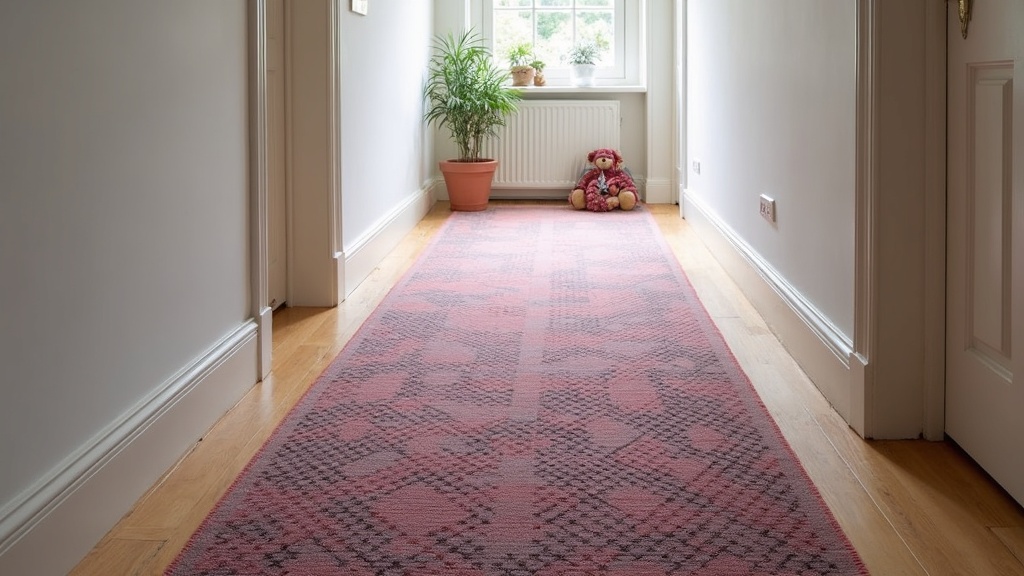
A runner should leave roughly 3 to 6 inches of bare floor visible along each long side of the hallway, and stop 6 to 10 inches short of the walls at each end, unless it is meant to continue up a staircase. Most residential hallways take a runner between 24 and 30 inches wide, with length simply cut or chosen to fit the corridor rather than a fixed standard size. Getting this right is less about a magic ratio and more about avoiding the two most common mistakes: a runner that reads as a narrow strip lost in a wide hallway, or one so tight to the walls it looks shrink-wrapped.
Why hallway proportions matter more than in other rooms
A living room rug has to negotiate furniture groupings, but a hallway is a single line of sight. Every inch of misalignment is visible the moment someone stands at either end and looks straight down it. Too narrow a runner in a wide hall looks like an afterthought; too wide a one in a narrow hall leaves no visual “frame” of floor and can make the space feel cramped rather than grounded. Because there is so little else in the composition, proportion does most of the visual work, which is why this category gets its own logic separate from general room sizing covered in the site’s rug buying guides hub.
Measuring the hallway before you measure the rug
Start with the hallway’s actual clear width, not an estimate. Measure at three points along its length, since older homes often have walls that are not perfectly parallel, and note the narrowest point — that is your real constraint. Then decide how much bare floor border you want on each side. As a working range:
- Narrow border, formal look: 2 to 3 inches of floor visible per side.
- Standard border, most homes: 3 to 6 inches per side.
- Wide border, casual or modern look: 6 to 9 inches per side.
Subtract twice your chosen border from the hallway’s clear width to get the runner width you’re shopping for. A 42-inch-wide hallway with a standard 5-inch border on each side calls for a 32-inch runner, which rounds down to the common 30-inch stock width.
A quick reference table
| Hallway clear width | Suggested runner width | Approx. floor border per side |
|---|---|---|
| 30–34 in | 24 in | 3–5 in |
| 36–40 in | 27–30 in | 3–6 in |
| 42–48 in | 30–36 in | 4–8 in |
| 48 in and wider | 36 in or a pair of narrower runners side by side | varies |
Length: leave breathing room, not a tight seal
Length is where people go wrong more often than width. The instinct is to buy a runner that almost touches both end walls, but this crowds doorways and makes the hall feel shorter, not longer. A better default is to stop the runner 6 to 10 inches from each end wall and from any door swing. If the hallway opens into a room at one end, it’s usually more graceful to end the runner before the threshold rather than butting it against the transition strip, since that gives the eye a clear stopping point and avoids a tripping edge right where people step through.
For very long hallways — anything past about 14 feet — a single continuous runner can look monotonous and is harder to source without ordering a custom cut. Two runners with a small gap, or one long custom-cut piece from a broadloom roll, are both reasonable solutions; which one suits depends on budget and whether you want a visible seam-free look or don’t mind a deliberate break in the run.
Staircases and landings are a different calculation
A runner going up a staircase is sized by width alone in most cases, typically leaving 3 to 4 inches of exposed tread on each side, since length is dictated by the stair run itself and is usually sold or cut by the foot. Stair runners see far more friction and foot traffic than a flat hallway, which is worth keeping in mind when choosing construction — a tightly woven flatweave or a low, dense pile generally holds up better on stairs than a plush pile that crushes unevenly on the nosing.
Construction and fibre affect how a runner behaves underfoot
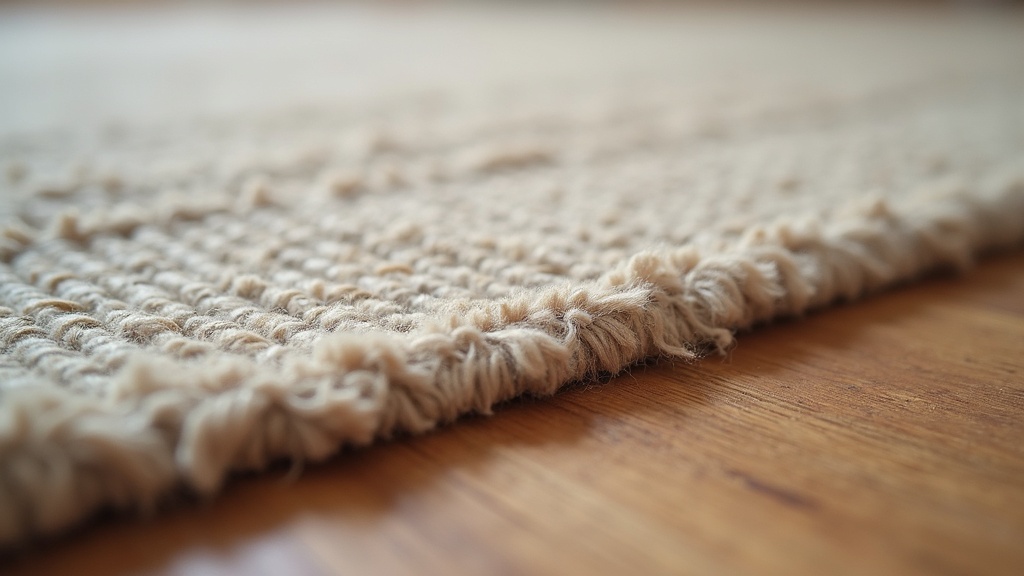
Sizing gets the proportions right, but construction determines whether the runner actually stays flat and lasts in a high-traffic corridor. Flatweave runners in cotton or wool tend to lie flatter from day one and are easier to reposition than thick pile rugs, which is one reason they’re popular for hallways; the trade-offs between flat and pile constructions are covered in more depth on the site’s flatweave vs pile comparison. Whatever the construction, a runner in a busy corridor should sit on a rug pad or a specific runner-grip pad, both to stop sliding on hard floors and to reduce the wear that comes from a rug rubbing against the subfloor with every step — the reasoning behind this is laid out in more detail in the guide on whether you really need a rug pad. Runners are also especially prone to curling at the short ends because they’re narrow and get stepped on repeatedly near doorways; if that’s already happening, the fixes are covered in the article on how to stop a rug from curling at the corners.
Pattern and colour choices for a narrow, long format
Because a runner is seen end-on more than a square rug, pattern direction matters. A directional or medallion-repeat pattern running along the length reads as intentional, while a pattern designed for a square format can look stretched or awkwardly cropped when squeezed into a runner shape. If you’re deciding between a busy pattern and a solid colour for a high-traffic corridor, the trade-offs — including how well each hides soil between cleanings — are laid out in the guide on choosing between a patterned and a solid rug. For sizing logic applied to other rooms, the broader sizes and placement archive covers dining tables, living rooms and bedrooms using the same border-and-clearance thinking used here.
Budgeting for a hallway runner
Price scales with length, fibre and construction far more than with hallway rugs of other shapes, because you’re often buying by the linear foot rather than a fixed size. A machine-made synthetic or wool-blend runner in a standard width might sit somewhere in the low hundreds for an 8 to 10 foot length, while a hand-knotted wool runner of the same length can run considerably higher — construction, fibre and the density of the weave drive this enormously, and any figure quoted online should be treated as illustrative rather than a quote for a specific piece.
Caring for a hallway runner
Runners take more foot traffic per square foot than almost any other rug in the house, so soil and grit accumulate fast, especially near entry points. Vacuum regularly, but skip the beater bar on any rug with fringe or a looser weave, since it catches and pulls threads; a suction-only setting or a hand attachment is safer. For a wool runner, blot spills promptly with cool water and a small amount of wool-safe detergent, working from the outside of the stain inward — never hot water, since heat combined with an alkaline cleaner can felt and shrink wool fibres permanently. Cotton flatweaves and washable synthetics tolerate cleaning differently again, and construction-specific steps are covered in the rug care hub. Always test any product on a hidden end or the underside first, and if the runner is hand-knotted, antique, silk, or you’re not certain what it’s made of, it’s worth having a professional rug cleaner assess it before you treat a stain yourself — cleaning damage to a good rug is very often permanent, unlike a sizing mistake, which you can simply correct with a different rug next time.
Frequently asked questions about runner rug sizes
What size runner rug do I need for a hallway?
Measure your hallway’s narrowest clear width, then subtract about 6 to 10 inches total so 3 to 5 inches of floor shows on each side. Most homes end up with a 24 to 30 inch wide runner; length should stop 6 to 10 inches short of each end wall.
How much space should be on each side of a runner rug?
Somewhere between 3 and 6 inches of exposed floor per side looks balanced in most hallways. Narrower borders around 2 to 3 inches suit a more formal, tailored look, while 6 to 9 inches feels more casual and works well in wider corridors.
Can I use two runners in one long hallway?
Yes, and it’s a common solution for hallways longer than about 14 feet where a single custom length is impractical or costly. Leave a small, consistent gap between the two pieces rather than butting them tightly, so the break reads as deliberate.
Should a hallway runner touch the walls?
No, leaving it flush against the walls tends to look cramped and can trap dust and moisture against the baseboard. A visible floor border on both long sides, plus a gap at each end wall, generally looks more finished and is easier to keep clean.
What width runner fits a standard hallway?
Most residential hallways are 36 to 42 inches wide and take a 24 to 30 inch runner comfortably. Always measure your own hallway’s narrowest point rather than assuming a standard, since older homes especially can vary by several inches along the same corridor.
Rug Academy publishes general information about rugs and is not a dealer, appraiser, or cleaning service. Cleaning and repair methods depend entirely on fibre, dye and construction — test any treatment on a hidden corner first, and consult a professional rug cleaner or conservator before treating a hand-knotted, antique, silk, or valuable rug, as damage from cleaning is usually permanent. Any prices mentioned are illustrative examples only, and nothing here is an appraisal, an authentication, or a guarantee of a rug’s origin or value.