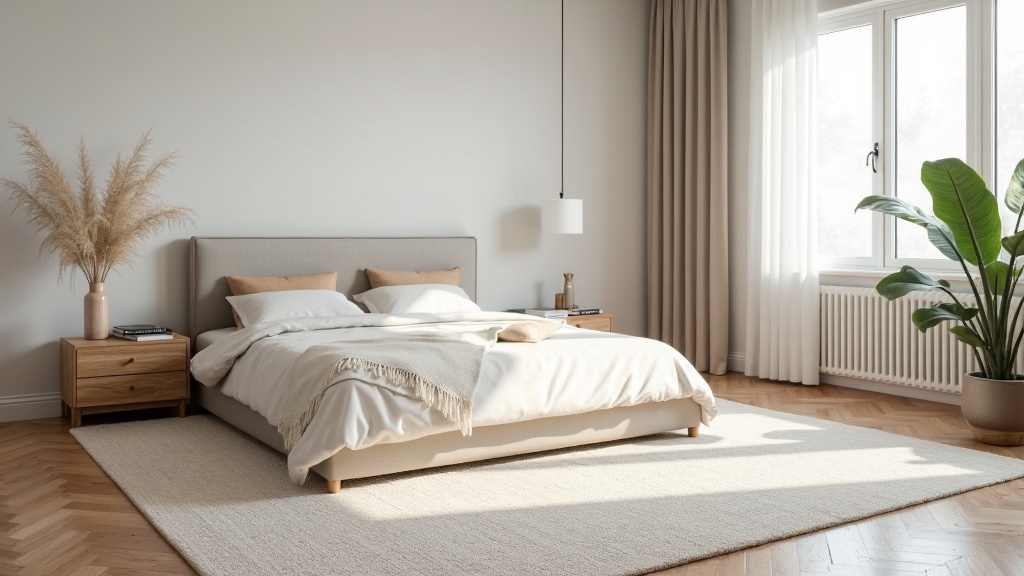
As a rule of thumb, a rug should show at least 18 to 24 inches of exposed floor beyond the bed on the sides and foot, with the rug extending far enough under the mattress that it doesn’t disappear when you sit on the edge. For a queen or king bed, that usually means a rug in the 8×10 or 9×12 range running the width of the room, though the “right” amount of overhang depends on your room size, bed height, and whether you want the rug to visually anchor the whole space or just soften the areas where feet actually land.
Why the overhang matters more than the total size
People often ask for a size in feet and inches, but the number that actually matters is how much rug is visible once the bed sits on top of it. A rug that’s technically large can still look skimpy if too much of it is hidden under the mattress and box spring, and a smaller rug can look intentional if the exposed border is even and generous. The goal is a clean margin of rug around the bed that reads as a frame, not an accident.
This is really a proportion problem, similar to the sizing logic used in living room rug sizing, where furniture sits at the edges of a rug rather than floating in the middle of a small one. In a bedroom, the bed is the one large object the rug has to relate to, so the visible border on each side is the detail that determines whether the room looks furnished or just carpeted.

Standard bed sizes and the rugs that suit them
These are starting points, not fixed rules — a room with a lot of open floor can support more overhang, and a small room may need to compromise.
| Bed size | Typical mattress width | Rug size to consider | Approx. side/foot overhang |
|---|---|---|---|
| Twin | 39 in | 5×8 or 6×9 | 12–18 in |
| Full/Double | 54 in | 6×9 or 8×10 | 15–20 in |
| Queen | 60 in | 8×10 | 18–24 in |
| King | 76 in | 9×12 | 18–24 in |
| California King | 72 in | 9×12 | 18–22 in |
These figures assume the rug runs the full length of the bed plus nightstands, which is the most forgiving layout for most rooms. If your room can’t accommodate that much rug, a runner-style layout at the sides and foot only is a legitimate alternative, and it’s worth reading through the trade-offs of that approach directly, since the decision between a full under-bed rug and a partial one changes the math on how much border you’ll actually see; the article Should a Rug Go Under the Bed or Beside It? walks through both layouts in more detail.
Three layouts, three different overhang goals
Full coverage under the bed
The rug sits under the entire bed frame, including nightstands, with even overhang on the two long sides and the foot. This is the layout that benefits most from the 18–24 inch rule, because the exposed border is what your eye actually registers — the hidden two-thirds under the mattress does nothing visually except keep the rug from sliding.
Two-thirds under the bed
The rug’s leading edge sits roughly under the pillows, and the rest extends out to cover the sides and foot. This uses a slightly smaller rug than full coverage while still giving a generous, even overhang everywhere it’s visible, which is often the most efficient use of a mid-size rug in a mid-size room.
Rugs on either side, none underneath
Two runners or accent rugs sit beside the bed rather than under it. There’s no “overhang” calculation here in the traditional sense — instead, aim for each runner to extend about 24 to 36 inches down the side of the bed, roughly matching or exceeding the length of the nightstand, so the rug reads as a deliberate landing pad rather than a scrap of leftover fabric.
Adjusting the standard for your actual room
The 18–24 inch figure is a comfortable average, not a law. A few things push it in either direction:
- Room size — in a large bedroom, a narrow border can look stingy next to all that open floor; going closer to 24–30 inches often reads better.
- Ceiling height and furniture scale — taller beds, high headboards, and larger nightstands can visually shrink a rug’s border, so err generous.
- Walking paths — if the rug has to clear a closet door swing or a walkway to an en suite, let the traffic pattern take priority over a perfectly symmetrical overhang.
- Existing wall-to-wall carpet — a rug over carpet needs a bit more visible border than one on hard flooring, since less of it will read as a distinct object at all.
Whatever the finished layout, a rug that spends most of its life partly under furniture is still worth stabilizing properly underneath. A pad reduces the slow ripple and buckling that comes from a mattress and frame pressing on one section of the rug for months at a time, and it’s covered thoroughly in Do You Really Need a Rug Pad?. If corners near the exposed sides start turning up over time, that’s a separate and very fixable problem addressed in How to Stop a Rug From Curling at the Corners.
Choosing a rug that can handle bedroom conditions
Bedrooms see bare feet, dropped water glasses, and the occasional pet, so material matters as much as size. The trade-offs between fibres — how they feel underfoot, how they age, how forgiving they are of moisture — are covered broadly in the site’s rug buying guides hub, and the full range of sizing and placement questions, including bedroom-specific ones, lives in the Sizes & Placement archive. If you’re weighing wool against a synthetic blend for a room that gets a lot of use, that comparison is worth reading before you commit to a size, since a busier household might reasonably choose a smaller, more durable rug over a larger, more delicate one.
As a rough illustration only — not a quote for any specific product — a machine-made wool-blend rug in an 8×10 size might sit somewhere in the low hundreds, while a hand-knotted wool rug of the same footprint climbs considerably higher, and construction and origin drive that gap far more than size alone. If you’re shopping with a hand-knotted or antique piece in mind rather than a machine-made one, the value factors an appraiser actually looks at — knot density, foundation material, dye character, wear pattern — are explained in What Determines the Value of an Antique Rug?, and any real buying decision at that price point deserves an in-person look by a qualified appraiser rather than a guess from photos.
Living with a rug under a bed long-term
Once the rug is down, keeping it clean under a heavy piece of furniture takes a bit more care than a rug in open floor. Vacuum around the exposed border regularly, but skip the beater bar on fringe or loose pile, since it can fray or pull threads rather than lift dirt. For everyday spills on a wool rug — a spilled coffee, a dropped skincare bottle — blot promptly with a clean cloth and, if needed, a small amount of cool water and a wool-safe detergent, working from the outside of the stain inward; avoid hot water or high-pH cleaners, since heat and alkalinity are what cause wool to felt, shrink, and yellow. Never reach for chlorine bleach on wool or silk, and never combine cleaning products, since mixing chemicals like bleach and ammonia-based cleaners produces dangerous fumes and won’t improve the result anyway.
Always test any treatment on a hidden corner first, and if the rug is hand-knotted, antique, silk, or simply of uncertain construction, the safer route is a professional rug cleaner or conservator rather than trial and error at home — the full reasoning behind that recommendation is in Cleaning & Stains and in the site’s broader rug care hub.
Frequently asked questions about rug size around a bed
How far should a rug stick out from under a bed?
Aim for roughly 18 to 24 inches of visible rug on the sides and foot of the bed, more in a large room and less in a tight one. The key is an even, generous-looking border rather than hitting an exact number.
Do I need the rug to go all the way under the bed?
No. Full coverage under the whole frame is one common layout, but a rug that starts around the pillow line, or two rugs placed only at the sides, are both legitimate alternatives that use less rug while still giving a comfortable landing spot.
What size rug do I need for a queen bed?
An 8×10 rug is the typical starting point for a queen bed, giving roughly 18 to 24 inches of visible border on the sides and foot when the rug runs the width of the room including nightstands.
Is it okay to use two small rugs instead of one big rug under a bed?
Yes — placing a runner or accent rug on each side of the bed, without one underneath, works well in smaller rooms. Aim for each piece to extend about 24 to 36 inches beside the bed so it reads as intentional rather than leftover.
Should a bedroom rug be bigger or smaller than a living room rug?
There’s no fixed rule; it depends on the room’s proportions and how much floor is available. Bedrooms often use a smaller rug than a living room because the bed itself takes up more of the floor plan than a sofa does.
Rug Academy publishes general information about rugs and is not a dealer, appraiser, or cleaning service. Cleaning and repair methods depend entirely on fibre, dye and construction — test any treatment on a hidden corner first, and consult a professional rug cleaner or conservator before treating a hand-knotted, antique, silk, or valuable rug, as damage from cleaning is usually permanent. Any prices mentioned are illustrative examples only, and nothing here is an appraisal, an authentication, or a guarantee of a rug’s origin or value.