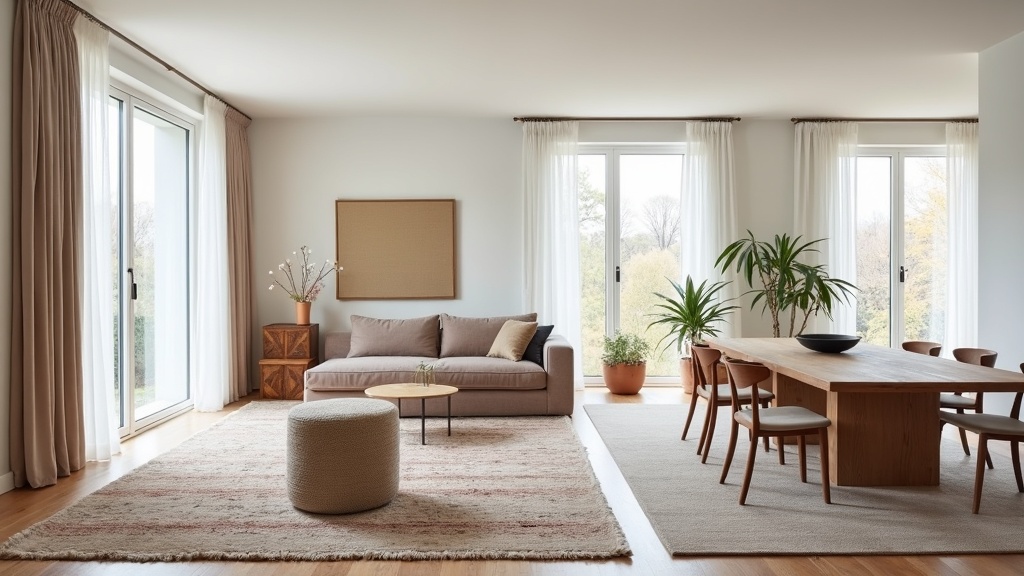
Mixing two rugs in one open-plan room works when each rug clearly marks its own zone, the two share at least one common thread — a color, a tone, or a pattern scale — and their edges never awkwardly overlap or nearly touch. Treat the rugs as a pair of related statements rather than one continuous pattern, size each to its own furniture grouping, and leave enough bare floor between them to read as a deliberate gap rather than a mistake.
Why open-plan rooms need more than one rug
A single large rug can visually flatten an open-plan space, especially when the living area, dining area, and sometimes a home office all share one footprint. Two rugs let you signal “this is where you sit” and “this is where you eat” without walls. The trick is that most of the visual failures in these rooms come not from choosing bad rugs individually but from treating the pairing as an afterthought — buying whatever fits the floor space left over once furniture is placed. Planning the zones before the rugs solves most of the problem in advance.
Set the zones first, then choose the rugs
Walk the room and decide, in furniture terms, where each activity actually happens. A living area typically needs a rug sized so the front legs of every seating piece rest on it — the same sizing logic covered in our living room rug size guide. A dining zone needs a rug that clears the chair legs even when pulled out, which is a different geometry entirely. Once you know the footprint of each zone, you know the size of each rug, and sizing decisions should always come before pattern or color decisions. For the broader logic of matching rug size to room use, the rug buying guides hub is a useful starting point before you shop.
Leave a real gap between them
As a rule of thumb, aim for at least 18 to 24 inches of visible floor between the two rugs, more in a larger room. Less than that and the eye tries to read them as one rug with a seam error. This bare strip of floor is doing real design work — it’s the visual pause that lets two different rugs coexist without competing.
Find one common thread, then let the rest differ
The two rugs do not need to match. They need one deliberate point of agreement. That might be:
- Color family — a rust-and-cream kilim in the dining zone paired with a solid cream wool rug in the living zone.
- Undertone — both rugs skew warm or both skew cool, even if the patterns are unrelated.
- Pattern scale — a small-scale geometric paired with a larger-scale but similarly busy pattern, so neither one reads as visually “louder” than the other.
Pairing one patterned rug with one solid or near-solid rug is often the easiest route for a first attempt, because it removes the risk of two competing motifs fighting for attention. Our guide to choosing between a patterned and a solid rug covers how to judge pattern scale against room size, which applies just as much when you are balancing two rugs against each other as when choosing one.
Match construction and pile height where you can
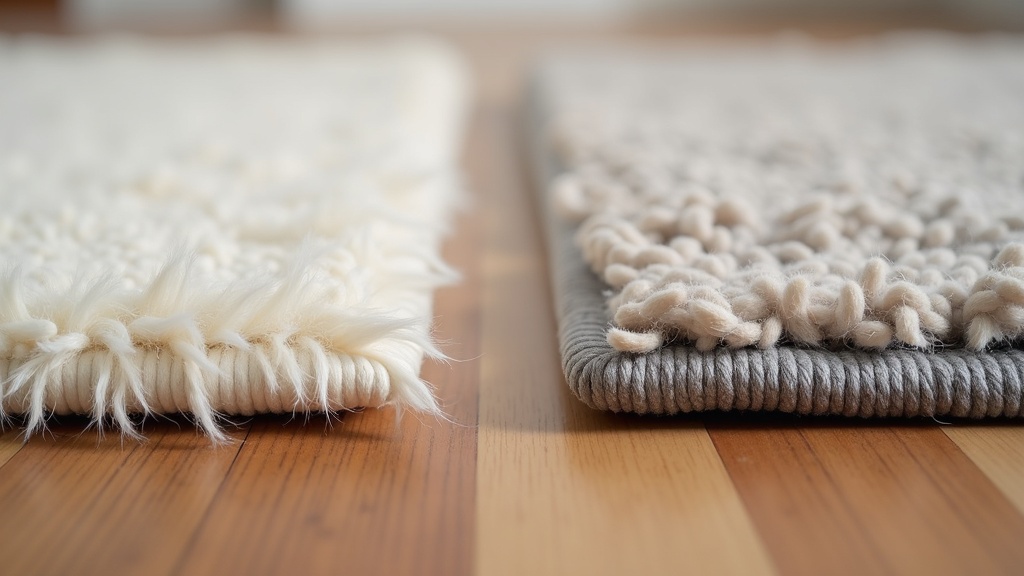
Two rugs of wildly different pile height and thickness sitting near each other in an open sightline can look unintentional, especially where they are visible in the same glance — say, from the kitchen looking toward both the dining table and the sofa. A flatweave kilim under the dining table and a thick pile rug under the sofa is a completely reasonable pairing, but it reads best when the transition happens at a natural break, like a change in flooring material or a step, rather than out in the open middle of the room. For background on how flatweaves and pile rugs perform differently underfoot and visually, see flatweave vs pile rugs.
It also helps to think about where each rug sits stylistically. A room doesn’t need two rugs from the same design tradition, but wildly mismatched formality — a very traditional medallion rug next to a stripped-back modern geometric — can look like two separate design decisions rather than one considered room. If you’re aiming for something that bridges older and newer motifs, our piece on what makes a rug “transitional” style explains the middle ground many pairings land in.
A practical sizing and gap table
| Zone | Typical rug approach | Sizing rule |
|---|---|---|
| Living/seating area | Larger pile rug, front legs of furniture on it | At least 18 in beyond the sofa arms on each side |
| Dining area | Flatweave or lower pile for easy chair movement | 24-30 in beyond the table edge on all sides |
| Gap between zones | Bare floor, no rug | 18-24 in minimum, more in larger rooms |
Keeping both rugs safe once they’re down
Different fibres and constructions age and get dirty at different rates, especially with two zones getting different foot traffic and food spills. This matters for maintenance planning as much as for looks. A wool pile rug in a seating area and a cotton or wool flatweave in a dining zone should generally be treated as two separate cleaning problems, not one. Wool tolerates gentle blotting with cool water and a wool-safe detergent for light spills, but hot water or alkaline, high-pH cleaners will felt and shrink the fibres and can leave yellowing — never reach for these on a wool pile. Cotton flatweaves are more forgiving of light washing but can still shrink or bleed dye if soaked rather than blotted. Whatever the fibre, always test any cleaning approach on a hidden corner first, and if either rug is hand-knotted, antique, silk, or you are simply not sure what it’s made of, it belongs with a professional rug cleaner rather than a home remedy — the risk of permanent damage is real and the cost of a mistake is usually higher than the cost of professional cleaning. Never mix cleaning chemicals like bleach and ammonia-based products, and avoid chlorine bleach on wool or silk entirely, since it breaks down the fibre itself. More on safe routines for wool specifically is in the rug care hub.
Under both rugs, a good pad does double duty: it stops slipping where two rugs sit close together on a hard floor, and it reduces the wear that eventually shows up as flattened pile or a curling edge. If you haven’t settled the pad question yet, do you really need a rug pad walks through when it’s worth the cost and when it isn’t.
When the two rugs are of very different quality or value
It’s common to pair a newer, less expensive rug in a high-traffic dining zone with something older or handmade in the quieter seating area. That’s a sensible practical choice, but if you’re ever curious what separates the two in terms of actual construction — knot type, foundation material, how the fringe and selvedge are finished — an appraiser or a knowledgeable dealer looks at those details rather than at pattern or color. Our overview of materials and construction explains what those differences look like in practice. If real money or a family piece is involved, an in-person appraisal from a qualified appraiser is the only reliable way to know what you actually have — nothing you read online, including this article, can substitute for that.
Frequently asked questions about mixing two rugs in one room
Can two rugs be different colors in the same open-plan room?
Yes, as long as they share some connecting element — a warm or cool undertone, a repeated accent color, or similar pattern density — so the two zones feel related rather than like they belong to two unconnected rooms.
How far apart should two rugs be in an open floor plan?
A gap of about 18 to 24 inches of visible floor is a reasonable starting point in most rooms, with more space in larger rooms so the break reads as intentional zoning rather than a leftover gap.
Should both rugs be the same shape?
Not necessarily. A rectangular rug under a dining table and a rectangular or even round rug in the seating area can both work, since shape usually follows the furniture arrangement in each zone rather than needing to match the other rug.
Can I put a patterned rug next to another patterned rug?
You can, but it’s harder to get right than pairing one patterned rug with one solid or low-pattern rug, since two busy motifs in the same sightline tend to compete rather than complement each other.
Do the two rugs need to be the same material?
No — a wool pile rug in a living zone and a flatwoven cotton or wool rug in a dining zone is a common and practical pairing, though it does mean planning for two different cleaning routines suited to each fibre.
Rug Academy publishes general information about rugs and is not a dealer, appraiser, or cleaning service. Cleaning and repair methods depend entirely on fibre, dye and construction — test any treatment on a hidden corner first, and consult a professional rug cleaner or conservator before treating a hand-knotted, antique, silk, or valuable rug, as damage from cleaning is usually permanent. Any prices mentioned are illustrative examples only, and nothing here is an appraisal, an authentication, or a guarantee of a rug’s origin or value.