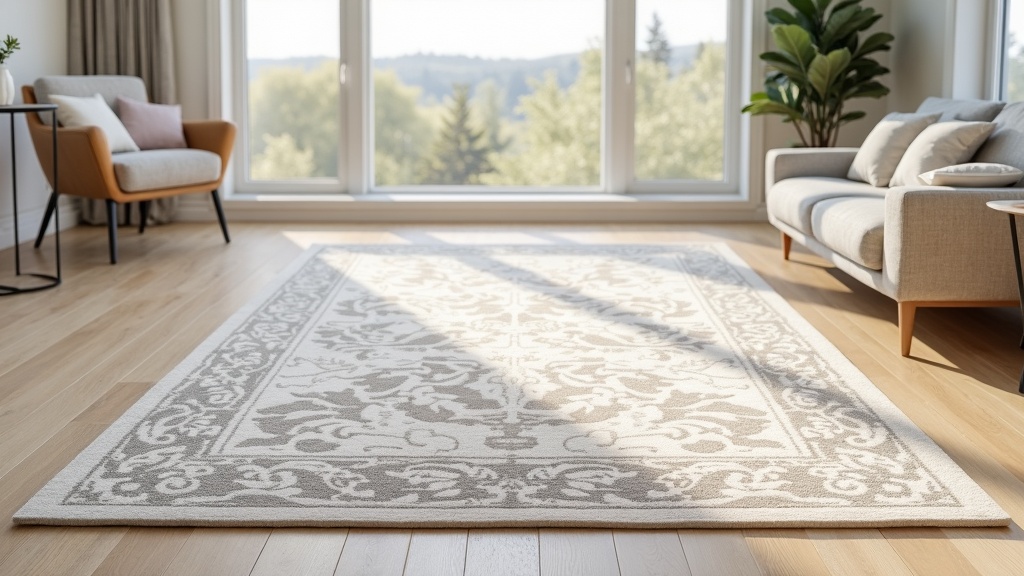
A “transitional” rug is one that borrows the motifs of traditional weaving — medallions, florals, lattices, botanical vines — but simplifies and recolors them to fit contemporary rooms. The pattern is usually softened, the palette muted or tonal instead of saturated, and the scale of the design enlarged so the rug reads as texture from across a room rather than as intricate detail up close. It’s a design category, not a place of origin or a specific age, and it spans every construction method from hand-knotted to machine-made.
The design idea behind “transitional”
The term comes from interior design shorthand: a style that sits “in transition” between traditional and modern. Traditional rugs — a classic Persian medallion, a Turkish geometric, a French Aubusson floral — carry dense ornamentation and often strong, contrasting color. Modern or contemporary rugs strip pattern away almost entirely, favoring abstraction, solid fields, or minimal geometry. Transitional design sits between the two: it keeps recognizable traditional bones but edits them down. Motifs get simplified, colors get desaturated into grays, taupes, blush, and ivory, and repeats get scaled up so a rug that would have had a busy all-over pattern instead reads as a few large, calm shapes.
This makes transitional rugs a popular middle ground for people who like the warmth and history implied by an ornamental pattern but don’t want a room that looks like a period piece. You’ll find the label used heavily by retailers, and it’s worth remembering it’s a marketing and design category more than a technical one — there’s no single loom type, fiber, or region that defines it the way there is for, say, a Persian rug from a specific weaving region. For background on how regional naming actually works, the site’s guide to Persian rug regions is a useful companion, since transitional designs frequently reference (loosely) those same traditional vocabularies.
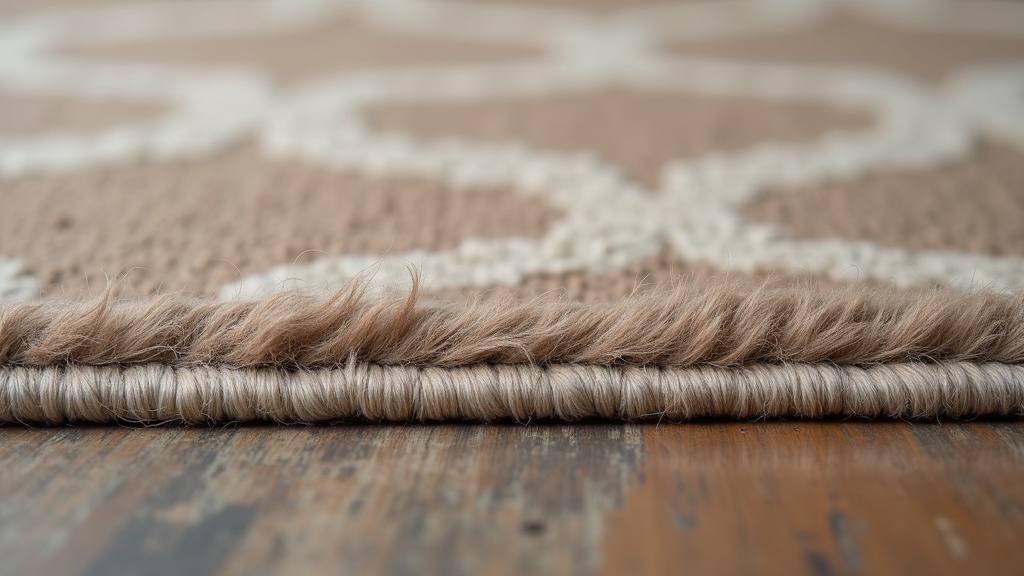
Pattern and color signals to look for
A few visual habits recur across most rugs marketed as transitional:
- Muted, tonal color — grays, ivories, soft blues, faded terracottas, or a monochrome palette in two or three closely related shades, rather than the high-contrast reds, blues, and golds of many classic traditional rugs.
- Enlarged or simplified motifs — a medallion or botanical vine rendered at a bigger scale with fewer internal details, so it functions almost like an abstract shape from a distance.
- Distressed or “vintage-look” finishes — some transitional rugs are deliberately overdyed or given a faded, weathered appearance to look like an old rug that has mellowed with decades of light exposure, even when the rug is brand new.
- Blended borders — a simplified or absent border, or one that echoes the field pattern rather than framing it sharply, which softens the overall silhouette.
None of these traits is exclusive to transitional design — you’ll find muted colors in some antique pieces too, and bold color in some contemporary ones — but the combination of simplified traditional motifs with a quieter palette is the throughline. Readers comparing broader style categories may also want the site’s styles and patterns archive, which covers the traditional and contemporary poles this category sits between.
Construction: transitional says nothing about how it’s made
This is the point most worth understanding before you buy: “transitional” describes the look, not the construction. A rug in this style can be:
- Hand-knotted on a traditional loom, using the same knotting techniques as an antique piece, just designed with a modern color story.
- Hand-tufted, where pile is punched through a backing fabric with a tufting gun and then glued and finished with a secondary backing — much faster and generally less expensive to produce, but with different durability characteristics and resale expectations.
- Power-loomed, produced by machine at high speed and volume, often in wool-blend or synthetic yarns, which is how most large retailers offer transitional patterns at accessible prices.
These construction methods differ enormously in longevity, feel underfoot, and long-term value, and the design label tells you nothing about which one you’re getting. If you’re trying to figure out which category a specific rug belongs to, the site’s guide on how to tell a rug is handmade or machine-made walks through the practical checks — looking at the back of the rug for a knotted structure versus a uniform woven or glued backing, checking for slight irregularities in hand-knotted pile versus the perfect regularity of machine work, and examining fringe (woven-in and continuous with the foundation on hand-knotted pieces, versus sewn-on strips on many machine-made ones). The related comparison of hand-knotted vs hand-tufted rugs is worth reading before buying anything described as “transitional,” since tufted construction is common in this category and has real trade-offs in shedding and shed-resistance over time.
Transitional vs traditional vs contemporary, at a glance
| Category | Pattern density | Color | Typical framing |
|---|---|---|---|
| Traditional | Dense, ornate, often symmetrical medallion or all-over repeat | Saturated — deep reds, blues, golds | Strong, clearly defined border |
| Transitional | Simplified, enlarged motifs | Muted, tonal, often gray/ivory/taupe | Soft or blended border |
| Contemporary/modern | Minimal or abstract, sometimes no representational pattern | Solid fields, bold accent color, or neutral | Often borderless |
Materials commonly used
Because transitional rugs are made across so many production methods, materials vary just as widely. Wool remains common for both hand-knotted and machine-made transitional rugs because it holds dye well and resists crushing. Wool-and-synthetic blends and pure synthetics (polypropylene, nylon, polyester) are common in power-loomed transitional rugs sold at lower price points — a machine-made wool-blend transitional rug in a standard living-room size might sit somewhere in the low hundreds, while a hand-knotted wool piece with a comparable design could run into four figures or more, but construction, materials, and size drive this enormously and any specific number should be treated as illustrative only. For a deeper look at how fiber choice affects feel and durability, the comparison of wool vs synthetic rugs and how long each lasts is directly relevant, and the materials and construction archive covers fiber identification more broadly.
Caring for a transitional rug
Care depends entirely on what the rug is actually made of, not on its style label. A synthetic or wool-blend power-loomed transitional rug generally tolerates vacuuming and occasional light cleaning reasonably well, though a beater-bar attachment can still fray fringe or loosen pile and is best avoided on rugs with any fringe or looser weave. A hand-knotted wool transitional rug should be treated with the same caution as any hand-knotted piece: blot spills promptly with a clean cloth, avoid hot water and high-pH or alkaline cleaners since these can felt, shrink, or yellow wool fibers, and always test any cleaning product on a hidden corner first. If the rug contains silk highlights — common in some higher-end transitional designs — water and most detergents can cause damage, and that work is best left to a professional. Whenever construction is uncertain, or the rug has any real value to you, a professional rug cleaner or conservator is the safer route rather than guessing. The rug care hub and its cleaning and stains section cover fiber-specific methods in more detail.
Evaluating quality, regardless of style label
Because “transitional” is a design category rather than a quality marker, the questions worth asking are the same ones an appraiser would ask of any rug: What is the foundation made of — cotton, wool, or synthetic? Is the pile hand-knotted, hand-tufted, or machine-woven? How dense is the weave, and is the color applied with natural, synthetic, or early synthetic dyes that might behave differently over time or under moisture? Wear patterns, selvedge finishing, and the regularity (or irregularity) of the knots all factor into how a piece is judged for both durability and value — but none of this can be determined reliably from a photo or a listing description alone. If you’re weighing a purchase or trying to understand what you already own, the value and authentication archive walks through these criteria, and for anything with genuine monetary stakes, an in-person appraisal from a qualified rug appraiser is the only reliable answer. Broader buying considerations, including how style choices interact with room size and placement, are covered in the rug buying guides hub.
Frequently asked questions about transitional rugs
Is a transitional rug the same as a traditional rug?
No. Traditional rugs carry dense, ornate, high-contrast patterns rooted in historic regional weaving. Transitional rugs borrow those same motifs but simplify them and mute the color palette, aiming for a middle ground between old-world pattern and modern minimalism.
Are transitional rugs handmade or machine-made?
Both exist. Transitional describes a design look, not a production method, so you’ll find transitional patterns hand-knotted, hand-tufted, and power-loomed at very different price points and quality levels — check the back of the rug and its fringe construction to tell them apart.
Do transitional rugs go with modern furniture?
Generally yes, because the muted color and simplified pattern were designed with that pairing in mind, but the overall effect depends on scale and contrast within the room — a rug guide such as the site’s living room size guide can help with proportion questions.
Why are transitional rugs usually gray or beige instead of bright colors?
The muted, tonal palette is a deliberate design choice meant to soften traditional ornament so it reads as calm texture rather than a bold focal pattern, making it easier to coordinate with neutral, contemporary interiors.
Can I clean a transitional rug the same way as any other rug?
Only if you know its fiber and construction — a synthetic power-loomed piece tolerates cleaning very differently than a hand-knotted wool or silk-blend rug, so identify the materials first and test any product on a hidden area before treating the whole rug.
Rug Academy publishes general information about rugs and is not a dealer, appraiser, or cleaning service. Cleaning and repair methods depend entirely on fibre, dye and construction — test any treatment on a hidden corner first, and consult a professional rug cleaner or conservator before treating a hand-knotted, antique, silk, or valuable rug, as damage from cleaning is usually permanent. Any prices mentioned are illustrative examples only, and nothing here is an appraisal, an authentication, or a guarantee of a rug’s origin or value.