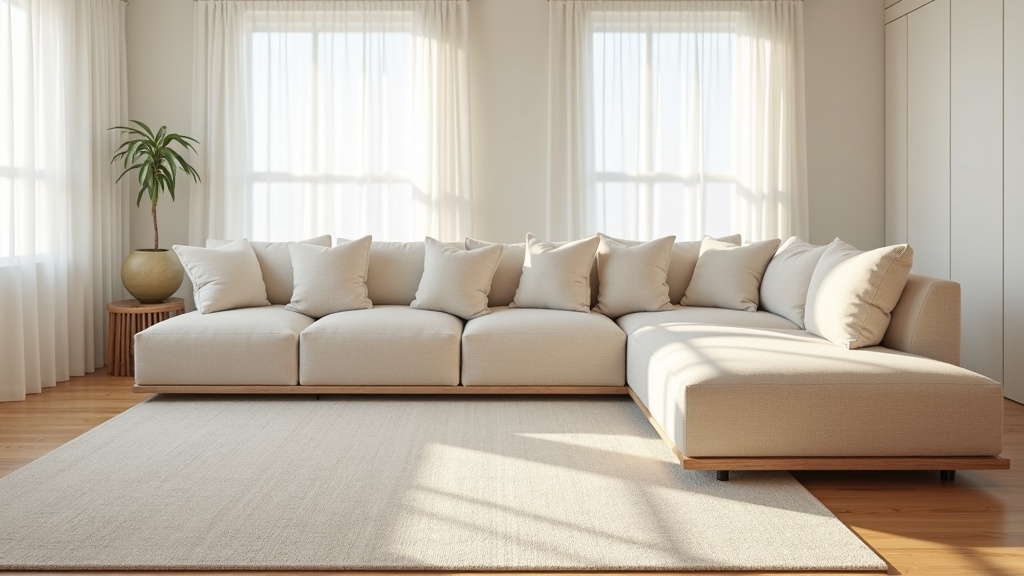
The core rule for a sectional is to size the rug to the seating group as a whole, not to the room: the rug should extend at least under the front legs of every section, including the chaise, so the sectional reads as one anchored unit rather than a shape floating on bare floor. Most living rooms with a sectional need a rug in the 8×10 to 10×14 range, sometimes larger for a big L- or U-shaped piece. Where you place the back and side legs — fully on, partly on, or off the rug entirely — depends on the room’s proportions and how much floor you want visible around the edges.
A sectional is a different placement problem than a two-sofa-and-two-chairs arrangement, because it’s one continuous mass with an irregular footprint. Get the rug wrong and even an expensive one will make the room look lopsided, with the chaise end drifting off into empty floor or the rug looking like an afterthought squeezed under a coffee table. Get it right and the rug does the job it’s meant to do: define the seating area, absorb sound, and give the eye a single, calm shape to rest on.
The core rule: anchor the seating, don’t just fill space
Interior designers generally work from one principle: every major piece of seating in the group should have at least its front legs on the rug. For a sectional this means measuring the full footprint — including the chaise or corner module — and choosing a rug that reaches under the front edge of each section. A rug that only sits under the coffee table and stops short of the sofa’s front legs will always look like it belongs to a different, smaller room.
The opposite failure is a rug that’s too small for the frame of the sofa but too large for the walking path around it, so guests have to step on and off it constantly. If you’re also placing a rug in a room that opens into a dining or entry area, the same logic of matching rug size to the full activity zone rather than to one piece of furniture applies; the general sizing principles are covered in more depth in the rug buying guides hub and specifically for open-plan layouts in the guide to choosing a rug size for an open-plan space.
Sizing a rug for an L-shaped or U-shaped sectional
Because sectionals aren’t rectangular, the simplest way to size the rug is to measure the sofa’s overall bounding box — the widest point front-to-back and side-to-side, including the chaise — and add roughly 12 to 18 inches of rug beyond the front edge of the seating on the open side, where people walk in. The back and outer sides can sit closer to the rug’s edge or even hang slightly off it, since that side usually meets a wall.
| Sectional footprint (approx.) | Suggested rug size | Notes |
|---|---|---|
| Compact L-shape, small apartment living room | 8×10 ft | Front legs of both the sofa run and the chaise should reach the rug |
| Standard L-shape with coffee table and one or two chairs | 9×12 or 10×13 ft | Most common size for a mid-size living room |
| Large U-shape or L-shape with a separate accent chair | 10×14 ft or a custom size | May require a room-size rug or two coordinated rugs; see notes on mixing rugs below |
These figures are illustrative starting points, not fixed rules — a narrow, deep room can make a 9×12 feel cramped even though the numbers look right on paper, so it’s worth taping out the rug’s outline on the floor with painter’s tape before buying.
All legs on, front legs only, or floating rug — which to choose
There are three workable placements, and the “correct” one depends on the room, not on a fixed design law:
- All legs on the rug. Works best in larger rooms where the rug can be big enough (often 10×14 or larger) to hold the entire sectional plus a chair or two, with 18–24 inches of floor showing around the perimeter. This is the most formal, most unified look.
- Front legs on, back legs off. The most common and forgiving option for a mid-size room. The rug anchors the seating visually without needing to be enormous, and the sofa’s back can sit against a wall off the rug’s edge.
- Floating rug in front of the sectional. A smaller rug placed only in the open area in front of the sofa, with all sofa legs off it entirely. This works in tight rooms or rentals but tends to look like a bath mat if the rug is undersized relative to the seating — it reads best when the rug is still large enough to sit fully under the coffee table with margin on all sides.
Whichever option you choose, consistency matters more than the specific rule: don’t let one end of the sectional sit fully on the rug while the other end floats off it unevenly, since that’s the asymmetry that makes a placement look accidental rather than designed.
Rug pads and buckling under heavy furniture
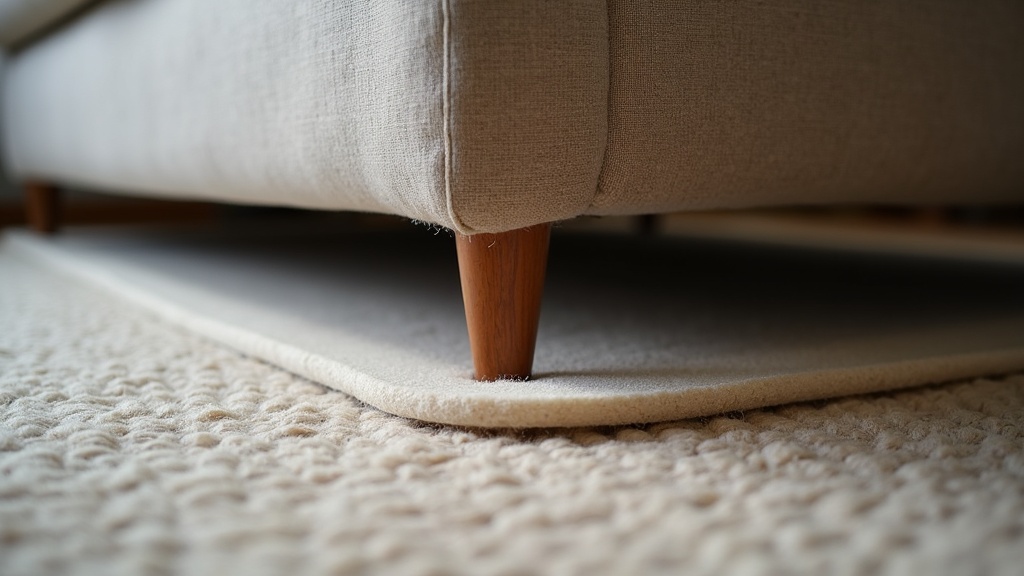
A sectional is heavy, and the legs or base rails stay in one position for a long time, which puts sustained, uneven pressure on a rug’s foundation. A rug pad matched to the floor underneath — thin felt-rubber for hardwood, a grip pad for tile, a different profile again over existing carpet — protects both the rug and the floor and reduces the chance of the rug creeping, rippling, or buckling under the sofa’s weight; the differences between pad types are covered in the guide to rug pads by floor type. If a rug is already rippling under heavy furniture, that’s usually a pad or humidity issue rather than a defect in the rug itself, and the fixes are outlined separately in the piece on rug buckling and rippling.
Because sectional legs sit in one spot for months at a time, the pile underneath compresses and can shed at a different rate than the exposed areas. Rotating the rug periodically — where the furniture layout allows it — evens out this wear, and the reasoning and timing are explained in rotating a rug: why it matters and how often. This matters more for a hand-knotted wool pile than for a low-cost machine-made rug, since hand-knotted wool shows compression wear as a visible sheen change that’s harder to disguise later.
Colour, pattern and coffee table proportion
A sectional already dominates the room visually, so the rug underneath it doesn’t need to compete for attention — a rug that’s too busy under a large sofa can make the whole seating area feel crowded rather than grounded. Many people choosing a rug for this exact layout lean toward a colour that won’t fight with a large upholstered piece for years to come; the trade-offs between bold pattern and a calmer solid or subtly patterned field are laid out in choosing between a patterned and a solid rug and in choosing a rug colour that won’t date. The coffee table itself should sit fully on the rug with room to spare on all sides — a table balanced half on and half off the rug edge is one of the more common small placement mistakes in sectional layouts.
If you’re weighing construction as well as placement — hand-knotted wool versus tufted or machine-made — that decision affects both budget and how the rug will wear under sustained furniture weight, and it’s worth reading before committing to a size, since a large room-filling rug in hand-knotted wool sits at a very different price point than a machine-made equivalent; as an illustrative example only, a machine-made wool-blend rug in a 9×12 size might sit somewhere in the low hundreds, while a comparable hand-knotted piece can run many times that depending on origin, knot density and materials, and construction and size both drive the range enormously.
Frequently asked questions about rug placement with a sectional
Should the front legs of a sectional be on the rug or off?
In almost every workable layout, the front legs of every section — including the chaise — should sit on the rug so the sofa doesn’t look separated from the rest of the room’s floor plan; back legs can go either way depending on room size.
What size rug do I need for a sectional couch?
Most sectionals in a standard living room need at least an 8×10, often 9×12 or 10×13, sized to the sofa’s full bounding box including the chaise, with margin for a walkway on the open side.
Can a rug be too small for a sectional?
Yes — a rug that only reaches partway under the sectional or sits isolated under just the coffee table tends to make the seating area look disconnected from the rest of the room rather than anchored by it.
Do I need a rug pad under a sectional sofa?
Yes, a pad matched to the floor type reduces slipping and creeping under a heavy, rarely-moved piece of furniture and helps prevent the rippling or buckling that sustained point pressure can cause over time.
Will a sectional leave permanent dents or marks on my rug?
Sustained weight compresses pile under the legs and can leave a visible sheen difference; rotating the rug periodically and using furniture coasters under the legs both help even out this wear over the rug’s life.
Rug Academy publishes general information about rugs and is not a dealer, appraiser, or cleaning service. Cleaning and repair methods depend entirely on fibre, dye and construction — test any treatment on a hidden corner first, and consult a professional rug cleaner or conservator before treating a hand-knotted, antique, silk, or valuable rug, as damage from cleaning is usually permanent. Any prices mentioned are illustrative examples only, and nothing here is an appraisal, an authentication, or a guarantee of a rug’s origin or value.