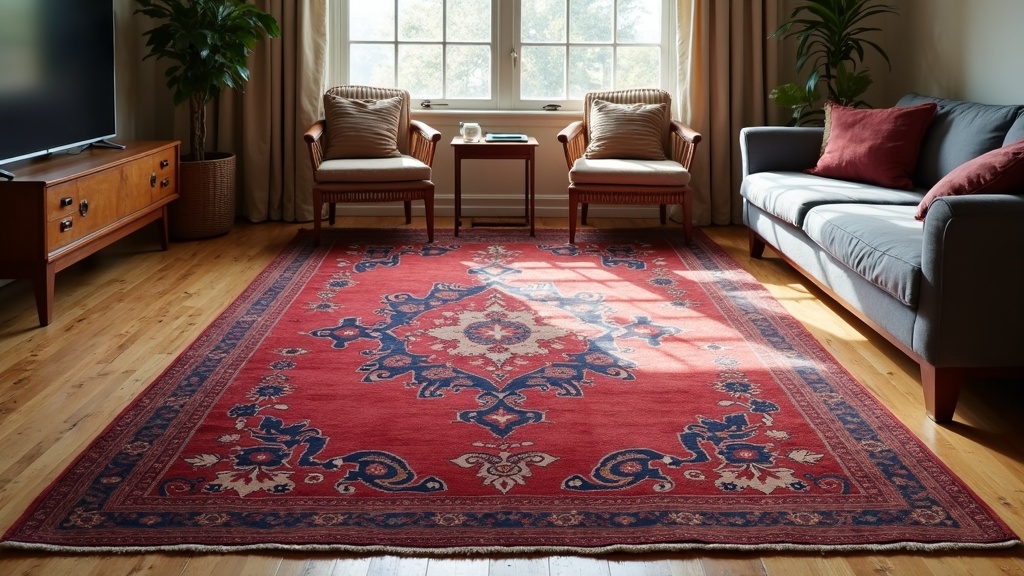
Afghan rugs are known for their deep, often brick-red to burgundy palettes, heavy hand-spun wool that feels dense and slightly coarse underfoot, and bold geometric patterns rooted in Turkmen tribal design — octagonal “guls,” repeating medallions, and angular borders rather than the curvilinear floral work seen in Persian city rugs. Most are hand-knotted on wool or cotton foundations by weavers working in Afghanistan or in Afghan refugee communities in Pakistan and Iran. Quality varies enormously with knot density, wool preparation, and dye source, so the same general description can cover a modest village piece and a genuinely fine one.
Where the look comes from
What is sold today as “Afghan” rugs is really a family of related weaving traditions rather than one single style. The dominant visual language — repeating octagons known as guls, stepped diamonds, and hooked border motifs — descends from Turkmen tribal weaving, since many communities producing rugs in Afghanistan are ethnically Turkmen, Uzbek, or Baloch, with weaving knowledge that predates modern borders. You will also find rugs made by Hazara and Tajik weavers with somewhat different colour habits and looser layouts. Because the region sits at a crossroads of Central Asian, Persian, and South Asian influence, it is common to see a Turkmen-derived medallion sitting inside a border that owes more to Persian city weaving. For a broader look at how these medallion, boteh, and Herati patterns evolved and spread across weaving cultures, the site’s guide to understanding rug motifs is a useful companion to this article, and the regional and antique rugs archive covers how neighbouring traditions compare.
A well-known subset are so-called “war rugs,” woven from the 1980s onward, which fold tanks, helicopters, and weapons into traditional border and field layouts. These are a genuinely distinct 20th-century phenomenon rather than a marketing gimmick, and they are collected specifically for that historical content rather than for conventional decorative appeal.
Wool, spin and why the hand feels different
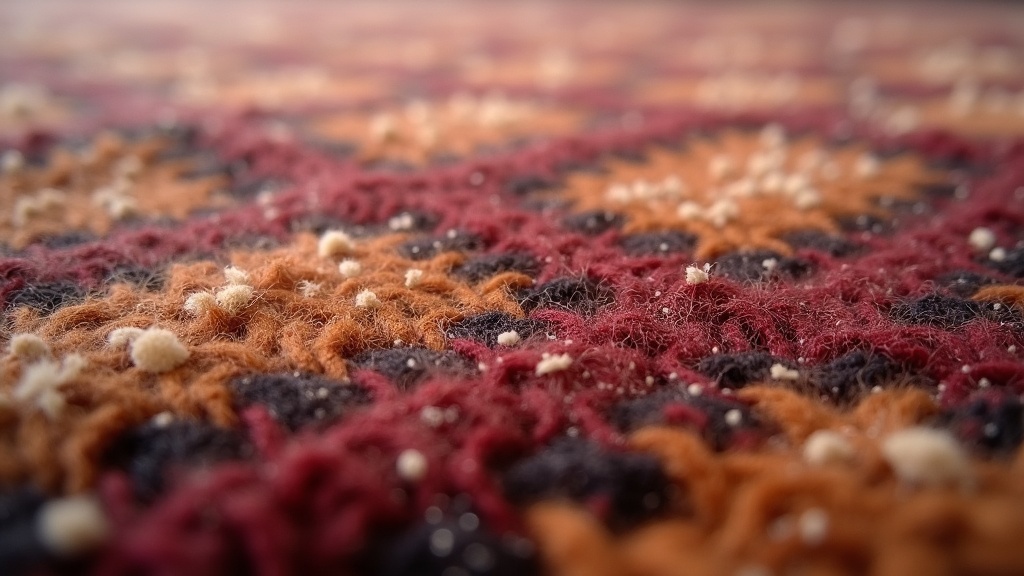
Much of the character of an Afghan rug comes from the wool itself. Traditional pieces often use wool that is hand-spun rather than machine-spun, which produces a slightly irregular, somewhat lofty yarn compared with the tighter, more uniform commercial wool used in many Persian or Indian workshop rugs. That irregularity is not a flaw; it is part of why these rugs have a heavier, more textured surface and why the pile tends to darken slightly and develop a soft sheen — sometimes called a “patina” — as lanolin and dust settle into the fibre over years of use. Dyes historically leaned on natural sources including madder root for the characteristic deep reds, though synthetic dyes are now widespread across the trade, and distinguishing one from the other by eye takes practice. The site’s piece on natural versus synthetic dyes walks through the visual and behavioural clues, such as how natural dyes tend to show gentle colour variation (abrash) across a field where synthetic dye lots are more uniform.
If you are comparing an Afghan rug against a wool-blend or synthetic alternative for a specific room, it is worth reading up on how wool and synthetic fibres age differently under foot traffic and sunlight before you commit, since the wool content is a large part of what you are paying for in a hand-knotted piece.
How construction affects what you’re looking at
Most rugs sold as Afghan are hand-knotted on a cotton or wool warp, using the symmetric (Turkish/Ghiordes) knot associated with Turkmen and Central Asian weaving traditions, though this varies by workshop and region. Knot density affects how crisp the pattern looks and how the rug wears, but higher density alone does not automatically mean better quality — the site’s discussion of whether knot density really matters is worth reading before treating it as the single deciding number. For a general primer on how the whole structure fits together, warp, weft and pile explained gives the vocabulary an appraiser or dealer will use.
Buyers sometimes encounter “Afghan-style” rugs that are actually machine-made or hand-tufted reproductions using the same colour palette and gul motifs. Machine-made pieces typically show a uniform, mechanically perfect back with no visible individual knots, a stiffer handle, and often a woven-in edge rather than a hand-finished selvedge. Hand-tufted rugs have a fabric backing glued or stitched over a canvas rather than a continuous woven foundation, and they shed and delaminate over time in a way hand-knotted rugs do not. If you are trying to work out which category something in front of you falls into, the guide to telling handmade from machine-made rugs covers the practical checks, and the materials and construction archive has related pieces on backing types and fibre content.
Caring for the wool without damaging it
Because Afghan rugs are usually wool on a wool or cotton foundation, ordinary maintenance follows the same rules as other hand-knotted wool rugs: regular light vacuuming without a beater bar (which can pull and fray fringe and loosen pile), rotation every few months to even out wear, and a rug pad to reduce foundation strain. For surface dust between proper cleanings, a dry method suited to hand-knotted wool is safer than any wet approach; the guide to dry cleaning methods explains which techniques are appropriate for which situations.
For a fresh spill on a wool pile Afghan rug, blot immediately with a clean white cloth and cool water only — never hot water, which can cause wool to felt, shrink, or yellow, and never an alkaline or high-pH household cleaner for the same reason. A small amount of a wool-safe, pH-neutral detergent can help with grease or food residue once blotted, but test it first on a hidden corner of the pile, such as under a furniture leg, and watch for at least several minutes to make sure the dye does not bleed or shift, since natural and some early synthetic dyes are prone to migrating when wet. Never use chlorine bleach on wool; it will weaken and discolour the fibre permanently, and never combine cleaning products, particularly anything containing ammonia or bleach together, since the fumes are hazardous and the chemistry does nothing useful for the stain. If the rug is antique, unusually fine, or you are simply not confident about its dyes and construction, the safer move is to stop blotting and call a professional rug cleaner rather than risk a permanent mark — cleaning damage on a hand-knotted rug generally cannot be undone. The rug care hub and its cleaning and stains archive cover specific stain scenarios in more depth.
Value and authentication: what actually gets examined
Nobody can responsibly tell you what a specific rug is worth, where precisely it was made, or how old it is from a written description or a photo alone — that requires handling the piece. What an appraiser or experienced dealer actually looks at includes the knot type and count per square inch, the material and spin of the foundation versus the pile, the dye characteristics under magnification and sometimes under UV light, the wear pattern relative to the pile height, and the finishing of the selvedge (the woven edge) and fringe, since these details are hard to fake convincingly and differ meaningfully between regions, eras, and skill levels. Reproductions and “antique-wash” pieces are sometimes chemically treated to look aged; the article on antique-wash and distressed rugs explains what that process actually does to the wool. If money is genuinely at stake — insurance, resale, inheritance — an in-person appraisal from a qualified textile appraiser is the only reliable answer, and the site’s guide to getting a rug appraised walks through what that process involves. The value and authentication archive covers related questions on wear, repairs, and how similar-looking rugs can differ hugely in price.
Buying one: rough expectations, not promises
Prices for Afghan rugs span an enormous range depending on wool quality, knot density, dye type, size, and where and how they are sold. A small, coarser-knotted, synthetic-dyed piece from a general home goods retailer might sit somewhere in the low hundreds, while a larger, finer, naturally dyed hand-knotted rug from a specialist dealer could run considerably higher — these are illustrative examples only, not current market figures, since actual pricing depends on the specific rug and where you buy it. If you are shopping for a room rather than a collection, start with the practical questions covered in the site’s rug buying guides hub, particularly sizing and how a bold geometric pattern will read against your existing furniture and flooring, before narrowing down on origin or age.
Frequently asked questions about Afghan rugs
Are Afghan rugs good quality?
Quality varies as widely within Afghan rugs as within any other regional category — hand-spun wool, tighter knotting, and natural dyes generally indicate a more durable and better-finished piece, but coarser, faster-made rugs exist alongside genuinely fine ones, so quality has to be judged rug by rug rather than assumed from the label.
What is the difference between an Afghan rug and a Persian rug?
Broadly, Afghan rugs lean on Turkmen-derived geometric motifs like octagonal guls in deep reds, while Persian rugs from Iran typically show curvilinear floral and medallion designs across many distinct regional styles; there is overlap, and the terms describe tradition and design lineage more than a strict legal origin.
How do you clean an Afghan wool rug at home?
Regular light vacuuming without a beater bar, occasional rotation, and blotting fresh spills with cool water and a wool-safe pH-neutral detergent is generally safe on hand-knotted wool; always test on a hidden area first and call a professional for antique, valuable, or uncertain rugs, since wet cleaning mistakes are usually permanent.
Why are Afghan rugs so red?
The dominant reds trace back to natural dyes like madder root historically used across Turkmen and Central Asian weaving, combined with a cultural preference for deep, saturated fields; many modern pieces now use synthetic dyes to achieve a similar look at lower cost.
Are war rugs from Afghanistan valuable?
Some war rugs are collected specifically for their historical imagery and period of production, but value depends on age, weave quality, condition, and documented provenance rather than the subject matter alone, so an in-person appraisal is the only reliable way to establish worth for a specific piece.
Rug Academy publishes general information about rugs and is not a dealer, appraiser, or cleaning service. Cleaning and repair methods depend entirely on fibre, dye and construction — test any treatment on a hidden corner first, and consult a professional rug cleaner or conservator before treating a hand-knotted, antique, silk, or valuable rug, as damage from cleaning is usually permanent. Any prices mentioned are illustrative examples only, and nothing here is an appraisal, an authentication, or a guarantee of a rug’s origin or value.