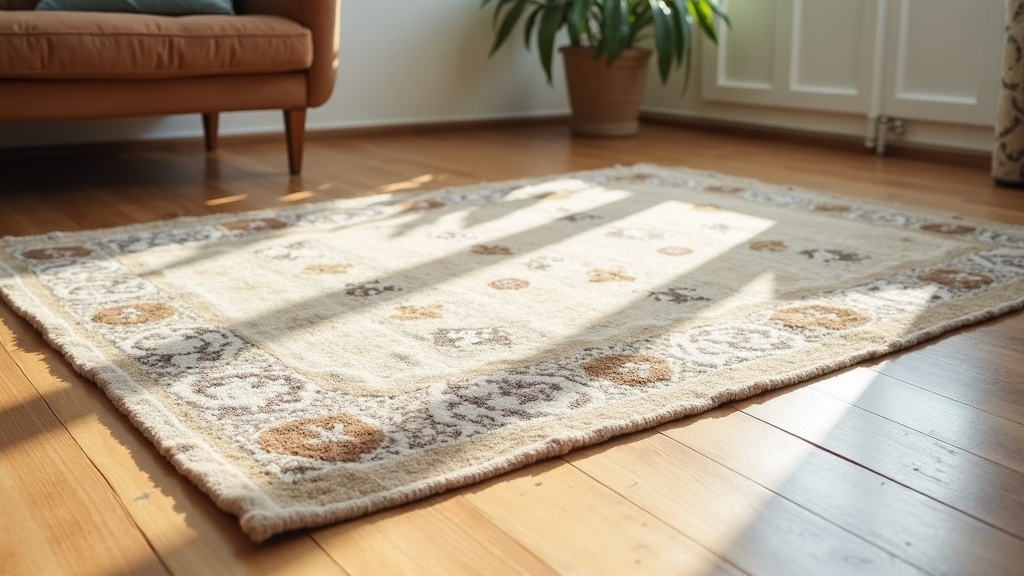
The fastest way to tell if a rug is handmade or machine-made is to flip it over and look at the back. On a hand-knotted rug, the pattern on the back mirrors the front with slight irregularities in the knots; on a machine-made rug, the back shows a uniform, often mesh-like grid with a felt-like backing glued or woven in. Fringe attachment, pattern regularity, and the presence of a woven-in versus sewn-on selvedge add further confirmation. None of these checks require special tools, but a confident answer on age, origin, or value still needs an in-person appraiser.
Start with the back of the rug
Turn the rug over. This single step eliminates more guesswork than anything else. A hand-knotted rug is built one knot at a time around a warp and weft foundation, so the reverse side shows the same design as the front, just slightly softer and less crisp, with small variations from knot to knot. A machine-made rug is woven on a power loom that locks yarn into a backing in continuous, mechanically identical rows, so the reverse tends to look like a stiff, uniform grid, sometimes with a canvas-like or latex coating that hides the foundation threads entirely. If you can see individual knots and slight asymmetries in spacing on the back, you are very likely looking at a handmade piece. If the back is glossy, rubbery, or perfectly regular, machine construction is the more probable explanation.
Check the fringe and the selvedge
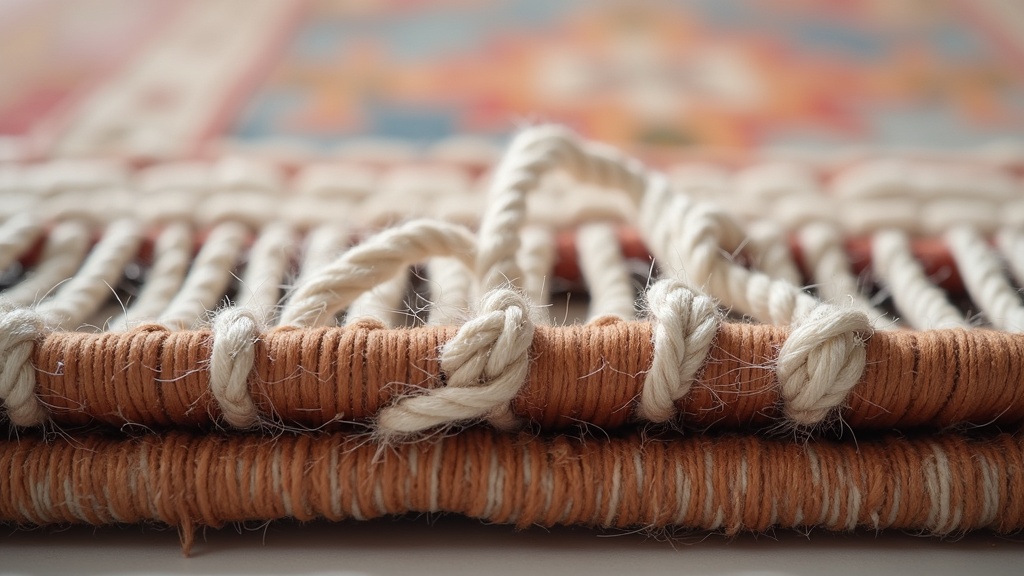
Fringe is one of the most misunderstood clues, because it is often assumed to be decorative trim. On a genuine hand-knotted rug, the fringe is actually the exposed warp threads that run the entire length of the rug’s foundation; pull gently at a strand near the edge (never yank hard) and you should feel it is continuous with the structure, not stitched on afterward. Machine-made rugs frequently have fringe that is sewn on separately as a finishing touch, which is why it can look perfectly even and detach cleanly along a seam. The selvedge, the wrapped edge along the rug’s sides, tells a similar story: hand-finished selvedges are usually overcast by hand with wool or cotton yarn and show minor irregularities, while machine-made edges are often bound by a machine-stitched tape in a uniform, almost printed-looking finish. For a fuller breakdown of how these construction details separate hand-knotted from hand-tufted work, the comparison in our piece on hand-knotted vs hand-tufted rugs is a useful companion to this checklist.
Look for the “imperfections” that prove a human hand was involved
Ironically, small irregularities are a good sign, not a flaw. Hand-knotted rugs show minor variations in knot density, slight color striping called abrash where a dye lot changed partway through weaving, and pattern elements that are not perfectly mirrored from one side of the rug to the other. Machine-made rugs, by contrast, are designed to be flawlessly repetitive, because that is what the loom does well. If you lay a straightedge along a border and the motifs line up with mechanical precision row after row, that is a strong indicator of machine production. If the border wanders slightly and the motifs are close but not identical, that points toward hand production.
Examine knot density and structure with a loupe or magnifier
Knot density, measured in knots per square inch, is one of the traditional markers appraisers use to judge the fineness of a hand-knotted rug, and higher density generally correlates with finer detail and more labor. To count it yourself, part the pile on the back and count the knots within a one-inch square in two directions, then multiply. This only works reliably on a hand-knotted foundation; machine-made rugs do not have discrete knots in the same sense, so trying to “count knots” on one will just show you the loop or tuft structure of the machine weave. This is genuinely technical territory, and the broader craft context, including how different regional traditions tie knots differently, is covered in more depth in our rug craft hub.
Consider the foundation material
Pick up a corner and look at the warp and weft, the threads running through the rug’s structure. Older and many finer hand-knotted rugs use cotton or wool foundations, while a large share of machine-made rugs use synthetic foundations such as polypropylene or a jute-and-latex backing, sometimes with a separate secondary backing glued on for stability. Foundation material alone does not prove construction type, since hand-knotted rugs can also use synthetic yarns in the pile, but a stiff, glued secondary backing is rarely found on a genuine hand-knotted rug and is a fairly reliable sign of machine manufacture. For a broader look at how fiber choices affect durability and feel, our guide to wool vs synthetic rug lifespan covers the practical trade-offs, and the materials and construction archive has further reading on specific fiber types.
Why this distinction matters for care, not just curiosity
Knowing whether a rug is handmade or machine-made changes how you should clean and maintain it, which is why this is not just a collector’s question. A machine-made rug with a synthetic pile and a poly or jute backing can often tolerate more routine home care, including a beater-bar vacuum on a gentle setting, though fringe and edges should still be vacuumed with the brush lifted to avoid fraying. A hand-knotted rug, especially one that is wool or silk, is much more vulnerable: saturating it can shrink or buckle the foundation permanently, hot water and high-pH cleaners can felt and yellow wool, and silk is damaged by water and most detergents and should generally be left to a professional. Whatever the fiber, always test any cleaning product on a hidden corner first, and never mix cleaning chemicals or reach for chlorine bleach, which destroys wool and silk, or combine ammonia with other household cleaners. If the rug is hand-knotted, antique, silk, or you are simply not sure of its construction, the safer and more respectful move is to consult a professional rug cleaner or conservator rather than experiment. Our rug care hub and the step-by-step advice in how to clean a wool rug without ruining it go into these fiber-specific precautions in detail, and the cleaning and stains archive covers spill and stain scenarios by fiber type.
What construction tells you about price, and what it does not
Construction type is one input into value, but it is far from the only one. As a general illustration only, a machine-made wool-blend rug in a common living-room size might sit somewhere in the low hundreds, while a hand-knotted wool rug of comparable size can range from several hundred to well into the thousands depending on knot density, age, dye type, and condition, and a fine silk piece can go higher still; these are illustrative patterns, not quotes for any specific rug. Reproductions complicate matters further, since some machine-made rugs are deliberately styled to resemble antique or tribal patterns, and some hand-knotted rugs are made recently using traditional techniques, so age and hand construction are not the same question. If real money is at stake, whether you are buying, insuring, or selling, an in-person appraisal by a qualified appraiser is the only reliable way to establish origin, age, and value; nothing in this article, and no photograph-based opinion, substitutes for that. For placement and sizing questions once you’ve settled on a rug, our living room rug size guide and the broader rug buying guides hub are useful next steps, alongside the weaving techniques archive if you want to go deeper on regional knotting styles.
Frequently asked questions about handmade vs machine-made rugs
How can I tell if my rug is hand-knotted just by looking at the front?
Look for slight irregularities in the pattern, small color variations called abrash, and pile that is not perfectly uniform in height. Perfectly crisp, mechanically repeated motifs with no variation usually point toward machine production instead.
Does a rug having fringe mean it’s handmade?
Not necessarily. Genuine hand-knotted fringe is the rug’s exposed foundation threads, but many machine-made rugs have fringe sewn on separately purely for appearance, so check whether the fringe pulls away as a continuous part of the structure or as an attached strip.
What does the back of a machine-made rug look like?
It typically shows a uniform, grid-like weave, often with a stiff canvas, latex, or rubber-like secondary backing glued on for stability, quite different from the softer, knot-by-knot mirrored pattern seen on the back of a hand-knotted rug.
Can a machine-made rug still be valuable?
It can have real value as a well-made decorative object, but it will not carry the same collectible or appraised value typically associated with hand-knotted rugs of age and fine knotting, since labor, materials, and craft history all factor into an appraiser’s assessment.
Should I clean a hand-knotted rug differently than a machine-made one?
Yes. Hand-knotted wool or silk rugs are far more vulnerable to shrinkage, felting, and dye bleeding, so gentle, professional-grade care is safer, while many machine-made synthetic rugs tolerate more routine home cleaning, though testing in a hidden spot first is still wise for any rug.
Rug Academy publishes general information about rugs and is not a dealer, appraiser, or cleaning service. Cleaning and repair methods depend entirely on fibre, dye and construction — test any treatment on a hidden corner first, and consult a professional rug cleaner or conservator before treating a hand-knotted, antique, silk, or valuable rug, as damage from cleaning is usually permanent. Any prices mentioned are illustrative examples only, and nothing here is an appraisal, an authentication, or a guarantee of a rug’s origin or value.