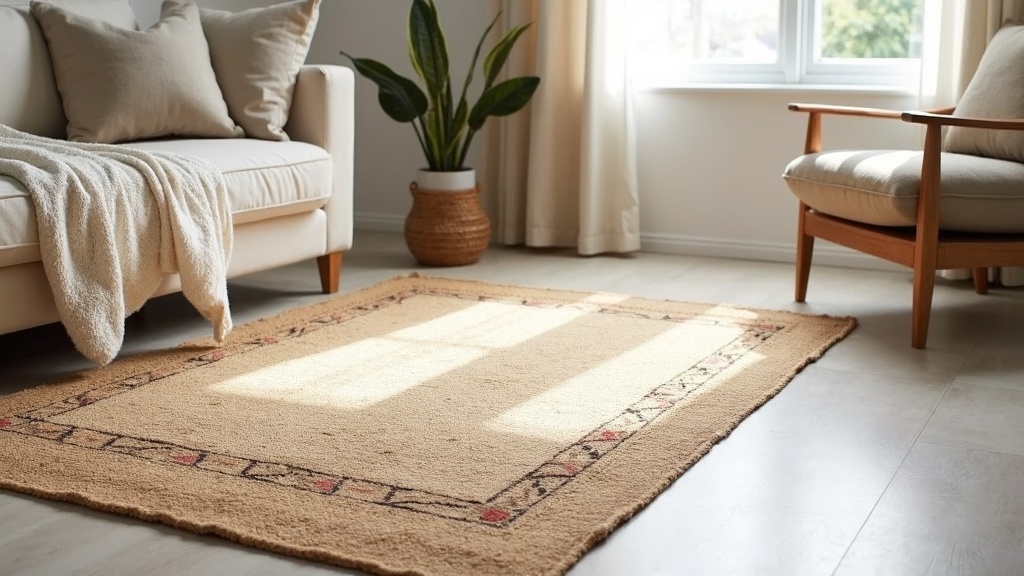
Layering rugs works when the bottom rug is large enough to read as a floor-covering foundation and the top rug is sized so a consistent margin of the base rug shows all the way around — typically 8 to 18 inches, depending on the sizes involved. As a rough ratio, a top rug that covers 50–70% of the base rug’s area tends to look proportioned rather than accidental. Get the margin uneven or the top rug too close in size to the base, and the effect reads as a mistake rather than a design choice.
Why layering rugs at all
Layering is mostly a practical fix dressed up as a style choice. It lets you put a smaller, more expensive or more decorative rug — a vintage Turkish piece, a bold geometric flatweave, a small hand-knotted accent — into a room where a rug of that size alone would look stranded on bare floor. The base rug does the spatial work of anchoring the seating area; the top rug does the visual work of adding pattern, texture or color where you actually look. It’s also a way to introduce a textured natural-fibre rug, like jute or sisal, without living with it as your only floor surface, since those materials are comfortable underfoot but not always the ones you want your feet or a coffee table leg resting on directly. If you’re weighing a jute base against other options, the trade-offs are covered in more depth in our piece on whether a jute rug is a good idea for a living room.
The base rug: think room-sized, not rug-sized
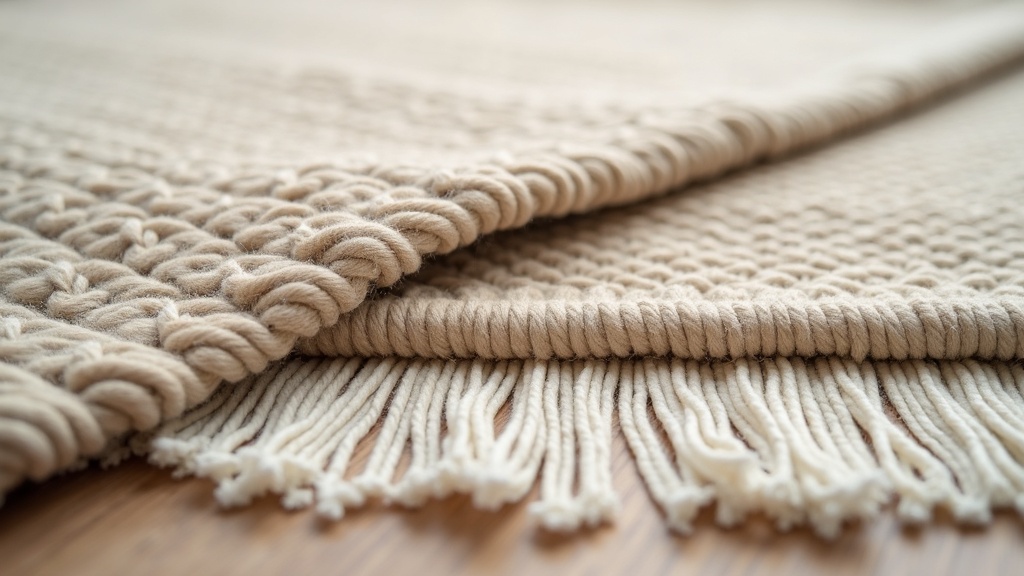
The base layer should follow the same sizing logic you’d use for a single large rug in that room — front legs of the sofa and chairs on it, sized to the seating group rather than to the room’s total square footage. In a living room this is usually an 8×10 or 9×12 rug; in a bedroom it might be a 6×9 sitting under and around the bed. The base is almost always a flatweave: jute, sisal, wool flatweave, or a durable low-pile machine-made rug. Flatweaves layer better than pile rugs because they sit flat, don’t compete texturally with what’s stacked on top, and are less likely to bunch when a second rug is added. Our comparison of flatweave versus pile rugs goes into why construction affects how a rug behaves underfoot and under another rug.
Common base sizes and what they suit
- 8×10 or 9×12: standard living room base, sized to the full seating arrangement
- 5×8 or 6×9: smaller living rooms, home offices, or as a bedroom base under a bed
- Runner-length flatweaves: hallways and entryways, sized per the guidance in our runner rug sizing article — layering a small vintage runner atop a longer jute runner is a common entry treatment
The top rug: sizing it against the base
Once the base is chosen, size the top rug as a fraction of it, not as an independent decision. A few reliable pairings:
| Base rug size | Top rug size | Approx. margin shown |
|---|---|---|
| 9×12 | 6×9 | ~18 in on the long sides |
| 8×10 | 5×8 | ~12–15 in |
| 6×9 | 4×6 | ~9–12 in |
| 5×8 (runner base) | 3×5 accent | ~10 in at each end |
These are starting points, not rules — a room with an asymmetric furniture arrangement may need the top rug pulled off-center to sit under a specific chair or in front of a fireplace rather than dead-centered on the base. What matters is that the margin is even and deliberate on the sides that are visible, even if it’s not identical on all four.
Shape and orientation
Two rectangles is the easiest combination and the one that forgives sizing mistakes most readily. Round-on-rectangle can work in a dining nook or under a round table, but it requires more care: center the round rug precisely, or the asymmetry reads as off rather than intentional. Two rugs with strong, busy patterns rarely layer well — one of the two pieces needs to be a relatively plain or textural flatweave so the eye has somewhere to rest. If you already own two patterned rugs you’re trying to use in the same space, it may be more successful to place them in separate zones of an open-plan room rather than stack them; our guide to mixing two rugs in one open-plan room covers that alternative.
Keeping layered rugs flat and safe underfoot
Two stacked rugs are inherently less stable than one, and the top rug is especially prone to sliding, curling at the corners, or creeping out of position with foot traffic. A rug pad cut to the top rug’s size, placed between the two layers, solves most of this — it adds grip, stops the top rug from sliding on the flatweave surface below, and reduces wear at the point where the edges rub. This is worth doing even if you’d normally skip a pad on a single rug; the guidance in Do You Really Need a Rug Pad? applies just as much, if not more, to a layered setup. If the top rug’s corners still lift, the causes and fixes described in How to Stop a Rug From Curling at the Corners are the same whether the rug sits alone or on top of another.
Cleaning a layered setup
Layering doesn’t change fibre rules, but it does complicate cleaning: spills often soak through the top rug into the base rug beneath, and dirt collects at the overlap edge where both layers get less airflow. For everyday care, vacuum each rug separately with a beater-bar-free setting or the brush turned off on natural fibres and fringe, since beater bars can fray jute edges and loosen wool pile — this is covered in our piece on vacuuming a rug correctly. Lift the top rug periodically to check the base for moisture, mildew smell, or dye transfer, particularly if the top rug is a natural-dyed or unstable-dye piece; wet colour can migrate onto a lighter base rug beneath it. If either layer is hand-knotted, antique, silk, or you’re not certain of its construction, treat any spill conservatively — blot, don’t rub, and get it to a professional rather than experimenting, since water and household cleaners can permanently damage silk and many wool rugs shrink or felt under hot water or high-pH products. General cleaning caution for whatever fibres you’re layering is covered across our rug care section.
When layering isn’t the answer
If you’re drawn to layering because you can’t decide on one rug size, it’s worth stepping back and checking whether a single well-sized rug would actually solve the problem better — layering adds visual interest but also adds cost, cleaning complexity, and a slip risk that a single rug doesn’t have. Our rug buying guides hub covers sizing and placement for single rugs across every room type if that’s the simpler fit for your space.
Frequently asked questions about layering rugs
What size rug goes on top of a jute rug?
A common approach is sizing the top rug to roughly 60–70% of the jute base’s area — for a 9×12 jute rug, a 6×9 accent rug leaves an even 18-inch border of jute showing on the long sides, which reads as intentional rather than mismatched.
Can you layer two area rugs of similar size?
You can, but it rarely looks proportioned — two rugs of similar footprint tend to look like a sizing error rather than a design choice. A visible margin of the base rug all the way around the top rug is what makes layering read as deliberate.
Do you need a rug pad between two layered rugs?
Yes, generally — a pad cut to the top rug’s dimensions and placed between the layers reduces sliding, curling at the corners, and abrasion where the two rugs rub against each other, and is worth using even in setups where a single rug might not need one.
What rug combinations work best for layering?
A flat, textural base such as jute, sisal, or a wool flatweave paired with a smaller patterned pile rug on top tends to work most reliably, because the flat base doesn’t compete visually or texturally with the rug stacked above it.
Can you layer a round rug on a rectangular rug?
Yes, this works well under round dining tables or in reading nooks, but it requires precise centering — an off-center round rug on a rectangular base looks unintentional in a way that off-center rectangles usually don’t.
Rug Academy publishes general information about rugs and is not a dealer, appraiser, or cleaning service. Cleaning and repair methods depend entirely on fibre, dye and construction — test any treatment on a hidden corner first, and consult a professional rug cleaner or conservator before treating a hand-knotted, antique, silk, or valuable rug, as damage from cleaning is usually permanent. Any prices mentioned are illustrative examples only, and nothing here is an appraisal, an authentication, or a guarantee of a rug’s origin or value.