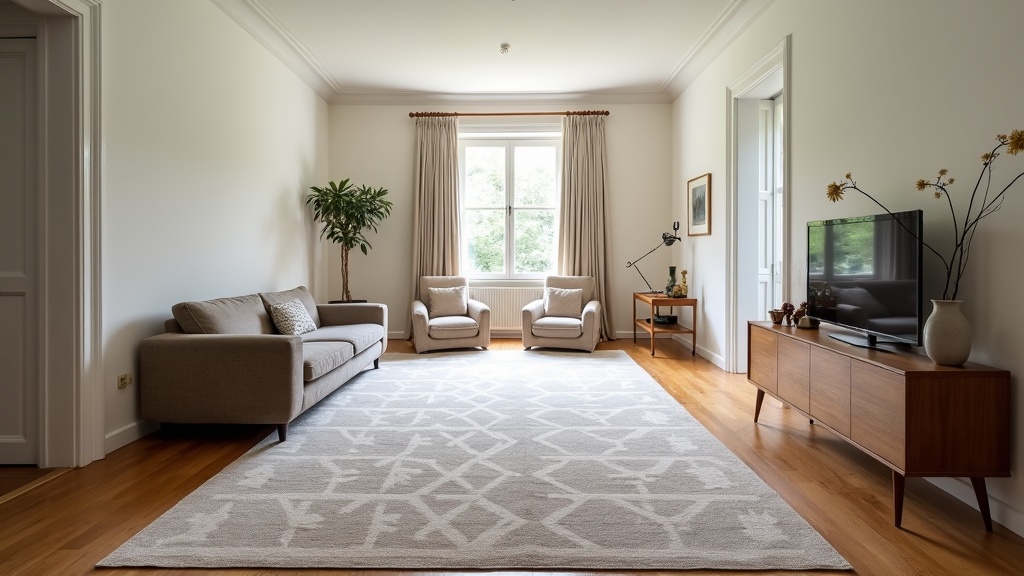
The best approach for a long, narrow living room is usually one rug sized to the seating group rather than the whole floor — long enough to anchor the sofa and chairs, but with enough bare floor on either side that the room doesn’t read as a corridor. In very narrow spaces, a runner-style rug or two coordinated rugs placed end to end can work better than a single oversized piece. The right choice depends on exact room proportions, furniture layout, and how much of the floor you actually want covered.
Long narrow rooms are common in older terraced houses, shotgun-style layouts, and apartments where the living area doubles as a hallway to somewhere else. The core problem is proportion: a rug that would look generous in a square room can look like a bowling lane once it’s stretched down a 20-foot space. Getting this right is mostly about restraint and measurement, not about finding a special “narrow room” rug shape.
Why narrow rooms trip people up
Most sizing advice assumes a roughly square or gently rectangular room where the rug simply needs to leave an even border of floor on all sides. In a long narrow room, that logic breaks down. If you try to leave the same margin on the long walls as on the short ones, you either end up with a rug that’s absurdly long and thin, or one so narrow it looks like a runner mistakenly placed under a sofa. The fix is to stop thinking about the room as a single rectangle and start thinking about it as a series of zones — seating, a walkway, maybe a reading corner — each of which can be treated on its own terms.
This is the same reasoning behind treating any unusually shaped room as a set of functional areas rather than one shape to be matched exactly; the general principles are covered in more depth on the question of whether a rug has to match the room shape and in the wider guidance for an awkwardly shaped room.
Three layout strategies that actually work
One rug sized to the seating zone
The most common and usually most flattering solution is to ignore the far ends of the room and size the rug to the sofa-and-chairs cluster instead. Front legs of the sofa and chairs sit on the rug, back legs can sit off it, and the rug’s edges run roughly parallel to the seating rather than to the room’s outer walls. This shortens the visual “length” the eye has to travel and gives the seating area its own defined footprint, leaving the remaining length of the room to read as a separate walkway or transition zone.
A runner or long narrow rug down the room’s spine
In genuinely tight rooms — anything under about 9 or 10 feet wide — a full-width area rug may not leave enough clearance to feel comfortable. Here a long, narrow rug running down the centre of the room, sized closer to a wide runner than a standard rectangle, can work well, especially if the furniture is arranged in a straight line along one wall rather than as a boxed-in seating group. The same sizing logic used for hallway runners applies: enough width to feel substantial underfoot, with a consistent margin of bare floor on both long sides.
Two rugs to break the room into rooms
For rooms that genuinely serve two purposes — a seating area at one end, a dining table or desk at the other — two smaller rugs, one per zone, often look more deliberate than one very long rug stretched across both. This also solves a practical problem: a single huge rug in an oddly proportioned room is harder to find, more expensive, and harder to have cleaned as one piece. Two rugs in complementary but not identical patterns can visually divide the room the way furniture arrangement alone sometimes can’t.
Getting the size right
There’s no single formula, but the following gives a starting point for a seating-zone rug in a long room. Treat it as a guide to be checked against your own furniture footprint with tape on the floor before buying anything.
| Room width | Typical rug width | Notes |
|---|---|---|
| Under 9 ft | 4–5 ft (runner-style) | Leave at least 18–24 in of bare floor on each long side |
| 9–12 ft | 6–8 ft | Standard area rug width, front legs of seating on rug |
| Over 12 ft | 9 ft+ | Consider whether one zone rug or two smaller rugs suits the layout better |
Rug length is more flexible than width in these rooms — it’s the width-to-room-width ratio that most often looks wrong when it’s off. The category page on sizes and placement and the broader rug buying guides hub cover sizing logic for other room shapes if your living room also opens into a dining or entry area.
Furniture placement rules
In a long narrow room, the temptation is to push all the furniture against the long walls to maximise the walkway down the middle — this is exactly the arrangement that makes a rug look like a corridor runner even when it isn’t one. Angling the seating slightly, or pulling the sofa a few inches off the wall so the rug can sit under it properly rather than beside it, does more to fix the proportions than changing the rug itself. The same tension between furniture arrangement and rug shape comes up in rooms with a sectional, where the sizing rules are covered separately on the page about rug placement for a living room with a sectional.
Pattern, colour and material
A single, continuous pattern tends to visually shorten a long rug better than a busy all-over repeat, which can emphasise length the way railway sleepers emphasise a track. A bold central medallion or a pattern with a clear directional flow across the width, rather than along the length, tends to work better than a design that reads as a long unbroken strip. Colour choices that won’t feel dated in a few years are worth thinking through separately — there’s a full discussion of that on the page about choosing a rug colour that won’t date.
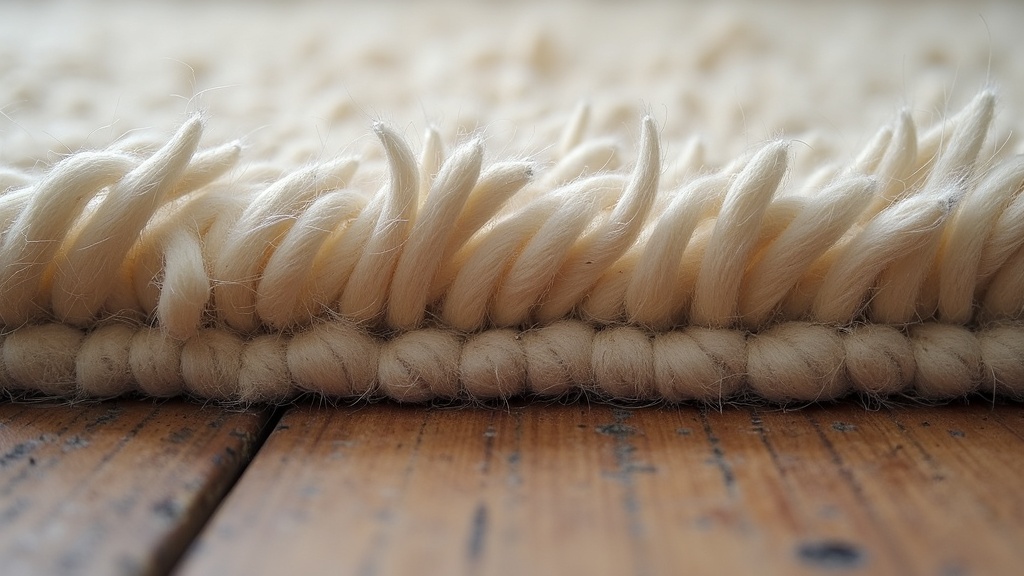
Material matters here too, mostly for practical reasons: a long rug in a room that also functions as a walkway will take more foot traffic along its length than a rug confined to a seating area, so a durable wool or wool-blend construction generally holds up better underfoot than a delicate silk or loosely woven flatweave in that specific zone. If the room has hardwood or engineered flooring, a rug pad suited to the floor type — covered on the page about rug pads by floor type — will also stop a long rug from creeping or rippling as people walk its length.
Where value and cleaning come in
None of the sizing advice above changes if the rug in question turns out to be a hand-knotted or antique piece rather than a machine-made one — but the stakes of getting fibre care wrong go up considerably. A wool pile rug can generally be vacuumed regularly and spot-cleaned with a wool-safe detergent and cool water, tested on a hidden corner first; a silk or finely hand-knotted piece is much more easily damaged by water and detergent and is better handled by a professional cleaner. Hot water, high-pH cleaners, and steam can cause wool to felt or shrink, and chlorine bleach will damage both wool and silk outright, so none of these belong anywhere near a rug you plan to keep for years. If you’re weighing a long runner-style purchase against the cost of a proper hand-knotted piece, the pricing and construction differences are explained in general terms — without quoting specific figures — on the pages covering materials and construction and value and authentication.
Frequently asked questions about a long narrow living room rug
What size rug do I need for a long narrow living room?
Size it to the seating zone rather than the whole room — front legs of the sofa and chairs on the rug, leaving bare floor at the far ends. A room under 9 feet wide often suits a runner-style rug 4–5 feet wide; wider rooms can take a standard 6–8 foot area rug.
Should I use one rug or two in a long living room?
Two rugs make sense when the room does double duty, such as seating at one end and a dining or desk area at the other. One long rug can look stretched and corridor-like if it spans both zones without a clear break.
Does a runner rug work in a living room?
Yes, particularly in rooms under about 9 feet wide where a full area rug leaves too little bare floor on either side. A wider runner-style rug down the centre, paired with furniture arranged in a line rather than a boxed group, usually looks more intentional than a squeezed-in area rug.
Which way should the rug pattern run in a narrow room?
A pattern with its main visual weight across the width, or a single centred motif rather than a repeating linear design, tends to shorten the apparent length of the room. A strongly directional stripe running the length of the rug can have the opposite effect and make the room feel longer and narrower.
Can I clean a large wool living room rug myself?
Light vacuuming without a beater bar and prompt blotting of spills with cool water and a wool-safe detergent is generally fine for a wool pile rug, after testing on a hidden corner. Hand-knotted, antique, silk, or uncertain-construction rugs are better sent to a professional cleaner, since cleaning damage is usually permanent.
Rug Academy publishes general information about rugs and is not a dealer, appraiser, or cleaning service. Cleaning and repair methods depend entirely on fibre, dye and construction — test any treatment on a hidden corner first, and consult a professional rug cleaner or conservator before treating a hand-knotted, antique, silk, or valuable rug, as damage from cleaning is usually permanent. Any prices mentioned are illustrative examples only, and nothing here is an appraisal, an authentication, or a guarantee of a rug’s origin or value.