A field guide to where hand-made rugs come from and how each tradition builds them. Each card is one named rug in The Metropolitan Museum of Art, with the materials, knot type, date and size exactly as the Met's catalogue records them, and the Met's own public-domain photograph. Read November 13, 2026.
Knot type is the first clue
The Met's essay on carpets of the Islamic world says each region "had a characteristic style of weaving that remained the same over time," and gives the main rule of thumb: "In Persia, for instance, an asymmetrical knot was most often used, and in Turkey a symmetrical one." It adds that Egyptian carpets are always fully wool and Indian ones are recognized by their red (Marika Sardar, The Met, 2003).
Rules of thumb have exceptions, and the catalogue shows them. The Met's Ottoman court "Carpet with Triple-Arch Design" from Turkey is asymmetrically knotted (The Met, 22.100.51). A Spanish fragment from probably the late 14th century uses a third kind, the "single-warp (Spanish) knotted pile" (The Met, 27.170.8). Knot type narrows the field; it does not settle where a rug was made.
Anatolian village and workshop rugs
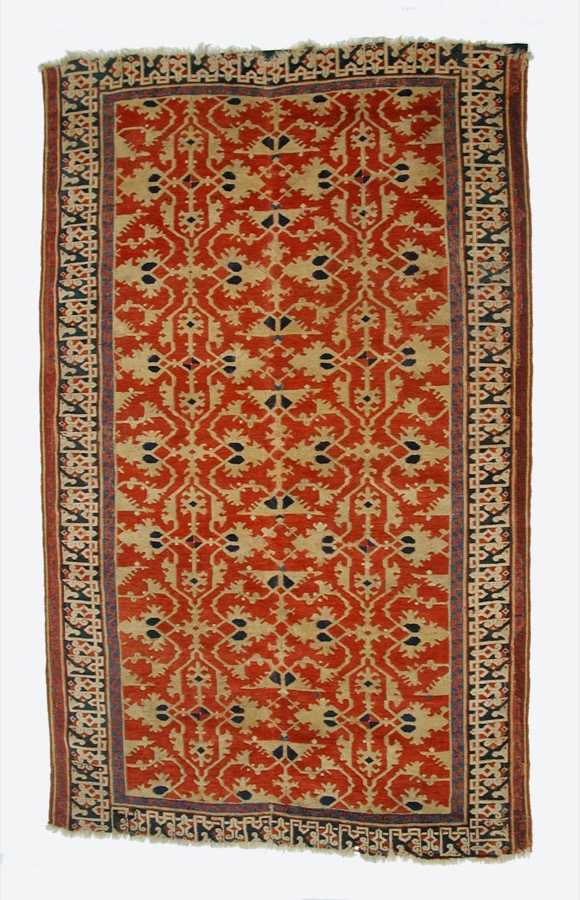
'Lotto' Carpet, 16th century. Turkey.
Wool (warp, weft and pile); symmetrically knotted pile. L. 85 1/2 in. (217.2 cm).
Rugs of this pattern are called 'Lotto' carpets: the Met essay explains that some rugs are "known by the name of the artist in whose paintings they appear, such as Lotto and Holbein."
The Met, 08.167.1 · Rogers Fund, 1908 · photo public domain (Met Open Access)
Western Anatolia: the 'Bellini' type
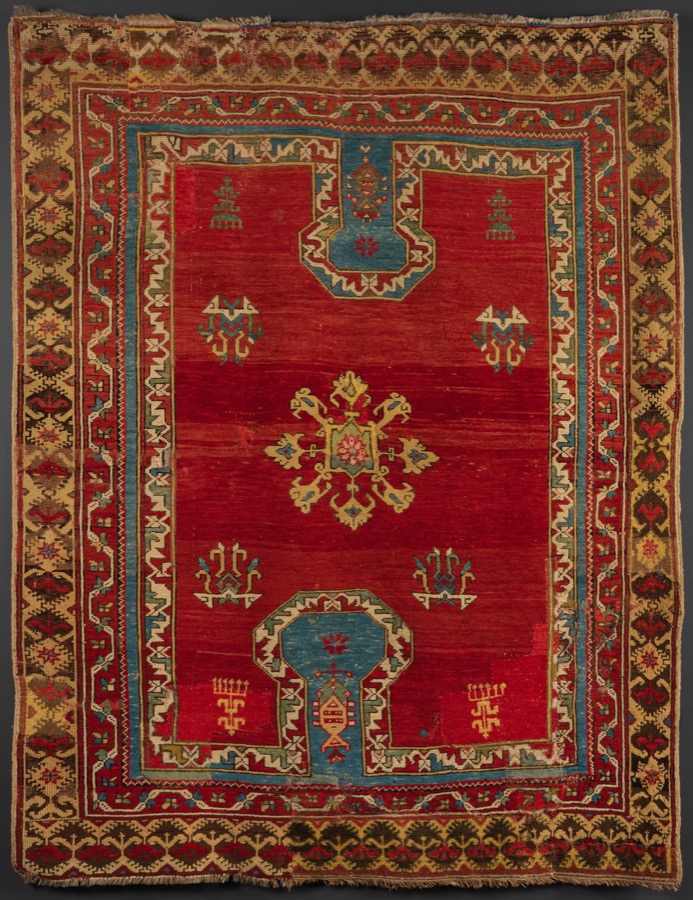
"Bellini" Carpet, 17th century. Probably western Turkey.
Wool (warp, weft and pile); symmetrically knotted pile. H. 69 in. (175.3 cm).
Another painter's name used for a rug type. Symmetric knots and wool throughout, as in most Anatolian pieces in the Met's records.
The Met, 22.100.89 · The James F. Ballard Collection, Gift of James F. Ballard, 1922 · photo public domain (Met Open Access)
Ottoman court carpets
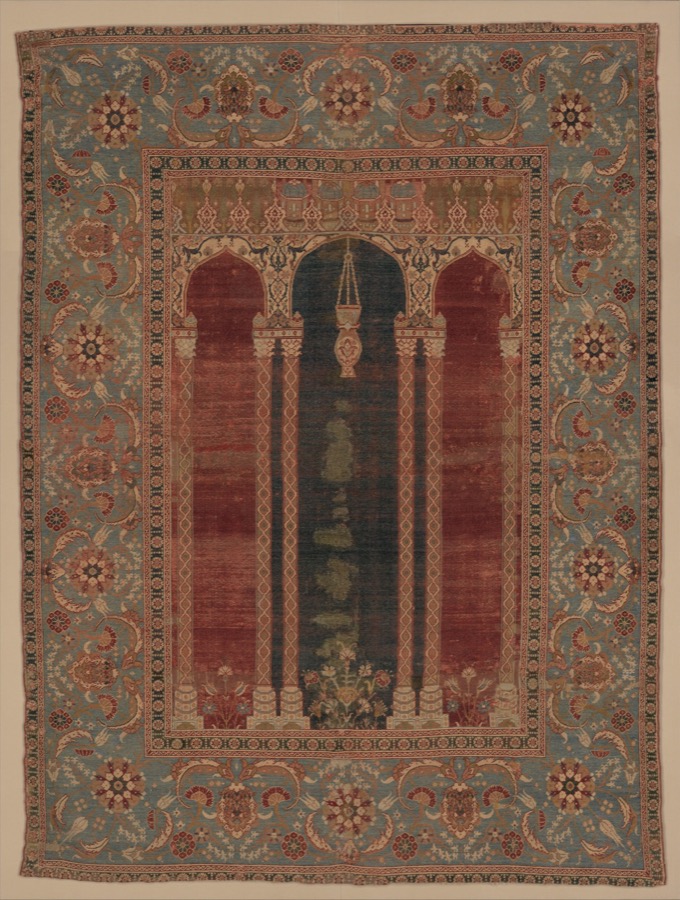
Carpet with Triple-Arch Design, ca. 1575–90. Turkey.
Silk (warp and weft), wool (pile), cotton (pile); asymmetrically knotted pile. L. 68 in. (172.7 cm).
An exception worth knowing: this Ottoman court piece is asymmetrically knotted, on a silk foundation, although the essay says a symmetrical knot was most often used in Turkey.
The Met, 22.100.51 · The James F. Ballard Collection, Gift of James F. Ballard, 1922 · photo public domain (Met Open Access)
Safavid Iran: vase carpets
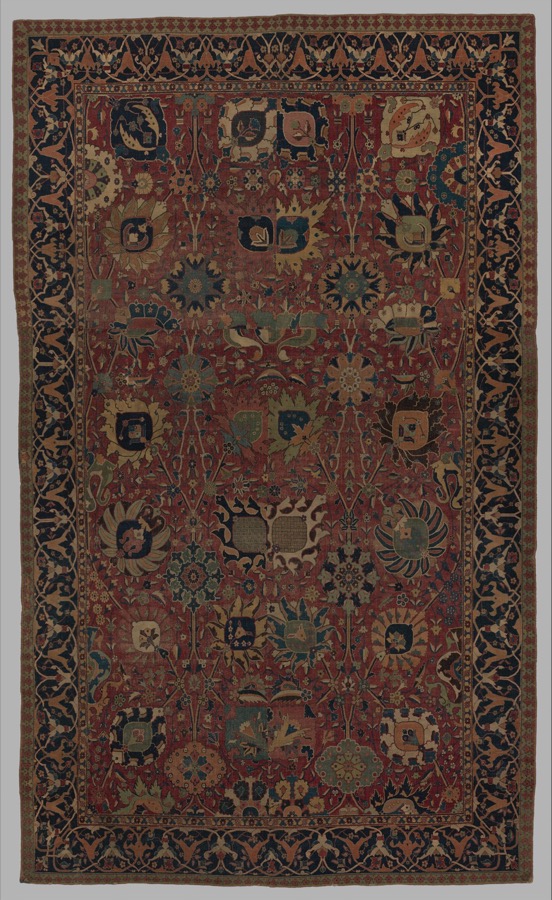
Vase Carpet, 17th century. Iran.
Cotton (warp and weft), wool (pile); asymmetrically knotted pile. H. 143 3/4 in. (365.1 cm).
The essay names vase and garden carpets as common types of Shah 'Abbas's period (r. 1587–1629), with vegetal motifs replacing the figural ones of the previous century.
The Met, 22.100.68 · The James F. Ballard Collection, Gift of James F. Ballard, 1922 · photo public domain (Met Open Access)
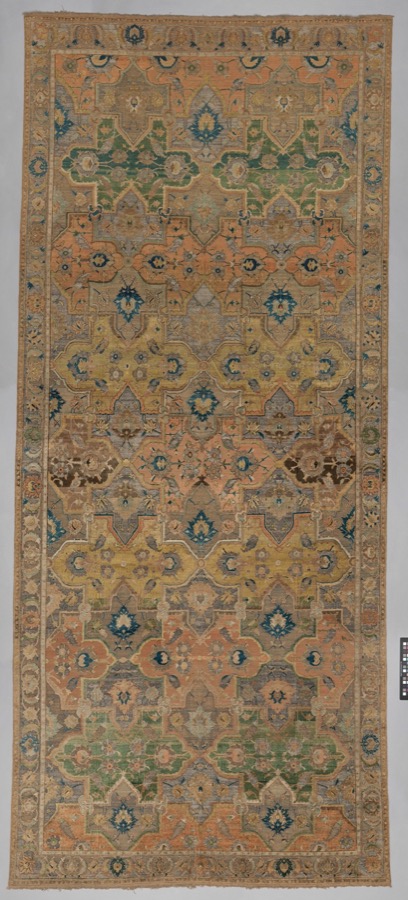
Safavid Iran: 'Polonaise' carpets
Polonaise Carpet, 17th century. Iran.
Cotton (warp and weft), silk (weft and pile), metal wrapped thread; asymmetrically knotted pile, brocaded. L. 160 in. (406.4 cm).
Silk pile and metal-wrapped thread. The essay says the Polonaise type was the most popular export: "over 300 of them are in foreign collections."
The Met, 50.190.1 · Gift of John D. Rockefeller Jr., 1950 · photo public domain (Met Open Access)
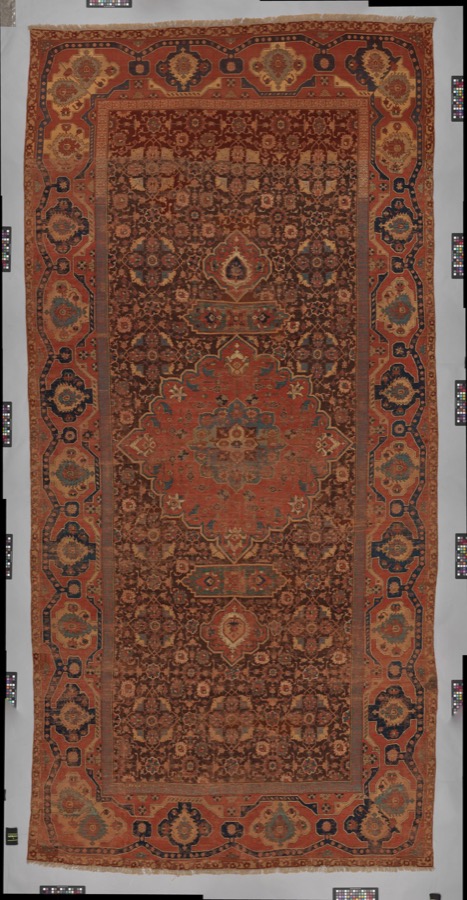
Northwest Iran
Carpet, 17th century. Northwestern Iran.
Wool (warp, weft and pile); asymmetrically knotted pile. H. 215 in. (546.1 cm) with fringe.
Wool foundation and asymmetric knots: the Persian knot the essay says was used most often in Iran.
The Met, 22.100.74 · The James F. Ballard Collection, Gift of James F. Ballard, 1922 · photo public domain (Met Open Access)
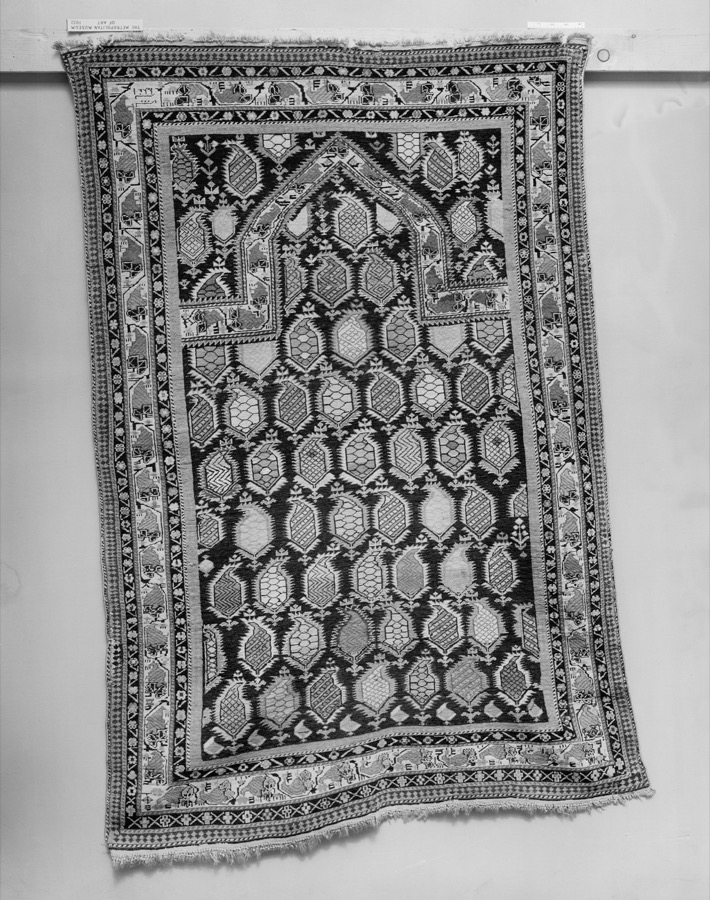
Caucasus: Shirvan
"Marasali" Shirvan Prayer Rug, dated 1223 AH/1808–9 CE. Azerbaijan.
Wool (warp, weft and pile); symmetrically knotted pile. H. 57 5/16 in. (145.5 cm).
Dated in the rug itself (1223 AH, which the Met gives as 1808–9 CE). Symmetric knots, all wool. Archival black-and-white photograph.
The Met, 22.100.3 · The James F. Ballard Collection, Gift of James F. Ballard, 1922 · photo public domain (Met Open Access)
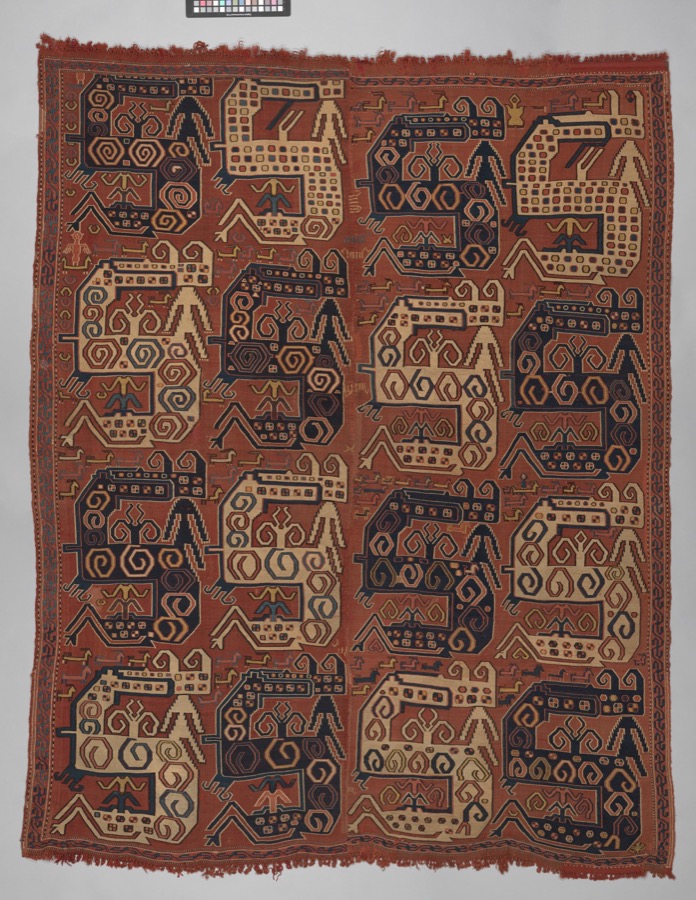
Caucasus: soumak (flat-woven)
Dragon Carpet, late 18th–early 19th century. Present-day Azerbaijan.
Wool, cotton; plain weave with supplementary-weft embroidery (Soumak). L. 90 in. (228.6 cm).
No knots at all: the Met records it as plain weave with supplementary-weft wrapping (soumak). See our soumak guide.
The Met, 1971.263.5 · Gift of Joseph V. McMullan, 1971 · photo public domain (Met Open Access)
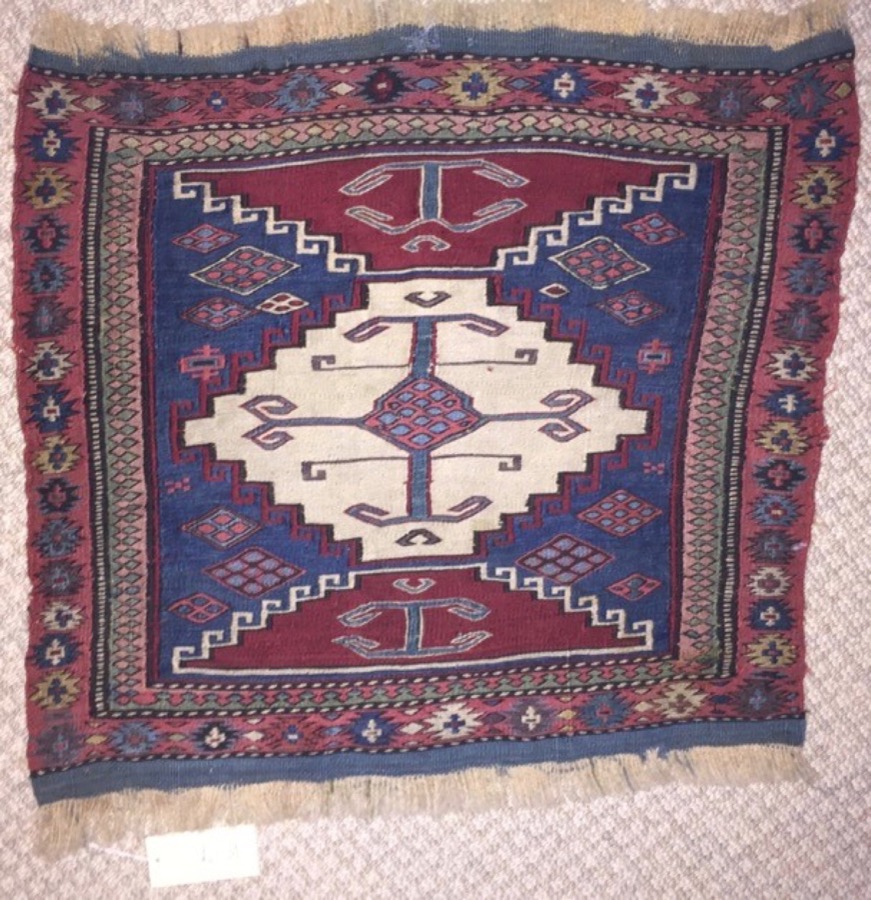
Shahsevan bags, Northwest Iran
Shahsevan Saddle Bag Face, ca. 1850. Northwest Iran.
Wool and cotton; sumak technique. H. 17 in. (43.2 cm).
A saddle-bag face in the sumak technique, wool and cotton: the everyday weaving of a pastoral group, not a court workshop.
The Met, 2018.666.12 · Gift of Inger G. and William B. Ginsberg, 2018 · photo public domain (Met Open Access)
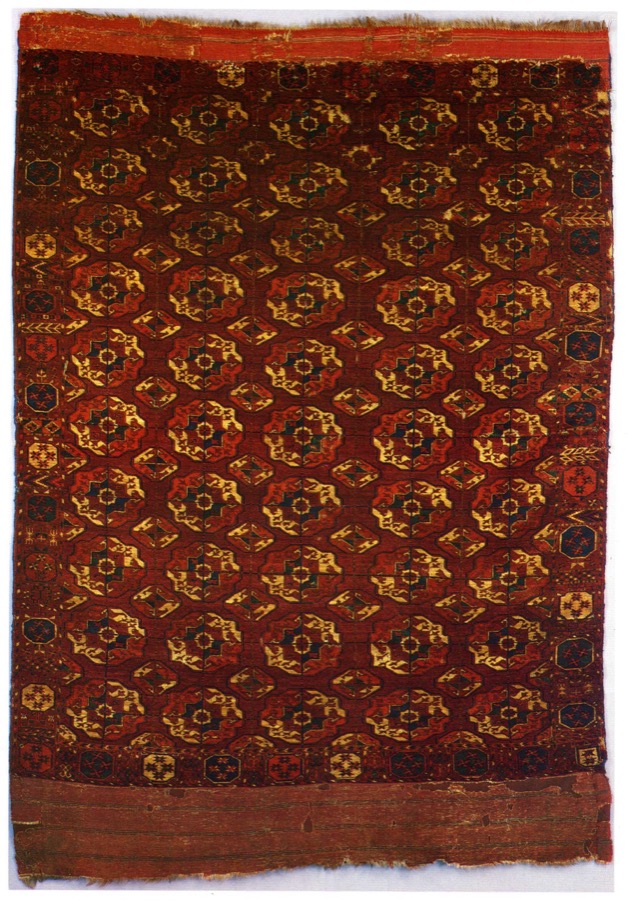
Turkmen: Tekke
Tekke Main Carpet, probably early–mid-19th century. Turkmenistan.
Wool; asymmetrically knotted pile. L. 101 in. (256.5 cm).
Asymmetrically knotted wool. The repeated medallions are the gul; see our Turkmen gul guide.
The Met, 2009.458.13 · Gift from the Collection of Hillary Black Dumas and Dr. D. Gilbert Dumas, 2009 · photo public domain (Met Open Access)
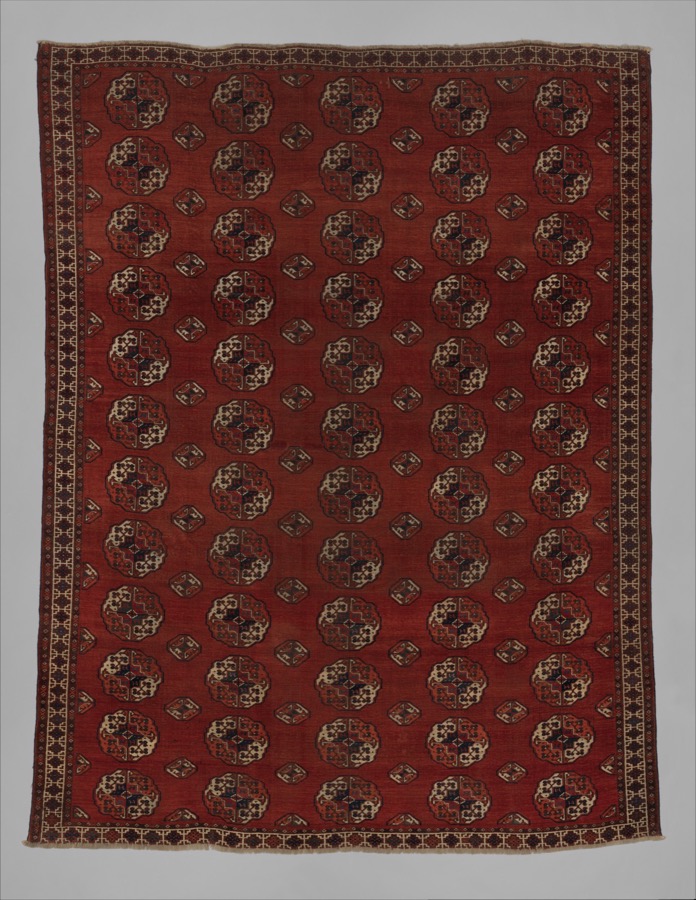
Turkmen: Salor
Salor Main Carpet, late 18th–early 19th century. Southern Turkmenistan.
Wool (warp, weft, and pile), silk; asymmetrically knotted pile. H. 127 1/4 in. (323.2 cm).
Wool with silk accents and asymmetric knots, like the Tekke piece above: the Met records both Turkmen main carpets as asymmetrically knotted.
The Met, 1974.149.46 · Bequest of Joseph V. McMullan, 1973 · photo public domain (Met Open Access)
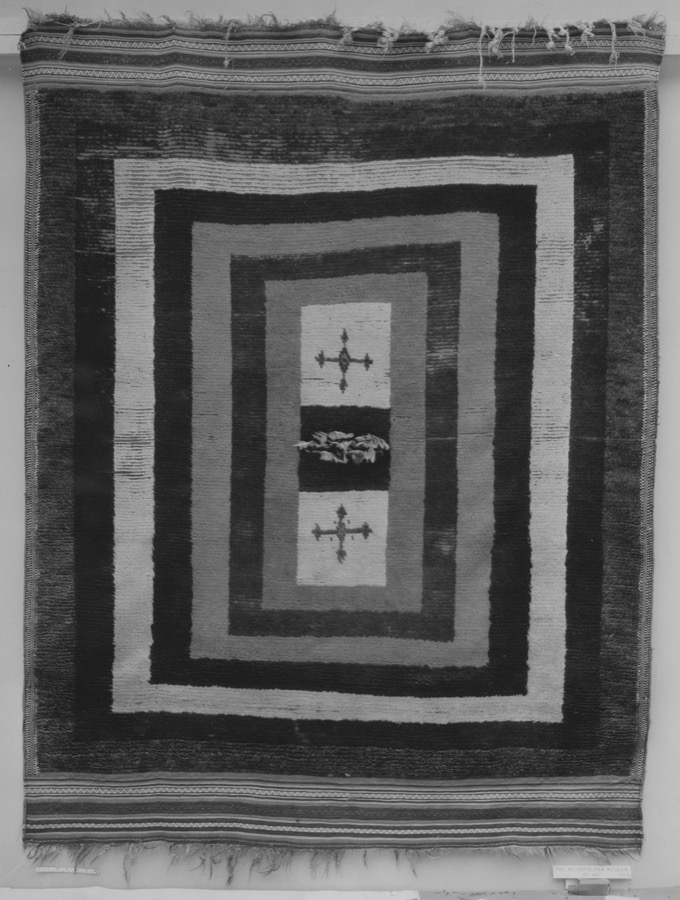
Gabbeh, Western Iran
Gabbeh, late 19th century. Western Iran.
Wool (warp, weft and pile); symmetrically knotted pile. H. 84 in. (213.4 cm).
Symmetric knots, all wool, and a design of plain concentric bands. Archival black-and-white photograph. See our gabbeh guide.
The Met, 22.100.66 · The James F. Ballard Collection, Gift of James F. Ballard, 1922 · photo public domain (Met Open Access)
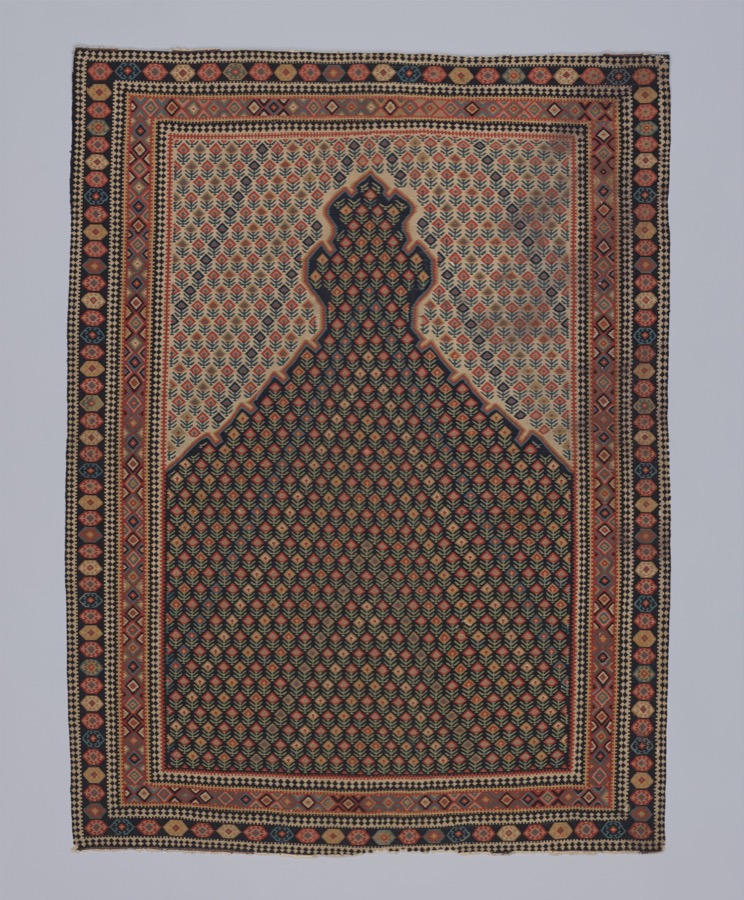
Senneh (Kurdish Iran) flat-weave
"Senneh" Prayer Rug, late 18th–early 19th century. Northwestern Iran.
Cotton (warp), wool (weft); tapestry-woven. L. 64 1/2 in. (163.8 cm).
Tapestry-woven on a cotton warp with wool weft: a kilim, not a pile rug. See what a kilim is.
The Met, 1970.302.8 · Gift of Joseph V. McMullan, 1970 · photo public domain (Met Open Access)
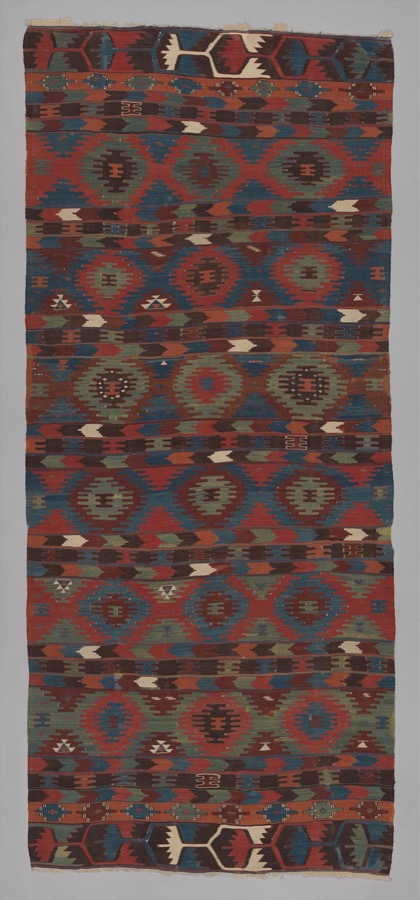
Anatolian kilim
Carpet, first half 19th century. Turkey.
Wool and cotton; tapestry-woven. L. 163 3/4 in. (415.9 cm).
Tapestry-woven wool and cotton: a flat-weave with no pile, from the same country as the knotted Lotto and Bellini rugs above.
The Met, 2000.639 · Gift of Brian and Diane Leyden, 2000 · photo public domain (Met Open Access)
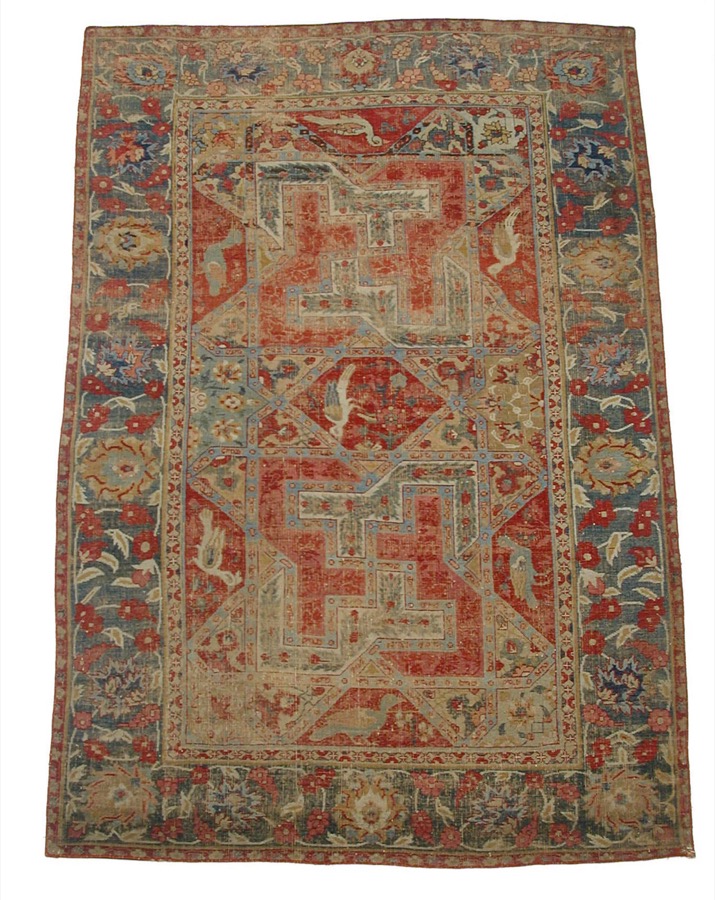
Mughal India
Carpet, 17th century. India.
Cotton (warp and weft), wool (pile); asymmetrically knotted pile. Max. H. 79 in. (200.7 cm).
Cotton foundation, wool pile, asymmetric knots. The essay says Indian carpets are "recognized by their distinctive red hue."
The Met, 22.100.73 · The James F. Ballard Collection, Gift of James F. Ballard, 1922 · photo public domain (Met Open Access)
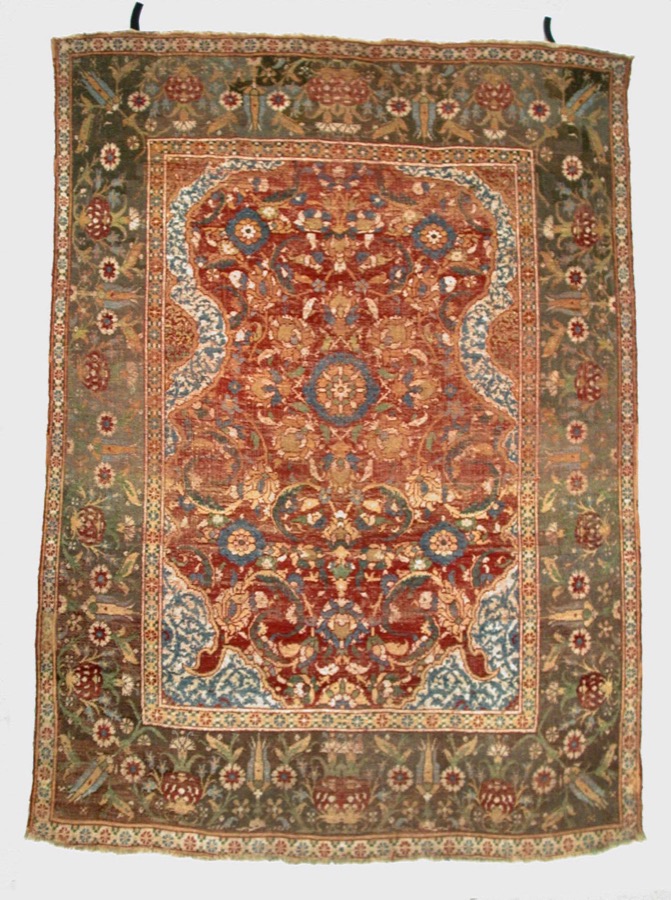
Egypt (Cairo)
Carpet, 17th century. Egypt.
Wool (warp, weft and pile); asymmetrically knotted pile. H. 65 in. (165.1 cm).
All wool, asymmetric knots. The essay: "Egyptian carpets are always fully wool."
The Met, 17.120.137 · Mr. and Mrs. Isaac D. Fletcher Collection, Bequest of Isaac D. Fletcher, 1917 · photo public domain (Met Open Access)
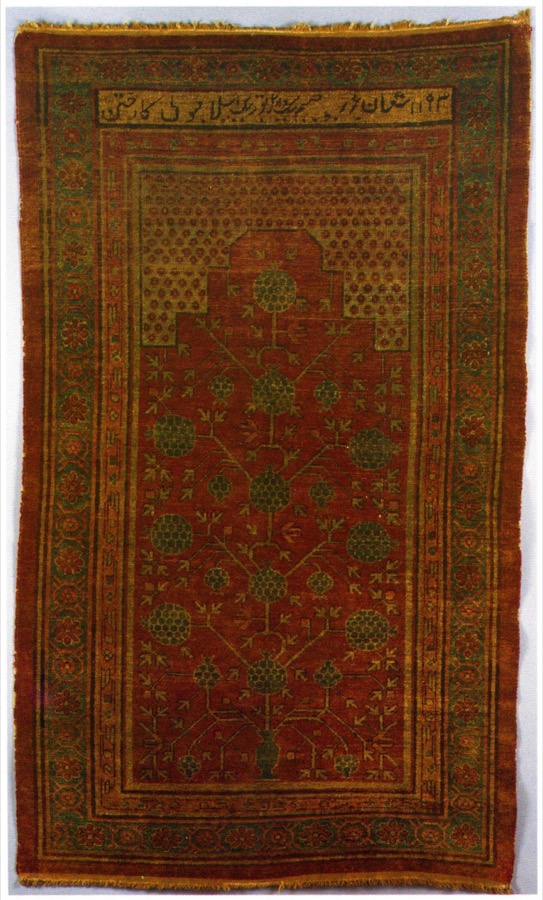
China
Carpet, 1872. China.
Silk; asymmetrically knotted pile. L. 70 in. (177.8 cm).
Silk pile, asymmetric knots, dated 1872.
The Met, 2009.458.19 · Gift from the Collection of Hillary Black Dumas and Dr. D. Gilbert Dumas, 2009 · photo public domain (Met Open Access)
Knot-density converter
Dealers and catalogues quote density either per square inch or per square decimeter (10 × 10 cm). Count knots along one inch horizontally and one inch vertically on the back of the rug, then convert.
One square inch is 6.4516 cm², and a square decimeter is 100 cm², so knots per dm² = knots per in² × 15.5.
The arithmetic: 1 inch = 2.54 cm exactly, so 1 in² = 6.4516 cm², and 100 ÷ 6.4516 = 15.5. A rug counted at 10 knots across and 12 knots down per inch has 120 knots per square inch, or about 1,860 per dm². What density means for a rug's quality and value is a separate question; see does knot density matter?
Card text quotes or summarizes each object's catalogue record on metmuseum.org; photographs are Met Open Access images released into the public domain. The guide is a reading aid, not an identification service: what your own rug is needs an in-person examination.