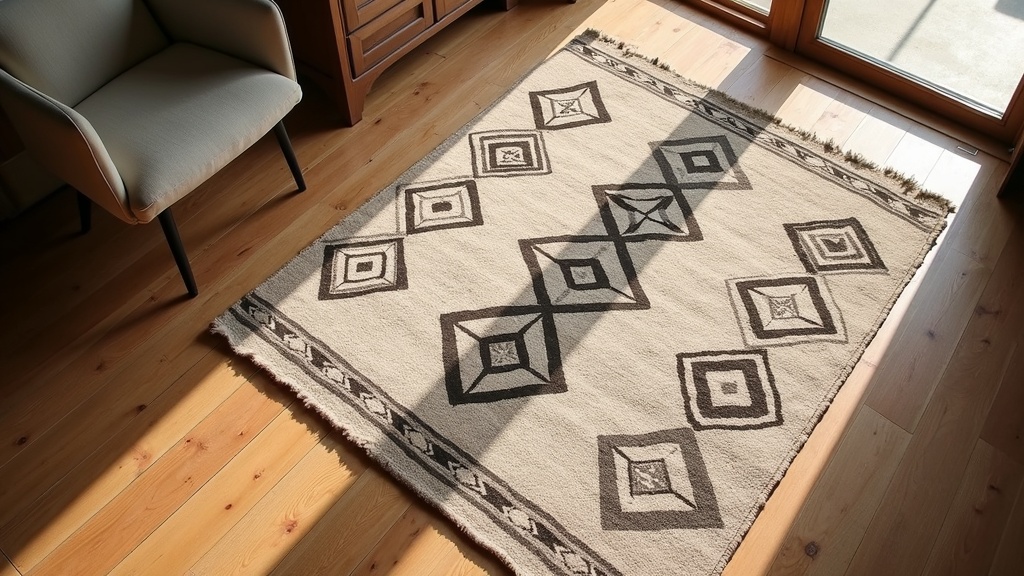
A kilim is a flat-woven rug or textile made by interlacing coloured weft threads directly through a foundation of warp threads, with no pile and no knots at all. The pattern is built entirely from the weave itself, usually in blocks of colour joined by a technique called slit-weave. This is what gives kilims their crisp geometric look, their light weight, and their reversible, nearly identical front and back.
Kilim versus pile rug: the basic difference
Most people picture a “rug” as something with a soft, cushioned surface you can run your fingers through. That’s a pile rug, built by tying thousands of individual knots around the warp and then trimming them to an even height. A kilim skips that step entirely. There is no pile to trim because there is no pile in the first place — the surface you see is simply the weft, packed down tight against the warp. If you’re trying to decide which construction actually suits your room and how you live in it, the comparison at flatweave vs pile rugs goes into the practical trade-offs of comfort, durability and maintenance in more depth than we can here.
How a kilim is actually made
The process starts the same way most handmade textiles do: a loom is strung with warp threads, held under tension either vertically on a frame loom or horizontally pegged to the ground. Warp is almost always a strong, low-stretch fibre — traditionally wool, cotton, or occasionally goat hair — because it has to hold shape under tension for months without give.
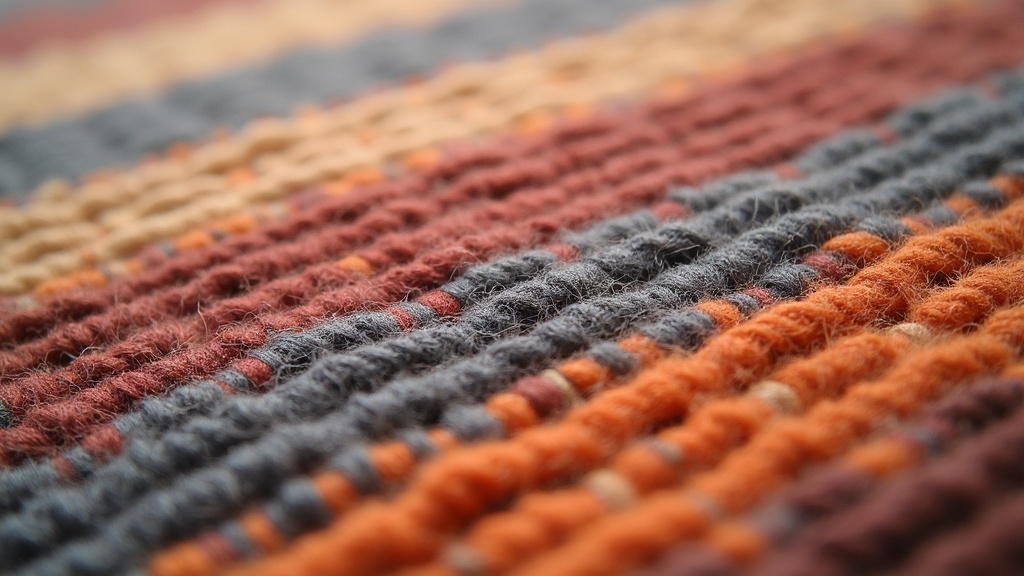
The weaver then works weft threads back and forth through the warp, over one thread and under the next, packing each pass down firmly with a comb-like beater so no warp is visible in the finished cloth. This is what makes a true kilim “weft-faced” — the warp is completely hidden, doing structural work only, while the weft carries all the colour and pattern.
The slit-weave technique
Geometric kilim patterns are built by weaving separate blocks of colour side by side rather than carrying one weft thread all the way across the rug. Where two colour blocks meet, the weaver simply turns the weft back around its own warp thread instead of interlocking with the neighbouring colour. This leaves a small vertical gap, or slit, along every colour boundary — hence “slit-weave.” It’s an efficient way to get sharp, clean edges between colours, though it does mean long straight vertical seams can be a structural weak point if the rug is pulled hard or stepped on unevenly for decades. Some regional traditions solve this by interlocking or dovetailing adjacent wefts instead, trading a little pattern crispness for extra strength.
Dyeing the wool
Traditional kilims use wool dyed before weaving, historically with plant and insect sources such as madder root for reds, indigo for blues, and various barks, leaves and pomegranate rind for yellows and browns. Natural dyes age unevenly and often mellow attractively over decades, which is one reason older kilims can develop a soft, weathered palette that’s hard to reproduce deliberately. Modern kilims may use synthetic dyes instead, which tend to be more colourfast and consistent but don’t always age the same way. Neither is automatically “better” — it’s a different look and a different ageing story, and it’s one of the details covered in the weaving traditions collected under weaving techniques.
Because kilim weaving and pile-rug knotting are both rooted in the same regional textile traditions, if you’re curious how kilim-producing regions relate to the knotted rugs more commonly discussed as Persian or Turkish, the overview at Turkish vs Persian rugs is a useful next stop, and the wider rug craft hub ties the weaving, regional and authentication threads together in one place.
What a finished kilim looks and feels like
A genuine flat-woven kilim is thin, light, and drapes almost like heavy fabric rather than sitting rigid like a pile rug. Run a hand over it and you feel the ridged texture of packed weft rows rather than cut fibre ends. Hold it up to light and you may be able to see faint slit lines tracing the pattern’s colour boundaries — a good visual cue that you’re looking at true slit-weave construction rather than a printed or machine-woven flatweave imitation. Machine-made “kilim style” rugs exist too, usually produced on power looms with synthetic yarns; they can look convincing from a few feet away but typically show a uniform, mechanical repeat and a back that’s noticeably different from the front, unlike a handwoven piece where both sides are nearly identical.
Caring for a kilim without damaging it
Because kilims have no pile, some of the risks that apply to knotted wool rugs don’t apply here, but plenty still do — and the flat, tightly packed weave can actually hide grit deeper than it looks. Regular light vacuuming with the beater bar switched off or a suction-only attachment is the safest routine care; a spinning beater bar can snag and fray the flat weave and any fringe far more easily than it would with a cushioned pile.
For spills on a wool kilim, blot immediately with a clean, dry cloth rather than rubbing, then use a small amount of cool water with a wool-safe, pH-neutral detergent on the affected area only, working from the outside of the stain inward. Never use hot water or an alkaline household cleaner on wool — heat and high pH cause wool fibres to felt, shrink and yellow, and that change cannot be reversed. Chlorine bleach and ammonia-based cleaners should be kept away from wool and especially any silk-blend kilim entirely; bleach breaks down the protein structure of both fibres, and mixing bleach with other household cleaners can also produce dangerous fumes, so never combine cleaning chemicals in the first place. If the kilim uses natural dyes or you’re not certain how colourfast it is, test any solution on a hidden corner first and watch for bleeding before treating a visible area — natural and some early synthetic dyes are notorious for migrating when wet.
Steam cleaning and machine washing are both risky for the same underlying reason: saturating the fibres can shrink the foundation unevenly and leave the rug permanently buckled or wavy, since a flatweave has less structural forgiveness than a thick knotted pile. If a kilim is antique, hand-dyed with natural colourants, silk, or simply valuable to you, the safer move is a professional rug cleaner or textile conservator rather than a DIY attempt — the general principles and where the real risks sit are laid out further at the rug care hub and in the category archive on cleaning and stains.
Age, origin and value: what to look for, not what to assume
Because a kilim carries no knots, some of the usual authentication clues used on pile rugs don’t apply directly, but appraisers still look at a comparable set of signals: the fibre and spin of the warp versus the weft, whether the dyes show the gradual, uneven mellowing typical of natural dyestuffs or the flatter consistency of synthetic dye, the tightness and regularity of the weft packing, and how the selvedges and end finishes were completed by hand. Wear patterns matter too — genuine age usually shows as gradual, uneven thinning consistent with foot traffic, not a uniform faded look across the whole piece. None of this can be reliably judged from a photo or a general description, and this article can’t tell you what a specific kilim is, where it was woven, or what it’s worth — that call belongs to a qualified appraiser or conservator who can examine the actual textile in hand. For a broader look at how these factors combine into an actual valuation, see what determines the value of an antique rug, and for spotting hand-work versus machine production more generally, how to tell if a rug is handmade or machine-made walks through the tells in more detail.
On price, it helps to think in ranges rather than expect a single number: a small machine-made kilim-style accent rug might sit in the low tens of dollars up to around a hundred, while a handwoven wool kilim of modest size could run from roughly one to several hundred dollars depending on age, dye type and condition — these are illustrative examples only, not current market figures, and actual value depends entirely on the specific piece.
Frequently asked questions about kilims
Is a kilim the same thing as a rug?
A kilim is a type of rug — specifically a flat-woven one made without pile or knots — so all kilims are rugs, but not all rugs are kilims. Pile rugs, hooked rugs and needlepoint rugs are all different constructions entirely.
Can you use a kilim as a wall hanging?
Yes, kilims are commonly displayed on walls because they’re lightweight, reversible, and their geometric patterns read well vertically; use a fabric-lined hanging sleeve rather than nails or adhesive so weight is distributed evenly and the weave isn’t stressed at single points.
Why does my kilim have small holes or slits in the pattern lines?
Small vertical gaps along colour boundaries are usually the slits from slit-weave construction, not damage — they’re a normal feature of the technique. If a gap runs unusually long or the surrounding weave feels loose, that may be actual wear worth having a professional assess.
Are kilims durable enough for high-traffic areas?
A well-made wool kilim can hold up reasonably well underfoot because the weave is dense, but the flat surface shows soiling and flattening differently than pile rugs and lacks a pile layer to cushion wear, so a rug pad and regular light vacuuming matter more than usual.
How do I know if my kilim is handmade or machine-made?
Check the back: a handwoven kilim looks almost identical front and back with visible slit lines, while a machine-made version often has a distinctly different backing, a mechanical, perfectly regular pattern repeat, and uniform synthetic yarn with no natural irregularity.
Rug Academy publishes general information about rugs and is not a dealer, appraiser, or cleaning service. Cleaning and repair methods depend entirely on fibre, dye and construction — test any treatment on a hidden corner first, and consult a professional rug cleaner or conservator before treating a hand-knotted, antique, silk, or valuable rug, as damage from cleaning is usually permanent. Any prices mentioned are illustrative examples only, and nothing here is an appraisal, an authentication, or a guarantee of a rug’s origin or value.