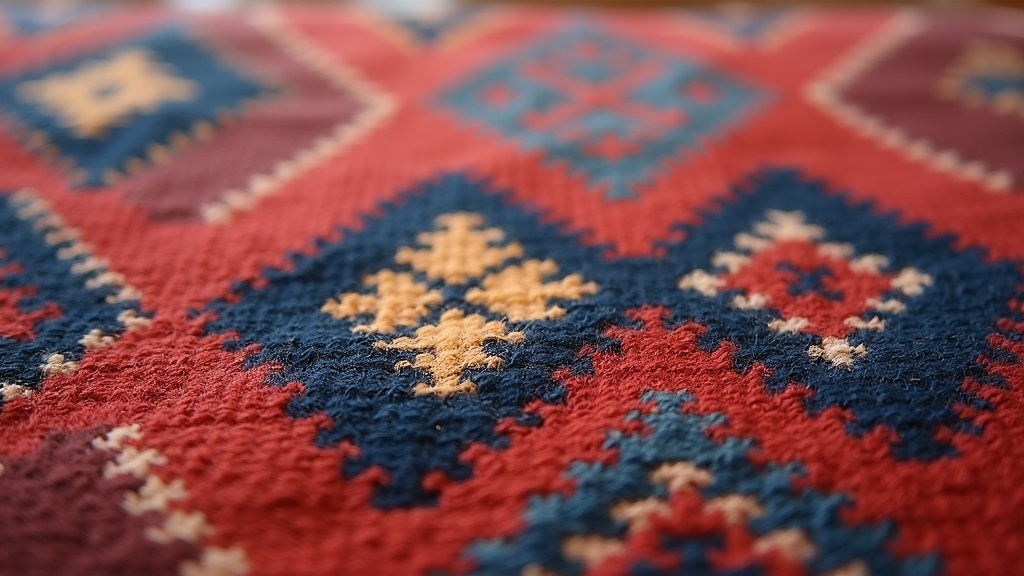
A soumak weave is a flat, pileless textile structure made by wrapping colored weft yarns around the warp in a diagonal, chaining pattern, rather than tying knots or passing weft simply over and under. The result is a thick, ridged, herringbone-like surface with no cut pile, and no loops on the front face at all — the extra threads run along the back, giving soumak weaves a heavier hand than a plain kilim. It’s a structure, not a place or a single style, and you’ll find it under rugs, bags, and trappings from the Caucasus to Central Asia.
How soumak differs from other flatweaves
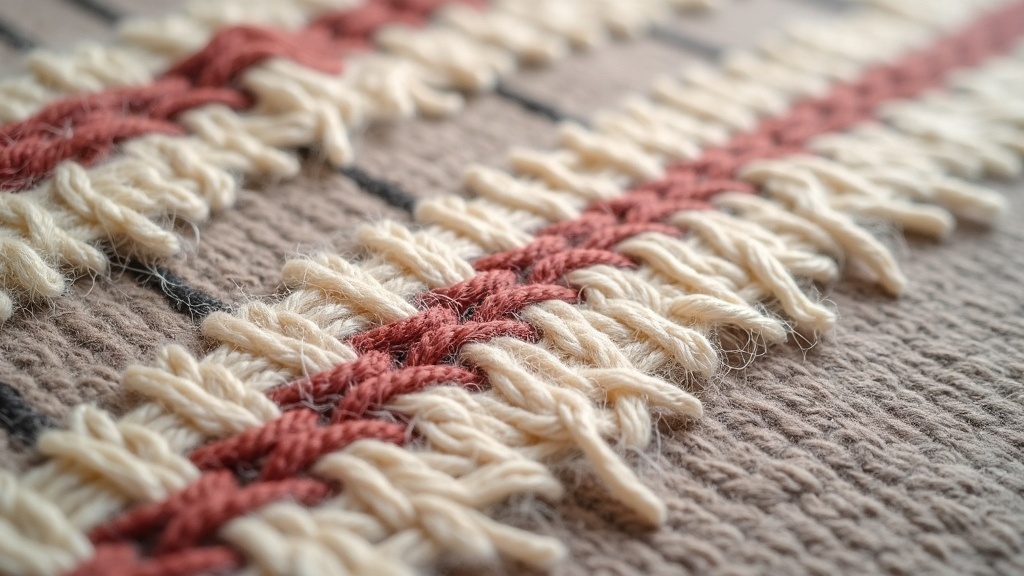
All flatweaves share one trait: there’s no pile to grab and no knots to count, because the pattern is built entirely by the weft threads interlacing with the warp. But the interlacing method varies a lot, and that variation is what separates a soumak from a kilim or a plain tapestry weave. In a kilim, the colored wefts pass over and under the warp in a simple over-one, under-one (or similar) rhythm, and where two colors meet, weavers either leave a small slit or interlock the threads — the technique covered in our explainer on how a kilim is made. In soumak, the weft doesn’t just pass through; it wraps around groups of warp threads in a repeating diagonal stitch, usually skipping back over a few threads before moving forward again. That wrapping is what produces the raised, braided-looking surface.
Because the wrapping threads sit proud of the foundation, a soumak-woven piece is noticeably thicker and stiffer than a plain kilim of similar size, and the back typically shows long floating threads rather than a flat mirror image of the front. If you’re trying to place soumak in the broader family of rug construction, flatweave vs pile rugs is a useful starting point, and warp, weft and pile explained in full will help the vocabulary make sense before you go further.
Where soumak weaving is traditionally found
Soumak technique shows up across a wide weaving belt — the Caucasus, parts of Persia, Anatolia, and Central Asia among them — most often in flat bags, storage sacks, tent bands, and area rugs rather than large-format carpets, since the thick, weft-heavy structure makes big pieces genuinely heavy to weave and to handle. Caucasian weaving in particular is closely associated with bold, angular soumak patterning; if that region interests you, our piece on Caucasian rugs and their geometry covers the visual vocabulary in more depth. It’s worth being cautious about attaching a soumak weave to a specific village or century just from photographs, though — construction technique alone tells you how a piece was made, not reliably where or when, and the two questions get conflated more often than they should.
What an appraiser actually looks at
If you’re trying to understand what you own, or what you’re being asked to pay for, the honest answer is that construction details are a starting point for research, not a verdict you can reach from a photo or a gut feeling. A qualified appraiser examining a soumak piece will typically look at:
- The wrapping direction and count — how many warp threads each stitch crosses, and whether that count is consistent across the piece, which speaks to hand skill and regularity.
- Foundation material — wool, cotton, or occasionally goat hair warps behave and age differently, and foundation fiber is one of the clues used in dating and origin work.
- Dye characteristics — whether colors show the subtle variation (abrash) typical of small-batch natural dyeing, or the flat uniformity of synthetic dye lots. Our guide to natural vs synthetic dyes walks through what to look for.
- Wear pattern and handling — flatweaves wear differently from pile rugs, and even, gradual wear across a piece reads differently than damage concentrated at fold lines or edges.
- Selvedge and edge finishing — how the outer warp threads are wrapped or reinforced, which varies by weaving tradition and can be a tell for machine reproduction when it’s too uniform or too clean.
None of these signs is conclusive on its own, and combinations of them can point in different directions depending on the piece. If money is actually at stake — buying, selling, insuring, or settling an estate — an in-person appraisal from a qualified textile appraiser is the only reliable way to answer questions about origin, age, or value. Broader background on how these factors interact is in our rug craft hub and in the value and authentication archive.
Living with and caring for a soumak weave
Soumak pieces are usually wool on wool or wool on cotton, and that combination has real, specific care implications. Because there’s no pile to cushion foot traffic, soumak rugs tend to show soiling on the surface rather than deep in a pile bed, which sounds like an advantage but also means dirt and grit can abrade the flat weave structure directly if it isn’t managed.
For routine care, vacuum a soumak flatweave regularly using suction only, with the beater bar switched off or a bare-floor attachment — a rotating beater bar can catch and pull the wrapped weft threads and fray the surface, and it’s especially hard on any fringe or tasseled ends. Our guide to vacuuming a rug correctly around beater bars and fringe goes through the settings that matter.
If a contemporary, colorfast wool soumak needs spot cleaning, the safe approach is to blot (never rub) with cool water and a small amount of wool-safe detergent, working from the outside of the spill inward, then blot dry with a clean towel and let it air dry fully before walking on it again. That’s appropriate for a modern wool flatweave of known, stable dyes. It is not appropriate for a piece that’s antique, hand-knotted alongside its soumak sections, silk, or of uncertain age and dye stability — in those cases, natural or early synthetic dyes can bleed and migrate the moment they get wet, and the safest move is to stop and call a professional rug cleaner or conservator rather than test your luck. Always test any cleaning product on a hidden corner first and watch for color transfer onto your cloth before treating a visible area.
Avoid chlorine bleach entirely — it breaks down wool protein fiber and will damage silk on contact. Avoid hot water and high-pH or alkaline cleaners too, since heat and alkalinity are what cause wool to felt, shrink, and yellow, and a flatweave with no pile to disguise shrinkage will show buckling or size distortion clearly. Never mix cleaning chemicals together, and be wary of reaching for ammonia-based glass cleaners or all-purpose sprays on a stain — combining products, or using the wrong one on wool, is a common way a stain becomes permanent damage instead of a temporary mishap. Steam cleaning and machine washing are both risky for the same underlying reason: saturating the foundation can shrink it unevenly and leave a rug that no longer lies flat, a problem covered in more detail in when steam cleaning helps or ruins a rug and rug buckling and rippling causes and fixes. For anything hand-knotted, antique, silk, or simply valuable to you, professional cleaning is the safer default rather than a last resort.
Frequently asked questions about soumak weave
Is a soumak rug the same as a kilim?
No. Both are flatweaves with no pile, but a kilim’s pattern comes from simple over-under weft passes, while soumak weft wraps diagonally around the warp in a chaining stitch, giving it a thicker, more textured, braided-looking surface than a typical kilim.
Are soumak rugs durable?
Wool soumak flatweaves are generally sturdy and can hold up well underfoot for years, since the tight wrapping structure resists crushing. Longevity still depends heavily on foundation fiber, weave density, and how the rug is cleaned and stored over time.
Can you clean a soumak rug at home?
Light surface care and gentle blotting with cool water and wool-safe detergent can be reasonable for a contemporary, colorfast wool soumak. Antique, silk, or dye-uncertain pieces should go to a professional cleaner, since bleeding dyes and foundation shrinkage are usually irreversible.
What is a soumak rug worth?
Value depends on age, dye type, weaving region, condition, and rarity, none of which can be judged from a description alone. A qualified in-person appraisal is the only reliable way to establish value; illustrative price ranges online are not a substitute for that.
Do soumak rugs have fringe?
Many do, formed from the warp ends left over once weaving stops, similar to other flatwoven and pile rugs. Fringe condition and finishing style are among the details appraisers look at, and frayed fringe is generally repairable rather than something that ruins the piece.
Rug Academy publishes general information about rugs and is not a dealer, appraiser, or cleaning service. Cleaning and repair methods depend entirely on fibre, dye and construction — test any treatment on a hidden corner first, and consult a professional rug cleaner or conservator before treating a hand-knotted, antique, silk, or valuable rug, as damage from cleaning is usually permanent. Any prices mentioned are illustrative examples only, and nothing here is an appraisal, an authentication, or a guarantee of a rug’s origin or value.