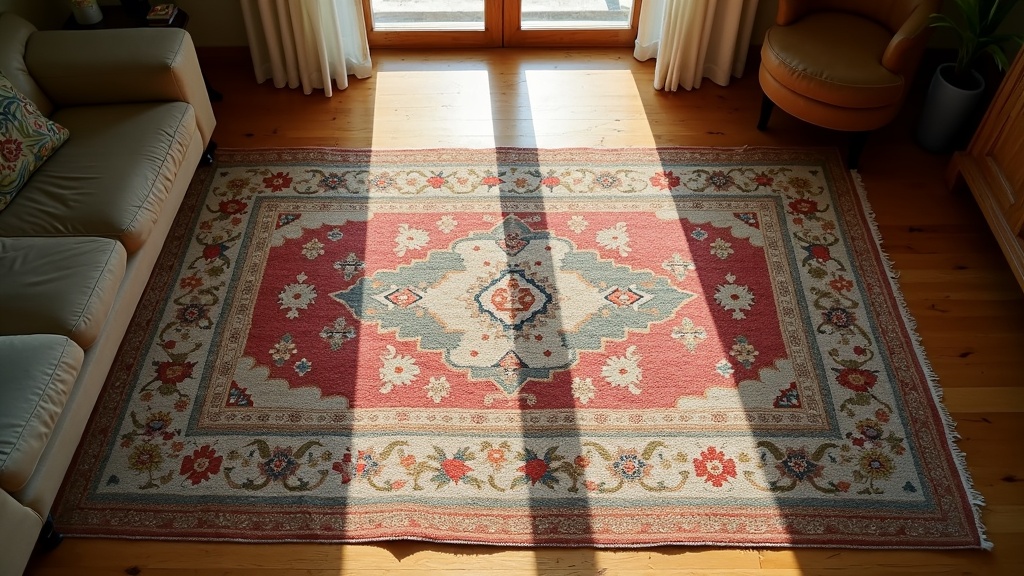
Medallions, boteh and Herati are three of the most common design families found on hand-knotted rugs, and each has a recognizable structure: a medallion is a central emblem (often diamond, star, or round) anchoring the field; boteh is the teardrop shape familiar from paisley shawls; and Herati is a small repeating unit of a rosette surrounded by curved “fish” or leaf forms, usually filling the whole field in a grid. Knowing these three shapes will let you read the layout of most traditional rugs at a glance, though the specific motif alone cannot tell you where a rug was made or how old it is — that takes closer physical examination.
What a medallion actually is
A medallion is a dominant shape, usually placed at the center of the field, that organizes the rest of the design around it. Medallions can be a single lozenge, a stacked pair with pendant points at top and bottom, or a cluster of smaller medallions marching down the length of a runner. They are frequently echoed by quarter-medallions tucked into the four corners of the field, a mirroring device that helps the eye read the whole composition as balanced even though the rug itself is a flat rectangle.
Medallion layouts are strongly associated with Persian workshop production — Tabriz, Kashan, and Isfahan pieces often use this format — but medallion designs have been copied, adapted, and mass-produced for well over a century, including on machine-made rugs sold in department stores. A medallion tells you about layout convention, not manufacture. For that distinction you need to look at the back of the rug and the structure of the knots, which is covered in more detail on our rug buying guides hub and in our piece on telling a handmade rug from a machine-made one.
Reading a medallion rug’s balance
Look at how the medallion relates to the border and the corner ornaments. Hand-drawn medallions from weaving villages tend to show small asymmetries — a petal slightly different from its mirror twin, a pendant that doesn’t quite match top to bottom — because the weaver worked from memory or a partial cartoon rather than a mechanically repeated template. Machine-woven versions are typically flawless in their symmetry, which is a clue worth noting even though it’s not proof on its own.
Boteh: the shape behind paisley
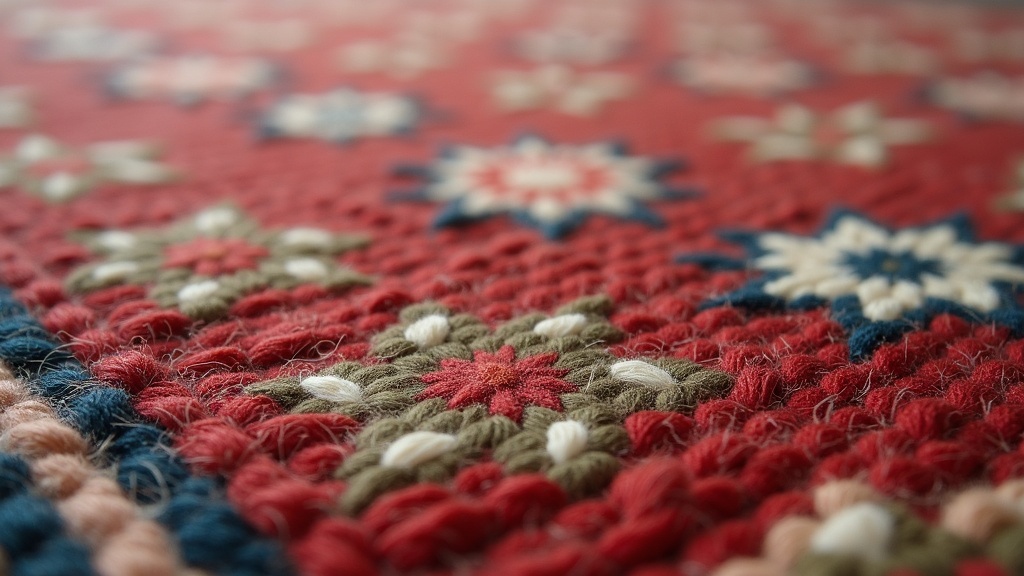
Boteh is a curved teardrop or cone shape, often with a hooked or curled tip, arranged in rows across the field. It is the same family of motif that became known in the West as “paisley,” after the Scottish town where woven imitations of Kashmir shawl patterns were produced in the nineteenth century. On rugs, boteh appears at wildly different scales — sometimes tiny and packed densely, sometimes large enough to be a field-filling statement on its own — and its origins are debated among textile historians, with proposed readings ranging from a floral spray to a bent cypress tree to a stylized almond or pinecone.
Boteh shows up across an enormous geographic range, from Persian workshop rugs to tribal weavings, which makes it one of the least reliable motifs for narrowing down origin by itself. What is more useful is how the boteh is drawn — angular and geometric versus soft and curvilinear — because that drawing style tracks more closely with weaving tradition and loom type than the motif’s mere presence does. Our overview of Persian rug regions and our piece on Caucasian geometric design both give useful contrast points for angular versus curved motif drawing.
Herati: the all-over grid
The Herati pattern (sometimes called the “fish” pattern, mahi) is built from a small repeating unit: a central rosette or flowerhead surrounded by four curling leaf shapes that read, to many eyes, like fish swimming around a pond. This unit is repeated in a grid across the entire field, sometimes with a medallion superimposed over it and sometimes filling the field on its own without a medallion at all. Herati is named for the city of Herat, in what is now Afghanistan, though the pattern spread widely beyond that region and is now woven across Iran, the Caucasus, and Pakistan in many size variations.
Because Herati is a repeat-unit pattern, it’s a good one for practicing pattern literacy: try tracing a single rosette-and-leaves unit and following it across the rug to see how consistently it repeats. Hand-drawn versions drift slightly in spacing and proportion row to row; a rug with mathematically identical, perfectly regular repeats over a large field is worth a second look at its construction, which is a topic we cover in our guide to knot density and what it actually tells you.
Why motif alone doesn’t identify a rug
It’s tempting to treat a motif like a fingerprint — “this has Herati, so it must be from X” — but pattern names travel far more freely than weaving traditions do. Cartoons (the paper or graphed patterns weavers work from) get copied, sold, and adapted across regions and eras, and commercial rug-making has reproduced popular motifs like medallions and boteh on machine looms for well over a hundred years. An appraiser or conservator identifying a rug’s likely origin and age looks at several things together, not the motif in isolation:
- Knot type and density — the structure of individual knots and how many appear per square inch, discussed further in our piece on knot count myths.
- Foundation material — whether the warp and weft are wool, cotton, or silk, which affects both weight and drape.
- Dye characteristics — whether colors are natural or synthetic and how they’ve aged, covered in our guide to spotting natural versus synthetic dyes.
- Wear patterns — how the pile has worn down, and whether that wear is consistent with age and foot traffic or looks artificially induced.
- Selvedge and fringe finishing — how the edges and ends were finished, since machine-made rugs often have fringe sewn on separately rather than being a continuation of the warp.
Common signs that a rug is machine-made rather than hand-knotted include a uniform, glued-on fringe, a perfectly even back with no irregularities, and a printed or synthetic-backed foundation. None of these signs are motif-dependent — a machine-made rug can carry a Herati or boteh pattern just as readily as a hand-knotted one. For a fuller walk-through of these signals, see our guide on hand-knotted versus hand-tufted construction and the broader rug craft hub, which covers weaving techniques and regional traditions in depth.
Caring for a patterned rug without disturbing the design
Motif and color are exactly what’s at risk when a rug is cleaned incorrectly, because most damage shows up first in the pattern — bleeding dye blurring a rosette’s edge, or a felted patch flattening a medallion’s outline. A few fibre-specific points matter regardless of which motif your rug carries:
- For a wool rug, routine care is a gentle vacuum without a beater bar (which can pull and fray pile and fringe — see our guide to vacuuming without damaging fringe) and, for light surface dirt, blotting with cool water and a wool-safe detergent rather than scrubbing. Hot water and high-pH cleaners can felt, shrink, or yellow wool, so avoid them.
- For a silk rug or a piece with silk highlights in the motif (common in fine medallion or boteh work), water and most detergents can cause irreversible damage; these pieces should generally go to a professional rather than being treated at home, a point we expand on in our silk rug guide.
- Never reach for chlorine bleach on wool or silk — it destroys both fibres — and never mix cleaning chemicals or combine bleach with ammonia-based products; the fumes and fibre damage are not worth the risk.
- Always test any treatment on a small hidden corner first, and if the rug is hand-knotted, antique, silk, or of uncertain construction, consult a professional rug cleaner or conservator before doing anything beyond dry vacuuming. Our rug care hub and the cleaning and stains archive go deeper into fibre-safe methods.
Frequently asked questions about rug motifs
What does the Herati pattern mean?
Herati typically refers to a small repeating unit of a central rosette surrounded by curling leaf or “fish” shapes, filling the field in a grid. Its name comes from the city of Herat, though the pattern is now woven far beyond that original region.
Is boteh the same as paisley?
Boteh is the traditional teardrop or cone-shaped motif from which the Western “paisley” pattern derives its name, after imitations woven in Paisley, Scotland. The shapes are visually related, though boteh appears in far more variations across rug-weaving traditions than commercial paisley fabric typically shows.
Does a medallion pattern mean a rug is Persian?
Medallion layouts are strongly associated with Persian workshop rugs, but the format has been widely copied on machine-made rugs and by weavers in many other regions, so a medallion alone does not confirm Persian origin — construction details matter more.
Can I tell how old my rug is from its motif?
Not reliably. Motifs and cartoons get copied across regions and decades, so age is better judged from knot structure, foundation material, dye aging, and wear patterns, ideally assessed in person by a qualified appraiser rather than from the pattern alone.
How do I clean a rug with a detailed medallion or Herati pattern without damaging the colors?
For wool, blot gently with cool water and a wool-safe detergent after testing on a hidden corner; avoid hot water, high-pH cleaners, and bleach. For silk or unknown-construction rugs, avoid home treatment and consult a professional, since dye bleeding and fibre damage from cleaning are usually permanent.
Rug Academy publishes general information about rugs and is not a dealer, appraiser, or cleaning service. Cleaning and repair methods depend entirely on fibre, dye and construction — test any treatment on a hidden corner first, and consult a professional rug cleaner or conservator before treating a hand-knotted, antique, silk, or valuable rug, as damage from cleaning is usually permanent. Any prices mentioned are illustrative examples only, and nothing here is an appraisal, an authentication, or a guarantee of a rug’s origin or value.