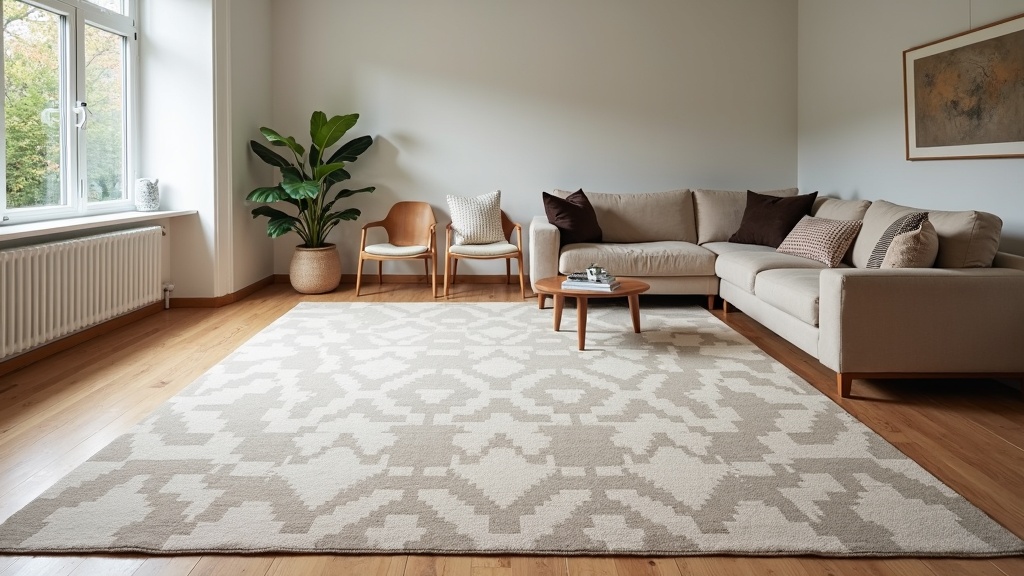
An awkwardly shaped room rarely needs an awkwardly shaped rug. The usual fix is to treat the rug as a tool for defining a rectangle of usable floor around your furniture, rather than trying to mirror the room’s odd angles, alcoves, or bump-outs. In most cases a standard rectangular or round rug, sized to the seating or activity area rather than the walls, will look calmer and function better than a custom-cut shape. There are exceptions worth knowing, though, and they usually come down to how the room is actually used.
Why the room’s shape matters less than you think
Most rooms that feel “awkward” — an L-shaped living-dining combination, a bedroom with a chimney breast eating into one corner, an attic room with sloped walls — are awkward because of walls, not because of furniture. Furniture still sits in rectangles: a sofa and two chairs face a coffee table; a bed sits against one wall with matching bedside tables. A rug’s job is to anchor that seating or sleeping arrangement, not to fill every square foot of odd-shaped floor. This is really the same principle covered in more general terms on Does a Rug Have to Match the Room Shape? — the short version is that it doesn’t, and trying to make it match usually creates more visual confusion than it solves.
Once you stop trying to fill the whole footprint, the awkward parts of the room — the angled wall, the nook, the jog where a hallway opens into a living area — become background. They stay visible, but the rug gives the eye a clear, regular shape to rest on in the middle of the room.
Working through the common awkward shapes
L-shaped or open-plan rooms
When a living area bleeds into a dining or kitchen space, the temptation is to buy one enormous rug that follows the whole footprint. It’s usually better to use one rug (or two, clearly separated) to define each zone — seating gets its own rug, the dining table gets its own, sized so all four (or six) chair legs stay on it even when pulled out. The reasoning behind sizing for open-plan zones specifically is laid out in How to Choose a Rug Size for an Open-Plan Space, and if you want two rugs to sit near each other without competing, Layering Rugs: Sizes and Proportions That Work covers how to keep the proportions and colours from fighting.
Angled walls, dormers, and bay windows
Sloped ceilings and bay windows are common in converted attics and older houses, and they create wall lines that no rectangular rug will ever follow exactly. That’s fine — let the rug run under the furniture and stop short of the angled section, leaving exposed floor in the awkward wedge. A rug that tries to hug a bay window’s curve usually has to be custom-made, costs considerably more, and locks you into that one floor plan permanently if you ever rearrange the furniture.
Narrow rooms and pinch points
Long, narrow rooms — a shotgun-style living room, a hallway that opens awkwardly into a lounge — often do better with a runner rather than a single large rug, or with a runner used to visually widen the pinch point before it opens into the main space. Sizing runners correctly so they don’t look like an afterthought is covered in Runner Rug Sizes and Hallway Proportions.
Rooms with multiple doorways or traffic paths
If two or three doorways feed into one room, a rug placed without thinking about walking paths becomes something everyone has to step around or over, which wears the edges unevenly and looks unintentional. Sketch the room’s traffic lines before you buy — the goal is a rug boundary that traffic crosses at right angles or not at all, not one that clips a corner every time someone walks through.
| Room challenge | What usually works better | What to avoid |
|---|---|---|
| L-shaped open-plan | Separate rugs per zone (seating, dining) | One giant rug following the whole footprint |
| Angled or sloped wall | Rectangular rug under furniture, floor exposed near the angle | Custom-cut rug matching the slope exactly |
| Narrow, long room | Runner, or runner plus area rug where it widens | Undersized square rug floating in the middle |
| Multiple doorways | Rug boundary aligned with traffic paths | Rug edge that traffic clips repeatedly |
| Small alcove or nook | Its own small rug, separate from the main rug | Trying to extend the main rug into the nook |
When a custom shape actually makes sense
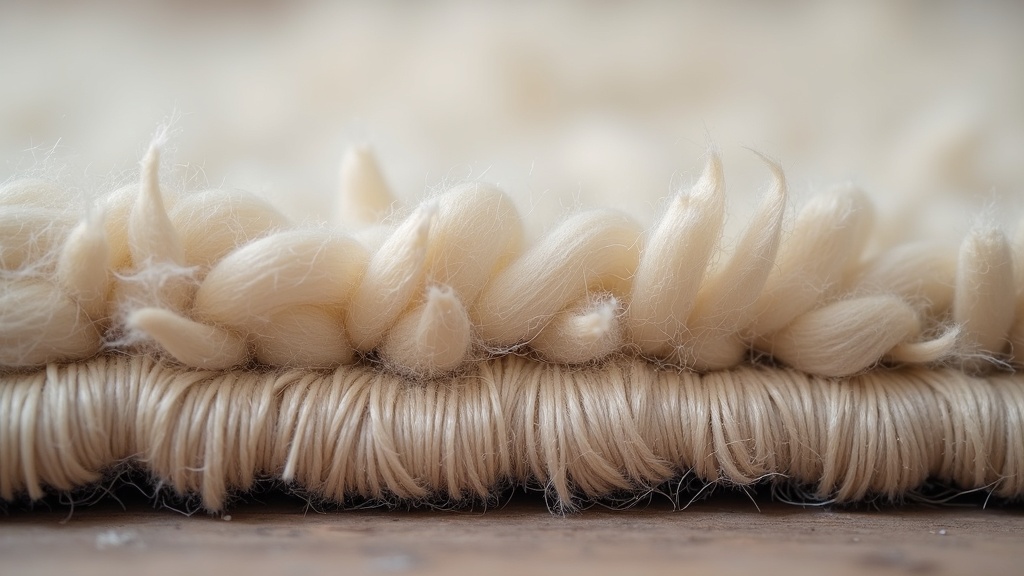
Custom-cut and made-to-measure rugs exist for good reasons — a stair landing, a curved reading nook, a room where the furniture genuinely follows the wall angle. If you go this route, ask what the rug is made from before you ask about the cut: a tufted or flatwoven construction can usually be trimmed and bound along a custom edge without much drama, but a hand-knotted rug is a different matter, since cutting into it disturbs the foundation and the finished selvedge that keeps the edge from unravelling. Background on how that edge finishing works, and why it matters, is covered in the broader rug buying guides hub, along with sizing and placement basics for more regular rooms.
Custom work also costs more than an off-the-shelf size in the same material — a made-to-order wool rug cut to an odd shape might run well above a comparable rectangular rug in the low hundreds for materials of similar quality, but the actual number depends enormously on fibre, construction, and the workroom doing the cutting, so treat any figure you’re quoted as specific to that order rather than a going rate.
Materials worth considering for irregular layouts
Because awkward rooms often mean multiple smaller rugs rather than one large one, it’s worth thinking about whether all the rugs in view need to match in fibre as well as colour. A wool rug in the main seating area and a flatwoven cotton or jute runner in an adjoining nook can coexist visually if the palette is coordinated, even though they’re different constructions — jute and sisal in particular have their own durability trade-offs worth knowing before you commit one to a busy through-path. Whatever you choose, a good rug pad cut to the rug’s actual footprint (not the room’s) will keep smaller rugs from sliding on hard floors, which matters more in rooms with awkward traffic patterns than in a simple rectangular living room; the differences between pad types by floor surface are covered in Rug Pads by Floor Type: Hardwood, Tile and Carpet.
If any of the rugs you’re placing are older, hand-knotted, or of uncertain origin, resist the urge to trim, bind, or otherwise alter them to fit an odd space yourself. That kind of alteration affects both the rug’s structural integrity and, if it turns out to be a genuinely old or valuable piece, its value — a question best settled by a qualified appraiser before, not after, you reach for scissors.
Frequently asked questions about choosing a rug for an awkward room
Should a rug follow the shape of an oddly shaped room?
Generally no. Rugs work best when sized to the furniture grouping — a seating area, a dining table, a bed — rather than to the room’s outline. Letting the rug define a clean rectangle in the middle of the space usually looks calmer than trying to match every angle or alcove in the walls.
Can I use two rugs in one oddly shaped room?
Yes, and it’s often the better option in L-shaped or open-plan spaces. Use one rug per distinct zone — seating, dining, a reading nook — and keep the colours or patterns coordinated so the two pieces feel intentional rather than mismatched leftovers.
Is a custom-shaped rug worth the extra cost?
It depends on the room and the rug’s construction. Flatwoven or tufted rugs can usually be cut and bound to an odd shape reasonably well; hand-knotted rugs are harder and more expensive to alter without weakening the edge, so a standard rectangular size placed thoughtfully is often the more practical choice.
What size rug do I need for an L-shaped living room?
Size each zone separately rather than the whole footprint. The seating area should hold at least the front legs of every sofa and chair, and a dining zone should keep all chairs on the rug even pulled out from the table — total room shape matters far less than these individual furniture groupings.
How do I stop a rug sliding in an oddly shaped room with lots of doorways?
A rug pad cut to the rug’s own dimensions, chosen for the specific floor beneath it, is the main fix — grip-style pads for hardwood and tile, thinner felt pads over existing carpet. Traffic-heavy rooms with multiple doorways put more stress on rug edges, so a properly fitted pad matters even more than usual.
Rug Academy publishes general information about rugs and is not a dealer, appraiser, or cleaning service. Cleaning and repair methods depend entirely on fibre, dye and construction — test any treatment on a hidden corner first, and consult a professional rug cleaner or conservator before treating a hand-knotted, antique, silk, or valuable rug, as damage from cleaning is usually permanent. Any prices mentioned are illustrative examples only, and nothing here is an appraisal, an authentication, or a guarantee of a rug’s origin or value.