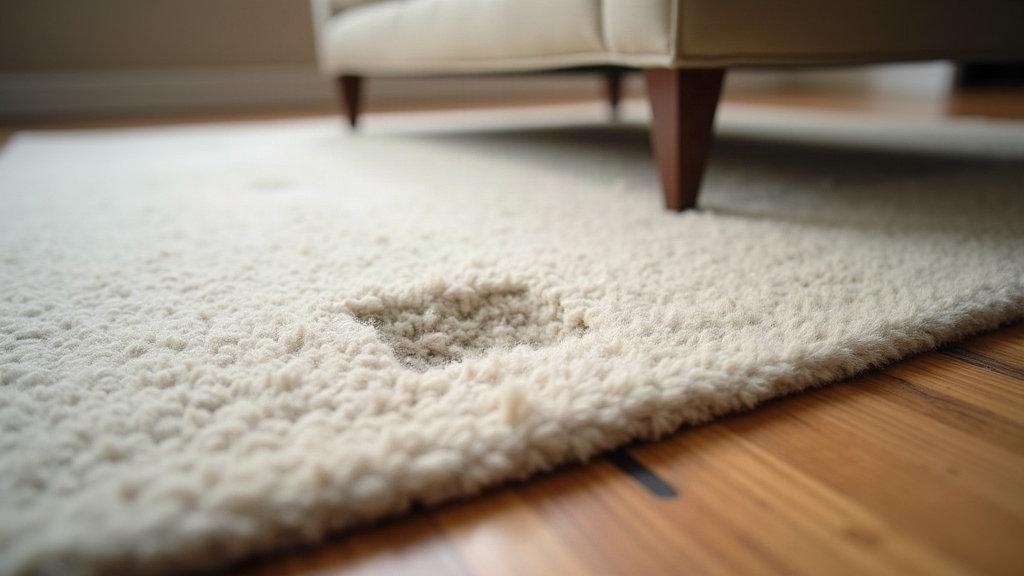
A furniture dent in rug pile is pile that has been physically compressed, and sometimes crushed, under sustained weight. Whether it recovers depends entirely on whether the individual fibers are still elastic or have been permanently broken down — and you can test that in about thirty seconds before you reach for an ice cube or a steamer. If the fibers still have spring, moisture-based methods genuinely work. If they don’t, no amount of steam will bring them back, and the honest options are trimming the pile level or repositioning furniture to cover the spot.
Why Furniture Leaves a Dent in the First Place
Pile yarn, whether hand-knotted wool, a tufted wool-blend, or a synthetic loop, is made of fibers with a natural crimp or twist that holds them upright against the foundation. A chair leg, sofa foot, or bed frame applies concentrated, continuous downward pressure to a tiny area of that pile for months or years. Over time the fiber’s internal structure — the microscopic crimp in a wool fiber, the memory in a nylon filament — gets pressed flat. In the early stages, this is purely mechanical: the fibers are bent, not damaged, and they still have the elasticity to stand back up once the pressure and a little moisture give them a reason to. Left long enough, though, repeated compression combined with the sheer weight of furniture can break down the fiber’s internal structure or snap individual filaments near the base, and at that point there is no “springing back” to be had — the damage isn’t surface-deep anymore, it’s structural.
This is the detail that most advice skips over. The common instructions — melt an ice cube on the spot, or steam it with a damp cloth and fluff with a spoon — are not wrong, but they are incomplete, because they assume every dent is recoverable. Plenty aren’t. Before you spend twenty minutes steaming a dent that’s been there for three years under a bed frame, it’s worth finding out which category you’re actually dealing with.

The Test: Is the Pile Still Resilient, or Is It Gone?
Move the furniture off the dent and look closely at the flattened patch. Take a few individual pile tufts right at the edge of the dent — not in the deepest, most compressed center, but at the boundary where the flattening tapers off — and do two things:
- Bend test: Gently fold a tuft over with a fingertip and release it. Does it spring back upright within a few seconds, or does it stay folded over?
- Tug test: Very lightly tug a tuft between thumb and finger (no yanking). Does it feel springy and resist, or does it feel brittle, thin, or does it snap or pull loose with minimal effort?
Those two responses tell you almost everything you need to know before you start any recovery attempt. Here’s how to read the result:
| What you observe at the dent’s edge | What it means | What actually works |
|---|---|---|
| Tuft springs back upright within a few seconds; feels resilient and slightly elastic when tugged | Fibers are compressed but structurally intact — this is mechanical flattening, not fiber damage | Steam or ice-melt recovery methods (below) will genuinely restore the pile |
| Tuft stays folded over, lies flat, feels limp or “dead” but doesn’t break | Fibers have lost most of their elastic memory from prolonged compression; partial recovery is possible but pile may never fully match surrounding areas | Try steam recovery but set realistic expectations; a faint shadow of the dent may remain permanently |
| Tuft feels brittle, snaps, thins out, or pulls free of the foundation with light tugging | Fibers are structurally broken or have separated from the base — this is permanent fiber damage, not reversible flattening | No moisture or steam method will fix this; the only real options are trimming the pile level with surrounding fiber, or repositioning furniture to hide the spot |
A rough rule of thumb worth keeping in mind: the longer furniture has sat in one spot, and the heavier that furniture is, the more likely you are to land in the bottom row of that table. A dent from a dining chair that gets shifted every few weeks is a different animal from one left under a stationary bed frame for several years — but the only way to know for sure is the test, not the calendar. Fiber type matters too, which is covered further down.
Recovering Pile That Still Has Spring
If your tufts passed the bend-and-tug test, the ice cube and steam methods that show up everywhere online are reasonable, and here is why they actually work on resilient fibers: both methods introduce a small, controlled amount of moisture and heat to the compressed fiber, which relaxes the crimp enough for the fiber’s own elasticity to push it back upright as it dries. You’re not adding anything to the fiber — you’re just giving its existing structure room to recover.
The ice cube method works well on wool and most synthetic pile: place a standard ice cube directly on the dent and let it melt slowly, which can take an hour or more depending on pile depth and room temperature. As it melts, the water is drawn into the compressed fibers gradually rather than all at once, which avoids oversaturating the backing. Once melted, blot any excess moisture with a dry white towel and use your fingers or a dull spoon edge to gently lift and separate the tufts, working from the outside of the dent inward. Let the area air-dry fully before putting anything back on it.
The steam method is faster: hold a clothes steamer or a steam iron set to a low setting an inch or two above the pile — never touching the iron directly to the fiber — and pass steam over the dent for ten to fifteen seconds, then immediately fluff the tufts upright with your fingers or a wide-tooth comb while the fiber is still warm and pliable. Repeat once or twice if needed, but let the area dry between passes rather than saturating it continuously.
Both methods are reasonably safe for sturdy wool pile and most synthetic (nylon, polypropylene) construction, which is why they’re the standard advice. But “reasonably safe for wool and synthetics” is not the same as “safe for every rug,” and this is where fiber safety has to come first:
- Silk pile or silk highlights should not be steamed or wetted with these home methods at all. Silk loses strength and luster when wet and can water-spot permanently; a rug with silk content, or one you suspect might have silk, belongs with a professional rug conservator rather than under a home iron.
- Wool tolerates light steam well, but avoid hot water and never use an iron set to a high or “cotton” heat setting directly against the pile — excess heat combined with moisture can felt and mat wool fiber, which is a different and much harder problem to undo than a simple dent.
- Jute, sisal, and other plant-fiber flatweaves should generally be kept dry altogether; these fibers absorb water readily, can stain or yellow, and lose strength when repeatedly wetted. If you’re dealing with a jute or sisal piece, see our guide on cleaning a jute or sisal rug safely before trying any moisture-based recovery.
- Viscose (often sold as “art silk”) is particularly vulnerable to water — it can crush, mat, and discolor permanently from even modest moisture, and dents in viscose pile are frequently in the “no fix” category regardless of the bend test, simply because the fiber itself has so little resilience to begin with.
- Natural or early synthetic dyes can bleed when wet, so always test any steam or ice-melt method on a hidden corner or the back edge of the rug first, and watch for any color transfer onto your blotting cloth before treating a visible area.
If you’re at all uncertain what your rug is made of, or it’s hand-knotted, antique, or otherwise valuable, that uncertainty is itself the signal to stop and consult a professional rather than experiment. A conservator can identify fiber content under magnification and knows which recovery methods are appropriate for which construction — something worth understanding in more detail in our piece on what a rug conservator does that a cleaner doesn’t.
When the Fibers Are Crushed or Broken: What Actually Works
If the bend-and-tug test told you the fibers are dead or snapping, steam and ice are a waste of time — you’re not reversing damage that’s already happened, you’re just adding moisture to fiber that has nothing left to spring back with. At that point there are really only two honest paths.
Trimming the pile level. A professional rug cleaner or a skilled hand can carefully trim the broken, uneven tufts at the dent down to match the surrounding pile height, using sharp shears and working in small passes. This doesn’t restore the original pile depth — it creates a shorter but even patch — and it’s a one-way decision, since trimmed pile can’t be un-trimmed. It tends to be far more successful on cut pile (where an even, slightly shorter patch blends reasonably well) than on patterned or high-low pile where uneven trimming would be visible from across the room. This is not a job for scissors and guesswork on a valuable or hand-knotted rug; a professional familiar with pile restoration is the safer route, and it’s worth reading about how pile height itself affects the way a rug wears and looks in our guide to pile height and daily use before deciding whether trimming is worth attempting at all.
Repositioning furniture to hide the spot. This is less glamorous but often the more sensible choice, especially on rugs where the dent sits in a visually busy part of the pattern or where trimming risks drawing more attention to the flaw than the original dent did. Shifting a sofa a few inches, swapping which end of a bed frame sits where, or simply accepting that a permanent dent under a regularly repositioned chair is a normal mark of a lived-in rug are all reasonable outcomes. A rug that has been in active use for years is not expected to look new, and a single flattened patch under furniture rarely affects a rug’s practical value the way, say, moth damage or dry rot does — it’s a cosmetic condition issue, not a structural one.
It’s also worth being honest that a crushed-pile patch is not something that affects a rug’s authenticity or origin in any way — it’s purely wear, and distinguishing ordinary wear from structural damage is exactly the kind of judgment an appraiser makes when assessing a rug’s overall condition, alongside knot density, foundation material, and dye characteristics. If you’re weighing whether an older or inherited rug is worth professional conservation at all, that’s a separate and larger question than a single dent, and one where an in-person evaluation is the only reliable answer.
Fiber Matters: Why Some Pile Bounces Back and Some Doesn’t
The difference between a recoverable dent and a permanent one often comes down to the fiber itself before it ever gets to the question of how long furniture sat on it. Wool fiber has a natural three-dimensional crimp — a coiled, spring-like structure at the microscopic level — that gives it genuine elastic memory; research on wool’s fiber architecture, including work from wool science bodies like CSIRO’s wool research program, documents how this crimp is what gives wool textiles their resilience and recovery under compression, which is exactly why wool rugs are generally the most forgiving when it comes to furniture dents. This is one of several reasons wool remains the default choice for rugs expected to hold up under daily furniture and foot traffic, a trade-off covered in more depth in our guide to why wool rugs cost more — and when it’s worth it.
Nylon synthetic pile also recovers reasonably well, since manufactured nylon fiber is engineered with its own elastic recovery properties. Polypropylene (often branded as “olefin”) recovers less reliably and can mat or crush more permanently, since it lacks the coiled structure of wool and has lower overall resilience. Viscose, as mentioned above, is the fiber most prone to permanent crushing — it’s prized for its silk-like sheen but has very little structural memory, which is part of why viscose rugs are often described as beautiful but fragile underfoot.
If you don’t know what your rug’s pile is made of, a simple visual and touch comparison against known samples can narrow it down, but definitively identifying fiber content — particularly distinguishing wool from a wool-synthetic blend, or spotting viscose dressed up to look like silk — is something a professional can confirm more reliably than a guess at home, and our broader comparison of wool, silk, cotton, jute, and synthetic rug fibers is a useful starting point for understanding what you’re working with.
Preventing Dents Before They Start
Recovery is always a bit of a gamble; prevention isn’t. A few practical habits go a long way:
- Furniture cups or coasters under heavy legs spread the weight over a wider surface area, reducing the pressure concentrated on any single cluster of pile tufts. These are inexpensive and work on both hard floors and rugs.
- Rotate furniture periodically if your layout allows it — even shifting a sofa two or three inches every six months prevents any one patch of pile from bearing weight indefinitely. The same logic applies to rotating the rug itself to even out wear patterns and sun exposure, which is covered in our guide on keeping a rug in place and in good condition on hardwood floors.
- Use a quality rug pad under the rug itself. A good pad cushions the foundation and pile from the full impact of furniture weight and foot traffic, and reduces the friction that compounds compression over time. Pad choice depends on your floor type and rug construction, which is why it deserves its own consideration.
- Vacuum carefully around dented or heavily compressed areas. A beater-bar vacuum can snag and pull at pile that’s already weakened from compression, worsening breakage in fibers that might otherwise have recovered — a rolling or suction-only attachment is the gentler choice on these spots, and on any hand-knotted or fringed rug generally.
- Think about traffic and weight at the placement stage rather than after the fact — heavy furniture in a fixed spot for years is simply going to leave a more stubborn mark than furniture that gets moved regularly, and that’s worth factoring in when you’re first deciding where a good rug goes in a room.
Preventive habits like these sit within the broader practice of protecting a rug’s condition over its working life, which our rug care hub covers alongside cleaning, repair, and storage topics in more depth — and for anyone dealing with a rug that sees constant furniture movement and foot traffic, the general principles in our collection on protection and storage are worth a browse.
When to Bring in a Professional
A simple, recoverable dent on a sturdy synthetic or wool rug is a reasonable DIY project. But there are a few situations where professional help is the right call rather than an overcautious one: when the rug is hand-knotted, ant
Rug Academy publishes general information about rugs and is not a dealer, appraiser, or cleaning service. Cleaning and repair methods depend entirely on fibre, dye and construction — test any treatment on a hidden corner first, and consult a professional rug cleaner or conservator before treating a hand-knotted, antique, silk, or valuable rug, as damage from cleaning is usually permanent. Any prices mentioned are illustrative examples only, and nothing here is an appraisal, an authentication, or a guarantee of a rug’s origin or value.