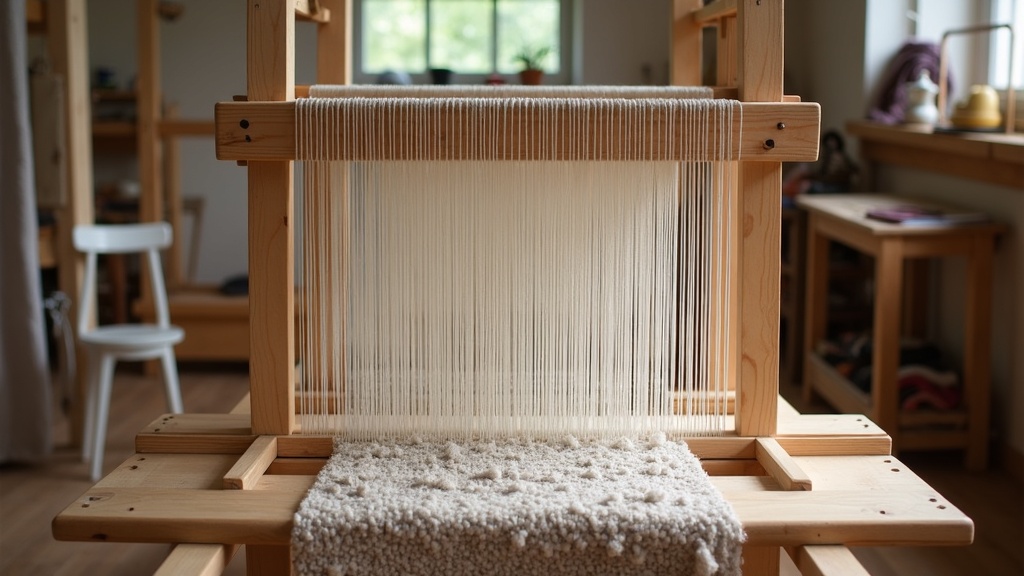
A rug loom is a frame that holds a set of parallel threads, called the warp, stretched tight from top to bottom or end to end. The weaver builds the rug by passing weft threads across the warp and, on pile rugs, tying rows of knots around warp pairs, then packing each row down with a comb-like beater. Everything about a rug’s structure — its stiffness, its selvedges, whether it lies flat or curls — comes from how that tensioned warp is held and worked.
Understanding the loom is really the fastest way to understand the rug itself. Once you can picture the warp under tension and the weft moving through it, terms like foundation, selvedge, and knot density stop being abstract and start describing something you can trace with your eye across the back of a rug.
The basic anatomy of a loom
Every rug loom, however simple or elaborate, does the same job: it keeps the warp threads under even tension so the weaver can work across them consistently. The main components are:
- Warp beam and cloth beam — rollers at the top and bottom (or two ends) that the warp is wound around, allowing tension to be set and, on some looms, released as the rug grows.
- Warp threads — the vertical (or lengthwise) threads that run the full length of the rug and form its structural skeleton. These are usually cotton, wool, or occasionally silk.
- Heddles and shed rods — devices that lift alternating warp threads to create a gap, or “shed,” so weft can pass through quickly rather than being threaded over-and-under by hand every time.
- Beater or comb — a heavy tool used to pack each newly added row of weft or knots down firmly against the row below, which determines how dense and durable the finished cloth is.
For a fuller breakdown of how these parts translate into the finished object, the site’s guide to warp, weft and pile walks through the anatomy in more depth.
Vertical looms versus horizontal looms
Rugs are woven on two broad categories of loom, and the difference matters more for craft history than for buying decisions, though it does show up in construction details.
Vertical looms
Vertical looms stand upright and are common in workshop and urban weaving traditions where a fixed structure and higher output are practical. The warp runs from a beam at the top to one at the bottom, and the weaver sits or stands in front, working across the width. Some vertical looms let the finished rug roll onto the bottom beam as it’s completed, which allows a single loom to produce a rug longer than the room it stands in.
Horizontal ground looms
Horizontal looms are staked to the ground, historically favoured by nomadic and village weavers because they can be dismantled, moved, and re-set relatively easily. The warp lies parallel to the ground, tensioned between two beams pegged into the earth. This portability is part of why many tribal and village rugs — including flatweaves — carry slight, human-scale irregularities in width and shape that a fixed workshop loom is less likely to produce.
Neither loom type is inherently “better”; they reflect different weaving lifestyles and traditions, which the rug craft hub covers in more detail alongside regional weaving practices.
How a row is actually built
Whether the rug will be flatwoven or piled, the sequence on the loom follows a similar rhythm:
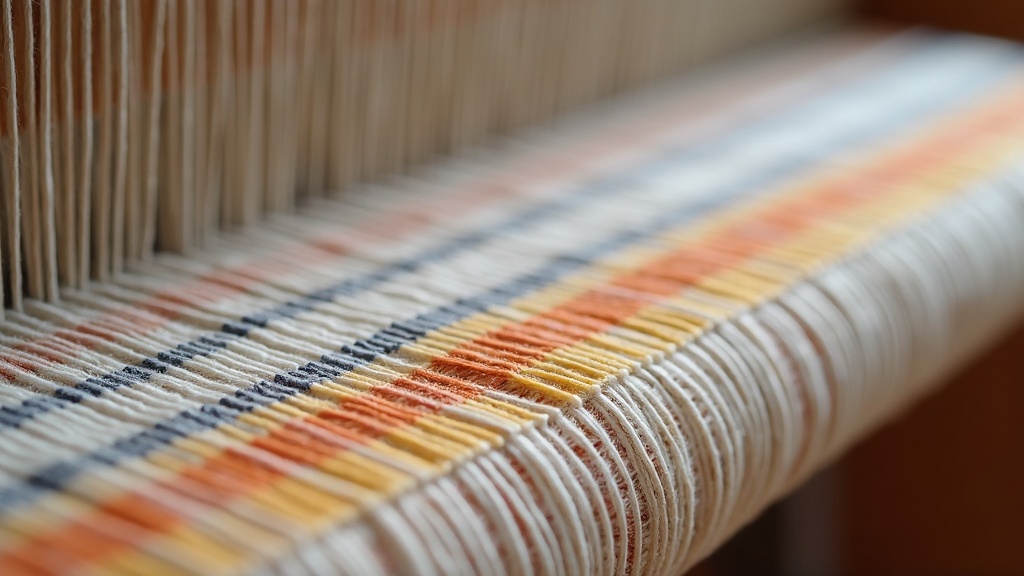
- The weaver opens a shed by raising alternating warp threads, then passes a weft thread through, or for pile rugs, ties a knot around a pair of warps and cuts the yarn to length.
- The row is beaten down firmly with the comb, compacting it against the previous row.
- One or more plain weft threads are usually thrown across between knot rows to lock the structure before the next row of knots begins.
- The process repeats, row by row, until the rug reaches its planned length.
Pile rugs differ from flatweaves mainly in this knotting step. A kilim is built entirely from interlocked or slit-tapestry weft, with no pile at all, while a knotted rug adds that extra step of tying and cutting yarn around the warp thousands of times per square metre. That repetition, multiplied across a whole rug, is what knot density actually measures, and it’s discussed further in the weaving techniques archive.
What the loom determines in the finished rug
A surprising amount of what buyers evaluate later — flatness, edge integrity, how a rug ages — traces back to tension and technique at the loom.
| Loom characteristic | Effect on finished rug |
|---|---|
| Even, consistent warp tension | A rug that lies flat and holds its shape; uneven tension is a common cause of long-term rippling |
| Warp material (cotton vs wool vs silk) | Affects foundation flexibility, weight, and how the rug responds to moisture and humidity |
| Selvedge finishing at the loom’s edges | How cleanly the sides are wrapped or overcast, and how well they resist fraying over decades |
| Beating force and consistency | Knot density and pile firmness, which influence durability underfoot |
Loom tension and weaver skill are exactly the kind of variables an appraiser looks at when examining a rug’s foundation and construction, alongside dye characteristics, wear patterns, and how the fringe and selvedge were finished. None of these individually confirm origin or age, but together they describe a coherent picture that a qualified in-person appraisal can properly assess.
Hand-loomed versus mechanised production
Not everything called “loomed” involves a person tying individual knots. Power looms, drawlooms, and Jacquard-style mechanised looms can produce patterned rugs at far higher speed by automating the shed-and-weft cycle, typically using a machine-consistent foundation and repeating pattern with none of the small irregularities a hand-worked piece naturally develops. Understanding this distinction matters for buyers because it affects both durability expectations and price: a machine-made wool-blend rug in a common area size might sit somewhere in the low hundreds, while a comparable hand-knotted rug of similar size can run into the thousands, though construction, materials, and knot density all drive that gap enormously and no number here should be read as a current market rate. If you’re trying to work out which category a specific rug falls into, the article on what “hand-loomed” actually means unpacks the labelling more precisely, and the buying guides hub covers materials and construction terminology more broadly.
Why this matters for care, not just for buying
Loom construction has direct consequences for how a rug should be cleaned and maintained. A hand-knotted rug’s foundation can shrink or distort if it’s saturated with water or exposed to hot, high-pH cleaning solutions, because the warp and weft threads — often cotton or wool — react to moisture very differently than the surface pile does, and that reaction can permanently buckle a rug that took a loom weeks or months to produce. Chlorine bleach and ammonia should never be reached for on wool or silk rugs, and never combined with other cleaning products, since bleach breaks down protein fibres and mixing chemicals can create harmful fumes for no cleaning benefit. Always test any treatment on a hidden corner first, and for anything hand-knotted, antique, silk, or of uncertain construction, a professional rug cleaner or conservator is the safer route than home treatment, since damage from cleaning is almost always permanent rather than something that can be corrected later.
Frequently asked questions about how a rug loom works
What is the difference between a warp and a weft on a rug loom?
The warp is the set of threads stretched vertically (or lengthwise) under tension on the loom before weaving starts; the weft is the thread the weaver passes across it row by row. The warp forms the rug’s structural skeleton, while the weft and knots build the visible surface.
Do all handmade rugs use the same type of loom?
No. Weaving traditions use different loom types — fixed vertical workshop looms, portable horizontal ground looms, and various regional variations — depending on lifestyle, available space, and local craft history, which is one reason similar-looking rugs can have quite different foundations.
Can you tell if a rug was made on a loom by hand or by machine?
Often yes, by examining the back and edges: hand-knotted rugs usually show slight irregularities, individually finished fringe that’s an extension of the warp, and visible knot structure, while machine-made rugs typically have a uniform, glued or serged backing and perfectly repeating patterns.
Why does loom tension affect whether a rug lies flat?
Uneven tension across the warp during weaving can cause some rows to be packed tighter than others, which shows up later as rippling, waviness, or a rug that won’t lie flat regardless of how it’s placed, sometimes requiring professional stretching or reweaving to correct.
Is a hand-loomed rug the same as a hand-knotted rug?
Not necessarily — “hand-loomed” can describe rugs woven by hand on a loom without individually tied pile knots, such as flatweaves, so the term alone doesn’t confirm knot construction and is worth checking against the rug’s actual back and structure.
Rug Academy publishes general information about rugs and is not a dealer, appraiser, or cleaning service. Cleaning and repair methods depend entirely on fibre, dye and construction — test any treatment on a hidden corner first, and consult a professional rug cleaner or conservator before treating a hand-knotted, antique, silk, or valuable rug, as damage from cleaning is usually permanent. Any prices mentioned are illustrative examples only, and nothing here is an appraisal, an authentication, or a guarantee of a rug’s origin or value.