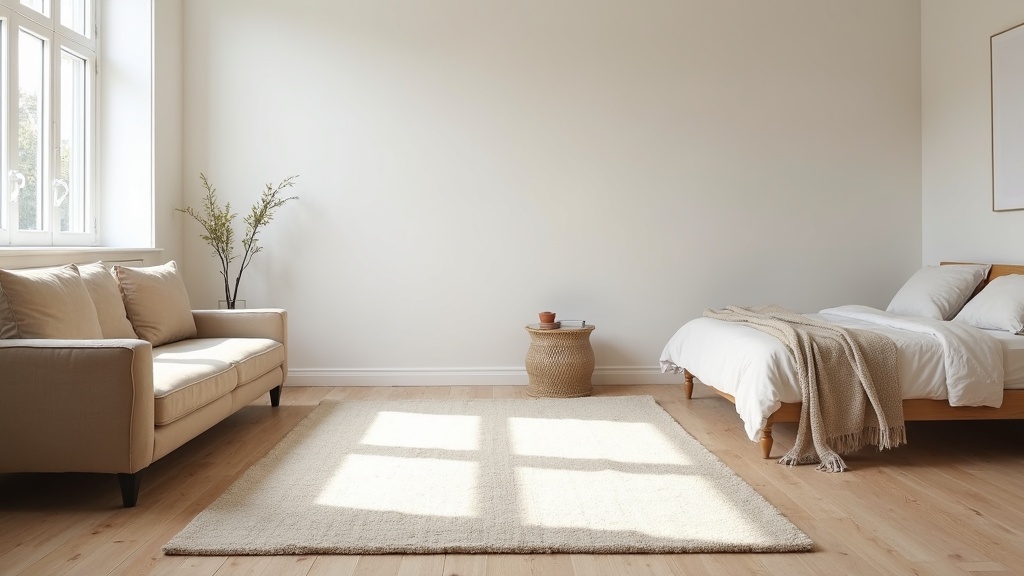
In a studio apartment, rug size is less about the room’s total square footage and more about the furniture groupings inside it. The general rule: a living zone rug should sit under the front legs of your seating (or all of it), a sleeping zone rug should extend at least 18-24 inches beyond the sides of the bed, and a dining nook rug needs enough overhang for chairs to stay on it when pulled out. Most studios do best with two or three modestly sized rugs used to define zones, rather than one enormous rug trying to cover everything.
Why studio apartments need different sizing logic
A conventional living room rug guide assumes a room with walls dividing “living” from “sleeping” from “eating.” A studio has none of that. The rug’s job shifts from decorating a defined space to actually creating the boundaries a wall would otherwise provide. Get the sizing wrong and the apartment reads as one undifferentiated box; get it right and a single 400-square-foot space can feel like three distinct rooms. This is really a variation on the challenge covered in our guide to choosing a rug size for an open-plan space — a studio is simply the most compressed version of that problem, where every inch of floor is doing double or triple duty.
The other studio-specific factor is traffic. In a one-room apartment, the same 10-by-12-foot patch of floor might be walked across to reach the kitchen, sat on for TV nights, and used as a landing spot for laundry baskets, all in a single evening. That argues for choosing durable, easy-care materials for high-use zones and reserving anything delicate — a fine wool piece with intricate detail, for instance — for a spot with lighter footfall, such as beside the bed rather than in the main walkway.
Sizing rug to zone, not to room
Think of the studio as three overlapping mini-rooms and size each rug to the furniture it serves, not to the apartment as a whole.
| Zone | Typical furniture | Suggested rug size |
|---|---|---|
| Living/seating area | Loveseat or small sofa + one or two chairs | 5×7 or 6×9 ft, front legs of all seating on the rug |
| Sleeping area (queen or full bed) | Bed with or without nightstands | 8×10 or 6×9 ft, rug extending 18-24 in past the sides and foot of the bed |
| Sleeping area (twin or daybed) | Single bed against a wall | 4×6 or 5×8 ft, or a runner-style piece along the exposed side |
| Dining/desk nook | Small table with 2-4 chairs | Table footprint plus 24 in on all sides so chairs stay on the rug when pulled out |
| Entry strip | Narrow hallway or landing | 2×3 or 2×4 ft, or a short runner |
For the bed specifically, the choice between a rug that goes fully under the frame versus one placed just at the foot or sides depends on the mattress size and how much floor you have to spare — our piece on whether a rug goes under the bed or beside it walks through both approaches in more depth, and it applies directly to studio bed nooks where every square foot is contested.
Defining zones without walls
The most common studio mistake is buying one very large rug and expecting it to unify the space. In practice, a single rug under both the sofa and the bed tends to blur the two areas together rather than distinguish them — the opposite of what most studio dwellers actually want. Two or three separate rugs, ideally in slightly different but complementary tones or textures, do a better job of signaling “this is the living area, that is the sleeping area” the way a doorway would in a larger apartment.
If you do want the cohesion of related materials without merging the zones into visual mush, layering smaller accent pieces at different scales over a shared neutral base can work — the sizing and proportion rules for that technique are covered in our guide to layering rugs, and they translate well to a studio where you’re essentially layering zones rather than just rugs. A restrained approach also suits small footprints generally; if the studio already feels visually busy, the advice in our piece on choosing a rug with restraint in minimalist rooms is worth reading before you commit to a bold pattern that a 300-square-foot room can’t easily absorb.
Material and construction for multi-use floors
Because a studio rug often has to survive cooking splashes, foot traffic, and being sat on directly (in lieu of a separate living room floor), construction matters as much as size. A tightly woven wool or wool-blend piece generally resists crushing and soiling better than a loose shag in these conditions, though it will cost more; a machine-made synthetic or wool-blend rug in a 5×7 size might sit somewhere in the low hundreds of dollars, while a hand-knotted wool rug of the same footprint can run considerably higher — construction and origin drive the price far more than size alone does, and that gap is explained in detail in our guide to why wool rugs cost more and when it’s worth it. Whatever you choose, the full comparison of fibre options and their real-world trade-offs is laid out in our rug buying guides hub, and the sizes-and-placement archive under Sizes & Placement has further examples for specific room shapes.
A studio’s hard flooring — often the same material throughout the whole space — also means a rug pad isn’t optional. On hardwood or laminate especially, an unanchored rug will creep every time it’s walked across, and that’s more disruptive in a studio where the rug is doing zone-defining work rather than sitting decoratively under a coffee table. Our guide to keeping a rug in place on a hardwood floor and the breakdown of rug pads by floor type both cover the right pad thickness and grip for this situation.
What to measure before you buy
- Measure each furniture grouping separately (sofa footprint, bed footprint, table footprint) rather than the room as a whole.
- Leave at least 18 inches of bare floor as a visual “gap” between two adjacent zone rugs so they read as distinct rather than one continuous surface.
- Check door swings and closet doors — a rug edge that catches a swinging door will curl and wear prematurely.
- If the studio has a kitchenette with no separating wall, keep a washable, low-pile piece there rather than the same material used in the sleeping zone.
Frequently asked questions about rug sizes for a studio apartment
What size rug should I get for a studio apartment living area?
Size it to the seating, not the room: a 5×7 or 6×9 ft rug is typical for a loveseat and one or two chairs, with at least the front legs of every piece resting on the rug so the grouping looks anchored rather than floating.
Can I use one big rug for a whole studio apartment?
You can, but it often blurs the living and sleeping areas together instead of separating them. Most studios read better with two or three smaller zone-specific rugs than one large rug spanning the entire floor.
What size rug goes under a queen bed in a small studio?
An 8×10 ft rug lets you tuck the whole bed on top with 18-24 inches showing on the sides and foot; if space is tighter, a 6×9 ft rug placed at the foot of the bed with the sides exposed still works well.
Should I put a runner between the kitchen and living area in a studio?
A short runner or a 2×4 ft mat can mark the transition without committing a full rug to a high-splash zone, and it’s easier to keep clean since it covers less surface area than a full living room rug.
How much space should I leave between two rugs in an open studio?
Roughly 18 inches of visible bare floor between adjacent rugs is usually enough to read as an intentional gap rather than a mismatch, and it lets each zone keep its own visual identity.
Rug Academy publishes general information about rugs and is not a dealer, appraiser, or cleaning service. Cleaning and repair methods depend entirely on fibre, dye and construction — test any treatment on a hidden corner first, and consult a professional rug cleaner or conservator before treating a hand-knotted, antique, silk, or valuable rug, as damage from cleaning is usually permanent. Any prices mentioned are illustrative examples only, and nothing here is an appraisal, an authentication, or a guarantee of a rug’s origin or value.