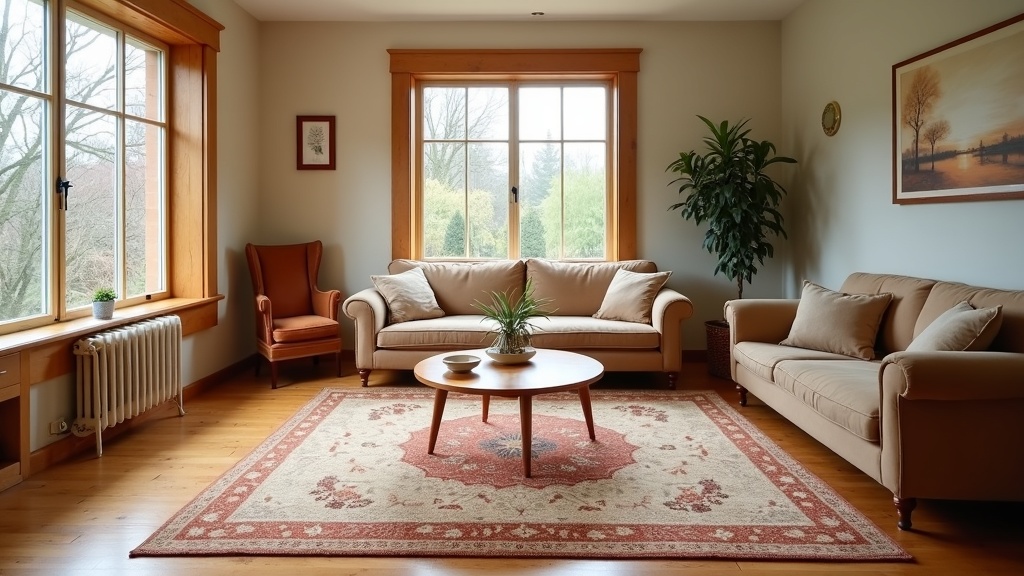
When a room already has a lot of wood — flooring, trim, exposed beams, furniture — the rug’s job is to either harmonize with those warm or cool wood tones through a similar undertone, or to deliberately break from them with a contrasting colour and enough pattern to read as its own layer. There is no single correct answer, but the mistake to avoid is picking a rug that has an undertone close enough to the wood to look accidental rather than intentional.
Why wood-heavy rooms need extra thought
Wood is not neutral the way grey paint is neutral. It carries a colour temperature — the orange-red of cherry and mahogany, the yellow-honey of oak and pine, the cool grey-brown of ash or weathered oak, the near-black of ebonized or stained walnut floors. When a room has wood flooring, wood furniture, and wood trim all at once, you effectively have three large surfaces pulling in the same colour direction. A rug that ignores this and lands in a similar mid-brown often disappears into the floor or, worse, clashes at the edges where two slightly different browns meet and visibly compete rather than blend.
The fix isn’t to avoid brown rugs altogether — it’s to be deliberate about whether you want the rug to blend with the wood’s undertone or contrast against it, and to pick colour, pattern and pile height with that decision in mind.
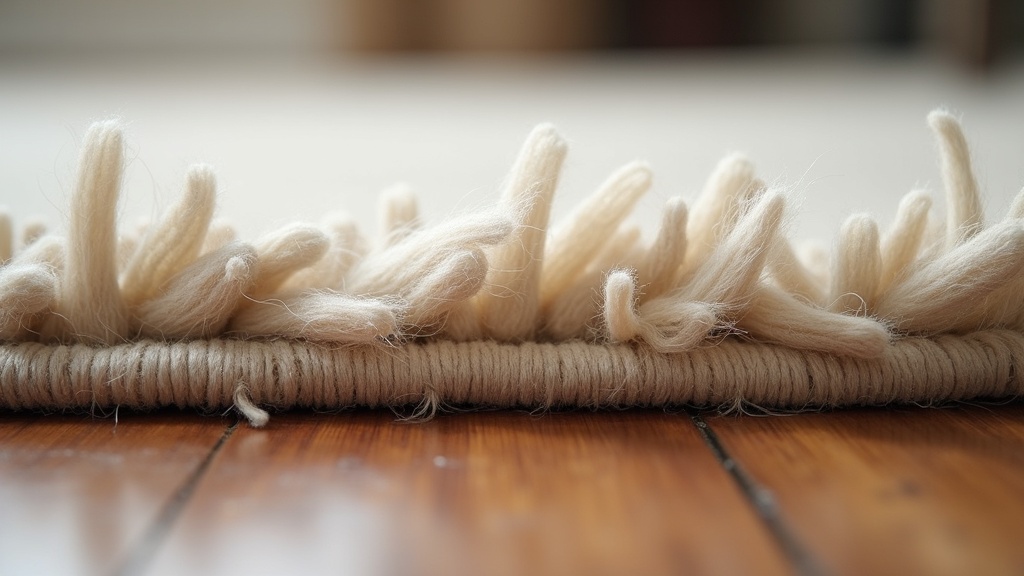
Matching or contrasting: two workable strategies
Blending with the wood’s undertone
If you want a calm, cohesive room, choose a rug whose dominant undertone echoes the wood — warm reds and rusts with warm honey oak, cooler taupes and greys with ash or whitewashed floors. This works well in rooms that already have a lot of visual activity from furniture, art or a view, where you don’t want the floor competing for attention. The risk is flatness: a rug and floor in the same tonal family can read as one indistinct beige mass unless the rug brings enough pattern or texture to separate itself. Antique and semi-antique pieces such as those grouped under names like Serapi, Heriz and Bakhtiari often carry the kind of soft, aged reds and rusts that sit comfortably with warm wood without matching it exactly.
Contrasting with the wood’s undertone
The opposite approach is to let the rug sit in a different colour family altogether — a cool blue-and-ivory rug against warm cherry floors, or a charcoal geometric pattern against honey pine. Contrast makes the rug read as a deliberate design layer rather than an afterthought, and it tends to photograph and age better because it doesn’t rely on a precise tonal match that can shift as wood ages and darkens with UV exposure. Bold geometric weaves, including many pieces described as Caucasian in style, tend to hold up well in this role because their contrast is baked into the design rather than dependent on subtle shading.
Pattern, density and how “busy” a room can take
Wood grain, panelling, and exposed beams already introduce visual texture and directional lines into a room. A densely patterned rug on top of heavy grain and busy furniture can tip a room into visual clutter, especially if the furniture itself is patterned — a scenario covered in more depth in our guide on pairing a rug with patterned furniture. In rooms with a lot of wood grain already doing visual work, a rug with a simpler, more restrained motif — a plain border, a single central medallion, an all-over but low-contrast pattern — usually reads as more considered than an equally busy rug fighting for the same attention. The general principles in our piece on choosing a rug with restraint apply just as well to wood-heavy traditional rooms as to minimalist ones.
Fibre and construction: what actually holds up on wood floors
Wood floors are usually harder underfoot than carpet, which changes how a rug feels and wears. Wool remains the standard choice for durability and resilience — it resists crushing and springs back after furniture is moved, which matters on a hard surface where the rug takes more direct pressure. Natural fibres like jute or sisal look handsome against wood but are considerably less forgiving of spills and can feel rough underfoot in a room meant for bare feet; the trade-offs are laid out in our comparison of wool, silk, cotton, jute and synthetic fibres. If budget is a driver, a wool-blend or synthetic rug can be a reasonable compromise, though it’s worth understanding what “blend” actually means for durability and hand-feel before buying, which is the subject of our separate guide on wool-blend construction.
Protecting the wood floor itself
A rug on a wood floor is not just about appearance — it’s also protecting a finish that scratches and dents more easily than a hard tile or stone surface. A quality rug pad does two jobs here: it stops the rug from sliding on a smooth wood floor, and it prevents the rug’s backing (particularly on tufted or flatweave rugs) from trapping moisture or grit against the finish. Because pad material needs to match the floor type — some pads that work fine on carpet can discolour or haze a wood finish over time — it’s worth checking our guide on rug pads by floor type before buying one. Keeping a rug from creeping or curling at the corners on a hardwood floor is also its own small science, covered separately in our piece on keeping a rug in place on a hardwood floor.
Sunlight is another consideration in wood-panelled rooms with large windows, since both wood and rug dyes fade under UV exposure — often unevenly, which can look worse than even fading. Rotating a rug periodically and being mindful of direct sun exposure helps both the rug and the floor age more evenly.
Sizing for a room with visible wood floor
One reason people choose a rug for a wood-floor room in the first place is to break up a large expanse of bare floor, so undersizing defeats the purpose. As a general rule, front furniture legs — or all four legs on smaller pieces — should sit on the rug so the room reads as one grouping rather than a rug floating in the middle of the floor with wood showing awkwardly around individual chair legs. Our broader guide to sizes and placement covers the standard measurements room by room, but in a wood-heavy space it’s worth erring toward the larger end of the size range you’re considering, since a generous rug does more to visually anchor the wood floor without making it feel scarce.
Caring for the rug once it’s chosen
Whatever fibre you land on, day-to-day care should match the construction. A wool pile rug can generally be blotted for fresh spills with cool water and a small amount of wool-safe detergent, working from the outside of the spill inward to avoid spreading it — never hot water or an alkaline cleaner, since heat and high pH cause wool to felt, shrink or yellow. Chlorine bleach should never be used on wool or silk under any circumstances, and household chemicals should never be combined in an attempt to boost a stain-removal effort — the risk of fumes and fibre damage outweighs any benefit. Always test any treatment on a hidden corner first. If the rug is hand-knotted, antique, silk, or you’re simply not certain of its construction, the safer route is a professional rug cleaner or conservator rather than DIY treatment, since cleaning damage on these pieces is usually permanent; our rug care hub covers cleaning, protection and storage in more detail, and what a conservator does that a cleaner doesn’t explains when that distinction matters.
If you’re considering an antique or vintage piece
Wood-panelled and traditionally furnished rooms are exactly where many buyers gravitate toward an older or hand-knotted rug, which raises a separate question from style: what the rug actually is and what it’s worth. That comes down to details an appraiser examines in person — knot type and density, the foundation material, dye characteristics, wear patterns, and how the selvedge and fringe were finished — not something that can be judged from style or colour alone. Machine-made and reproduction rugs can mimic traditional patterns convincingly, so if the answer matters financially, an in-person appraisal from a qualified appraiser is the only reliable route; our guide on getting a rug appraised explains what that process involves.
Frequently asked questions about choosing a rug for a room with lots of wood
What colour rug goes best with dark wood floors?
Lighter rugs with cream, grey or muted colour grounds tend to lift a room with dark wood flooring by adding contrast, while rugs close in tone to the floor can look flat or make the room feel smaller and heavier than it needs to.
Should a rug match the wood furniture or the wood floor?
Neither has to match exactly — most successful rooms pick one undertone (warm or cool) to loosely echo across floor, furniture and rug, then let the rug’s pattern and colour do the visual work rather than aiming for a precise tonal match.
Do I need a rug pad on a wood floor?
Yes — a rug pad suited to hard flooring prevents slipping, cushions the pile so it wears more evenly, and protects the wood finish from grit trapped under the rug’s backing; the right pad material depends on the specific floor finish.
Will a rug scratch or damage my hardwood floor?
A rug itself rarely scratches wood, but a poor-quality rubber or PVC pad can discolour some finishes over time, and grit trapped between rug and floor can grind in with foot traffic if the rug isn’t lifted and cleaned underneath periodically.
What size rug works in a room with a lot of exposed wood floor?
Sizing generously enough that at least the front legs of major furniture sit on the rug generally looks more intentional than a small rug floating in the centre of a large expanse of wood, which can make the space feel unfinished.
Rug Academy publishes general information about rugs and is not a dealer, appraiser, or cleaning service. Cleaning and repair methods depend entirely on fibre, dye and construction — test any treatment on a hidden corner first, and consult a professional rug cleaner or conservator before treating a hand-knotted, antique, silk, or valuable rug, as damage from cleaning is usually permanent. Any prices mentioned are illustrative examples only, and nothing here is an appraisal, an authentication, or a guarantee of a rug’s origin or value.