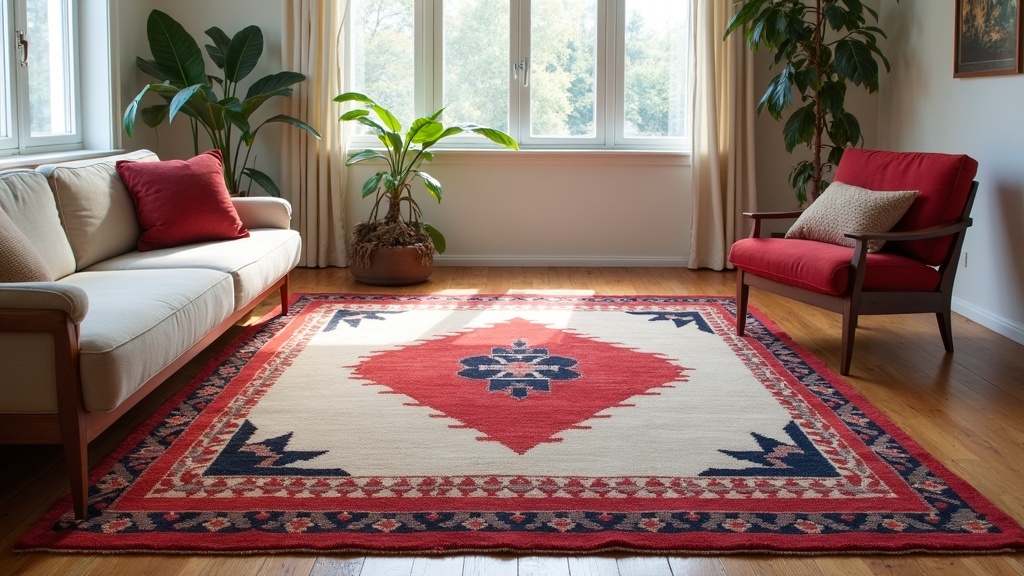
Caucasian rugs are recognised by their bold, angular geometry — stepped medallions, latch-hooks, eight-pointed stars, and stylised animal or plant forms rendered in flat, saturated colour rather than shaded curves. This comes from a coarser weave and lower knot count than many Persian city rugs, which forces motifs into blocky, pixel-like shapes instead of soft curvilinear ones. Add a wool foundation, punchy contrasting colour fields, and often an abrash (a visible colour shift across the field), and you have the core signature of the group. None of this alone confirms where a specific rug was made or how old it is — that calls for physical examination — but the pattern language is distinctive enough to learn.
What makes Caucasian geometry distinctive
The Caucasus region — the mountainous area between the Black and Caspian Seas, historically home to Armenian, Azerbaijani, Georgian, and other weaving communities — produced village and tribal rugs on relatively simple looms. Weavers weren’t working from workshop cartoons the way many Persian city rugs were; they worked from memory and convention passed down through families. That method naturally favours geometric abstraction: a bird becomes a hooked diamond, a flowering vine becomes a repeating zigzag, a garden becomes a grid of stars. The result is graphic, high-contrast design that reads as confidently from six feet away as it does up close — a big part of why these rugs remain popular in modern interiors that pair well with a patterned rather than solid rug approach.
Colour plays as large a role as line. Traditional palettes lean on saturated red and rust grounds, indigo blue, ivory, and touches of yellow-green or aubergine, often derived from natural dye sources such as madder root and indigo before synthetic dyes became widely available in the late 19th century. Because natural dye lots vary batch to batch, older pieces frequently show abrash — subtle horizontal banding in a field colour — which collectors read as a hallmark of hand-dyed, hand-spun wool rather than a flaw. Distinguishing natural from early synthetic dye behaviour is a skill in itself, and it’s covered in more depth on the site’s guide to spotting natural versus synthetic dyes.
Recognisable motif families
Several named rug groups from the region share this geometric vocabulary while differing in layout and detail. These names describe broad weaving traditions and common characteristics, not a definitive test for any individual rug — a piece described informally as “Kazak-style” today may be a genuine antique, a later reproduction, or a machine-made rug printed with the pattern.
| Common name | Typical field character | Recognisable motifs |
|---|---|---|
| Kazak | Bold, large-scale, high pile, few but dominant elements | Large stepped medallions, memling guls, strong primary colour blocks |
| Shirvan | Finer weave, denser all-over patterning | Small repeating botehs, stars, diagonal trellis fields |
| Karabagh | Often larger format, sometimes with shaded “rainbow” columns | Bold rosettes, sometimes floral hybrids showing European influence |
| Gendje | Diagonal or striped compositions | Latch-hook diamonds arranged on the bias |
| Talish | Narrow, elongated formats | Simple repeating medallions on plain grounds |
These regional labels overlap with the broader question of how Caucasian weaving relates to Persian and Turkish traditions, which is worth reading alongside the site’s comparisons of Turkish and Persian rugs and the beginner’s guide to Persian rug regions, since trade routes and shifting borders mean motifs travelled and were adapted well beyond any single valley.
How to examine a rug for these characteristics
Recognising the style is one thing; determining what a specific rug actually is requires physical examination, ideally in person. An appraiser or experienced dealer works through several layers rather than judging by pattern alone:
- Knot type and density. Older Caucasian village rugs are typically hand-knotted with a symmetrical (Turkish) knot on a wool foundation, at a relatively coarse density compared to fine Persian city production. Density alone doesn’t indicate quality or age — see the broader discussion of whether knot density actually matters — but it does help place a rug within a weaving tradition.
- Foundation material. Wool warps and wefts feel different from cotton underfoot and photograph differently under raking light; cotton foundations became more common later and in different regions, so foundation material is one data point among several, not a standalone dating tool.
- Back-of-rug pattern clarity. On a hand-knotted rug, the geometric motif should be legible, if slightly blurred, on the reverse. A rug where the back shows a uniform grid with a printed-looking front pattern, or a fuzzy backing with no knot structure at all, is a signal of tufted or machine construction rather than a hand-knotted piece — a distinction explored fully in how to tell if a rug is handmade or machine-made.
- Selvedge and fringe finishing. Hand-finished selvedges and fringes that are a continuation of the foundation warps (rather than sewn-on trim) generally point toward traditional construction, though selvedges are also commonly re-overcast during restoration, which changes what you’re actually looking at.
- Wear and colour pattern. Even, gradual pile wear and consistent colour aging across the rug read differently from a rug that has been chemically “antiqued” or spot-bleached to fake age.
None of these signs, alone or combined, tells you a rug’s exact origin, age, or worth — that’s the job of a qualified appraiser working from the object itself, and it’s the honest answer whenever real money is involved. The general criteria used in that process are laid out further in what determines the value of an antique rug, part of the site’s broader rug craft hub covering weaving technique, regional traditions, and authentication.
Reproductions and machine-made lookalikes
Because the bold-geometry look is popular, it’s widely reproduced by machine on power looms, often at a fraction of the price of a hand-knotted equivalent. A machine-made wool-blend rug in a Caucasian-inspired pattern, in a common living-room size, might sit somewhere in the low hundreds as an illustrative example — construction, materials, and size drive the real number enormously, and this isn’t a quote for any specific product. There’s nothing wrong with choosing a machine-made version for a busy household; it’s simply a different object with a different lifespan, and the trade-offs between the two are covered in the comparison of wool and synthetic rug lifespan. Confusion usually arises when a reproduction is marketed or resold as an antique hand-knotted piece — the construction checks above are exactly how that gets sorted out. The full range of styles, patterns, and regional traditions is browsable in the site’s styles and patterns archive and regional and antique rugs archive.
Caring for a bold-colour wool rug
Caucasian and Caucasian-style rugs are almost always wool pile on a wool or cotton foundation, and older pieces are frequently dyed with natural or early synthetic colourants that can bleed when wet. For light surface dust and everyday debris, vacuum without a beater bar, or with the brush roll disengaged, since beater bars catch and fray fringe and loose pile. For a fresh spill on a wool pile rug, blot immediately with a clean white cloth — never rub — and, if needed, use only a small amount of cool water with a pH-neutral, wool-safe detergent, testing on a hidden corner of the pile first to check the dye doesn’t shift. Hot water and alkaline or high-pH cleaners can cause wool to felt, shrink, or yellow, so they should be avoided entirely, and chlorine bleach or ammonia should never be used or mixed with anything else, as both damage wool fibre and can set or spread dye bleed rather than removing it. Full wetting, steam cleaning, or machine washing a hand-knotted rug risks shrinking or buckling the foundation permanently, which is why that route is covered in detail in when steam cleaning helps or ruins a rug. If the rug is hand-knotted, antique, or of uncertain construction, or if the stain is stubborn, the safer and genuinely recommended path is a professional rug cleaner or conservator rather than a home remedy — see the site’s guide to cleaning a wool rug safely and the broader rug care hub for cleaning, repair, and storage guidance, plus the cleaning and stains archive for specific stain scenarios.
Frequently asked questions about Caucasian rugs
How do I know if my rug is Caucasian or Persian?
Look at the geometry: Caucasian rugs favour blocky, angular motifs and bold colour blocking, while many Persian city rugs use curvilinear floral patterns and finer knotting. But regional overlap is common, so a confident answer needs in-person examination by someone experienced in regional attribution.
Are Caucasian rugs valuable?
Value depends on age, condition, dye type, knotting, and rarity, not just pattern style. Some are modest village pieces, others are sought-after collector rugs. There’s no reliable way to estimate worth from a description alone — a qualified in-person appraisal is the only dependable route.
What is a Kazak rug exactly?
Kazak is a traditional name for bold, high-pile geometric rugs historically woven in the Caucasus region, typically with large-scale medallions on wool foundations. Today the term is also used loosely for reproductions made anywhere, so the name alone doesn’t guarantee origin or age.
Can I clean a Caucasian rug at home?
Light vacuuming without a beater bar and gentle blotting of fresh spills with cool water and wool-safe detergent are generally fine for wool pile rugs. Avoid hot water, bleach, or soaking, and always test on a hidden area first; hand-knotted or antique pieces are best left to a professional cleaner.
Why do these rugs have such bold, blocky patterns?
The angular look comes from village-loom weaving worked from memory rather than a fine cartoon, combined with a coarser knot count than many city workshop rugs. That construction naturally turns curved motifs into stepped, geometric shapes.
Rug Academy publishes general information about rugs and is not a dealer, appraiser, or cleaning service. Cleaning and repair methods depend entirely on fibre, dye and construction — test any treatment on a hidden corner first, and consult a professional rug cleaner or conservator before treating a hand-knotted, antique, silk, or valuable rug, as damage from cleaning is usually permanent. Any prices mentioned are illustrative examples only, and nothing here is an appraisal, an authentication, or a guarantee of a rug’s origin or value.