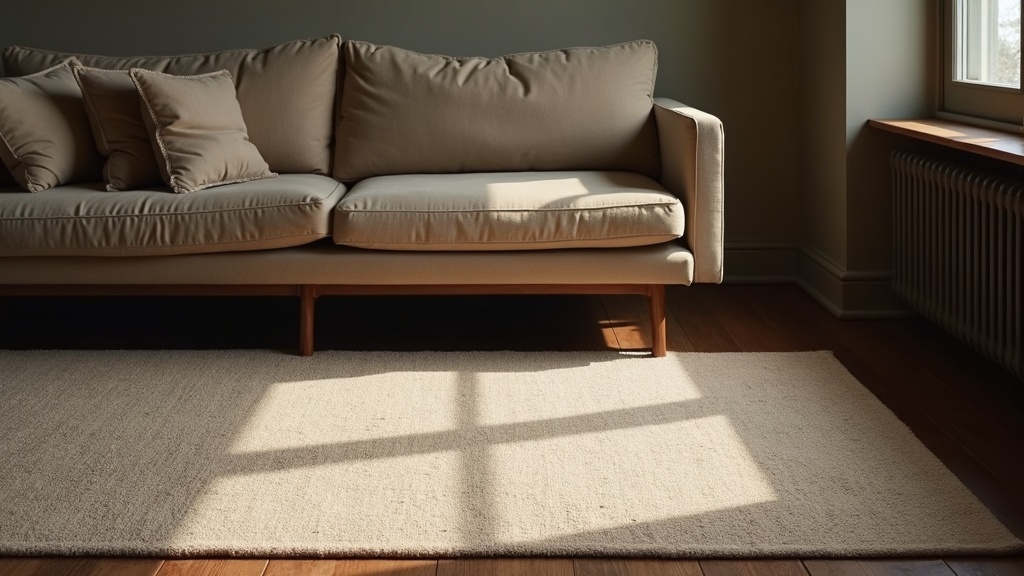
The fastest way to choose a rug for a dark room is to work with light rather than fight the darkness: pick a rug in a lighter, warmer tone than the floor around it, favor some texture or subtle pattern over a flat solid color, and test a real sample in the room under both daylight and lamps before committing. Dark rooms punish low-contrast, light-absorbing choices — a deep charcoal rug on a dark floor can visually disappear into a shapeless void. The goal is a rug that adds definition and bounces available light back into the space, not one that swallows it.
Why dark rooms change the rules
Most rug advice assumes a room with decent natural light, where a moody, saturated rug reads as intentional and rich. In a genuinely dark room — north-facing, small-windowed, or heavily shaded by trees or neighboring buildings — that same rug can just look murky. Rugs work partly by reflecting ambient light back up into a room, and dark fibers, dark dyes and dense flatweaves reflect far less than pale, textured wool or a looped construction. When there isn’t much light to begin with, every surface that absorbs rather than bounces it makes the room feel smaller and heavier.
This is separate from the question of matching a rug to the room’s shape or furniture layout, which is covered in our general guide to rug buying; here the driving constraint is photons, not floor plan.

Colour and tone: lighter, and usually warmer
As a starting principle, a rug that is noticeably lighter than the surrounding floor will do more to open up a dark room than one that matches or goes darker. Ivory, oatmeal, soft camel, pale grey-beige and dusty rose all reflect more light than charcoal, navy or forest green, simply because they contain more white pigment or undyed natural fiber in the mix. That doesn’t mean the rug has to be stark white — a warm off-white or a soft caramel tends to feel more inviting under artificial light than a cool, bright white, which can look clinical or slightly blue once the sun goes down.
Undertone matters as much as lightness. Many “neutral” rugs actually lean warm (yellow, gold, pink undertones) or cool (blue, grey undertones), and a cool-toned pale rug in a room lit mostly by warm incandescent or soft LED bulbs can look muddy or greenish rather than crisp. If you want ideas for neutrals that still have personality rather than reading as flat or forgettable, our piece on neutral rugs that don’t look boring is a useful companion to this one, and the broader styles and patterns archive covers how tone interacts with a room’s existing palette.
Texture, sheen and pile height
Flat, matte surfaces absorb light evenly and can look dull in low illumination. A rug with some pile height, a subtle sheen, or variation in yarn twist catches light unevenly across its surface, which reads as texture and depth rather than a flat block of color — genuinely useful in a room that doesn’t get much light to begin with. Hand-knotted wool rugs often have a natural sheen from the lanolin in the wool and the way pile is clipped, which is one reason they can look more luminous in person than in a flat product photo; you can read more about why that construction costs more in our guide to why wool rugs cost more. Wool-blend and synthetic rugs vary enormously in sheen depending on the fiber and finishing, which is discussed in more general terms in our comparison of rug fibres.
Very high pile can work against you in a dark room, because deep pile casts its own small shadows across the surface, especially in raking light from a single lamp or window. A moderate pile height with some texture — a hand-loomed weave, a subtly patterned wool, or a looped construction — tends to look more alive under low light than either a very flat weave or a shaggy one.
Pattern versus solid
Solid rugs show every shadow, every bit of pet hair, and every uneven patch of light in a way patterned rugs simply don’t. In a dark room, where you’re relying on artificial light at odd angles for much of the day, a low-contrast pattern — tone-on-tone medallions, a soft trellis, a muted geometric — can do more visual work than a solid color while still keeping the overall palette light. This is one of the few situations where pattern is a practical choice rather than a purely aesthetic one: it disguises the unevenness that dim, directional lighting tends to expose on a flat surface.
If your room leans more restrained and you’d rather not introduce obvious pattern, our article on choosing a rug with restraint covers how to get texture and interest without visual noise, which is exactly the balance a dark room usually needs.
A quick reference
| Choice | Works better in a dark room | Tends to disappear or feel heavy |
|---|---|---|
| Tone | Ivory, oatmeal, camel, soft warm grey | Charcoal, navy, black, deep forest |
| Surface | Some sheen or texture, moderate pile | Very flat matte, or very high shag |
| Pattern | Subtle tone-on-tone pattern | Bold solid colour with no texture |
| Undertone | Matched to your bulbs (warm vs cool light) | Mismatched, reading muddy or grey |
Testing before you buy
Rug colour photographs and swatches lie more than almost any other home purchase, because the same fiber can look completely different under a north-facing window at 2pm, under a warm table lamp at 8pm, and under an overhead LED. If you’re allowed to bring home a sample or a small rug on approval, do it, and look at it at the darkest point of your day — usually early morning or dusk — as well as with your normal evening lighting on. A colour that looks perfectly pale and warm in a shop under bright fluorescent light can read cool and grey once it’s sitting under your own 2700K bulbs.
This is also where wood tone matters. If your dark room has dark floorboards, the contrast between rug and floor is doing a lot of the visual lifting; our guide to choosing a rug for a room with lots of wood goes into how floor tone and rug tone interact in more detail, and is directly relevant if your darkness comes from the floor as much as the light levels.
Fibre and practical considerations
Lighter rugs show dirt, spills and pet hair more readily than dark ones, which is a genuine trade-off worth planning for before you buy rather than after. Wool has natural soil resistance and tends to hide ground-in dust reasonably well even in pale colours, while some synthetics and natural fibers like jute show staining more visibly. Whatever fiber you choose, keep a plan for maintenance in mind from the start — our rug care hub covers cleaning, protection and storage in general terms, and it’s worth reading before you commit to a pale rug in a household with pets or young children, since a lighter rug in a dim room will need a bit more upkeep to keep looking bright rather than dingy.
Any cleaning method has to match the specific fiber and construction of the rug you actually own — wool, silk, cotton, synthetic and natural-fiber flatweaves all respond differently to water, heat and detergents, and using the wrong method on the wrong fiber is one of the few rug mistakes that can’t be undone. If you’re ever unsure what your rug is made of or how it’s constructed, that’s a question for a professional rug cleaner rather than a guess.
Frequently asked questions about choosing a rug for a dark room
What colour rug is best for a dark room?
Lighter, warmer neutrals such as ivory, oatmeal or soft camel generally work best because they reflect more available light than deep charcoal, navy or black, which can make an already dim room feel smaller and heavier.
Should I avoid patterned rugs in a low-light room?
No — a subtle, low-contrast pattern can actually help by disguising shadows and uneven light that a flat solid colour would expose, so tone-on-tone pattern is often more forgiving than a plain rug in dim lighting.
Does a shaggy rug make a dark room brighter?
Not necessarily; very high pile casts small shadows across its own surface under directional light, which can look duller than a moderate-pile, textured rug with some natural sheen.
Why does my rug look a different colour at home than in the shop?
Store lighting is usually bright and even, while home lighting is dimmer, warmer or cooler depending on your bulbs and window exposure, so undertones that were invisible in the shop can suddenly read as muddy, grey or yellow at home.
Will a light rug show dirt too easily in a dark room?
Pale rugs do show soil and pet hair more visibly than dark ones, so it’s worth choosing a fiber with reasonable soil resistance and planning routine care in advance rather than after stains appear.
Rug Academy publishes general information about rugs and is not a dealer, appraiser, or cleaning service. Cleaning and repair methods depend entirely on fibre, dye and construction — test any treatment on a hidden corner first, and consult a professional rug cleaner or conservator before treating a hand-knotted, antique, silk, or valuable rug, as damage from cleaning is usually permanent. Any prices mentioned are illustrative examples only, and nothing here is an appraisal, an authentication, or a guarantee of a rug’s origin or value.